
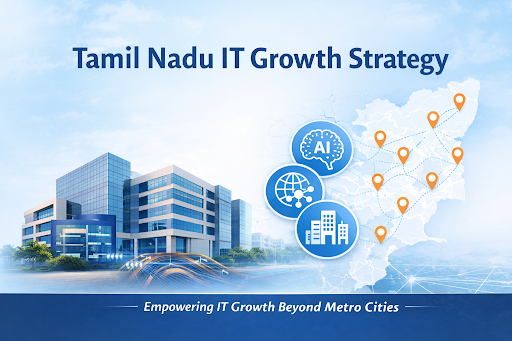
The Tamil Nadu government is promoting Information Technology (IT) through a multi-pronged strategy focused on decentralization, infrastructure expansion in Tier-2 and Tier-3 cities, and sector-specific policies for emerging technologies.
What differentiates the Tamil Nadu IT Growth Strategy from other states is its balanced growth model. Instead of concentrating development only in metro cities, the government is actively distributing IT infrastructure, investments, and job opportunities across districts. This approach not only reduces urban pressure on cities like Chennai but also unlocks the economic potential of smaller regions.
From building mini IT parks to enabling high-speed connectivity and launching future-ready policies, Tamil Nadu is creating a sustainable, scalable, and inclusive IT ecosystem.
1. Regional Decentralization (TIDEL Neo Network)
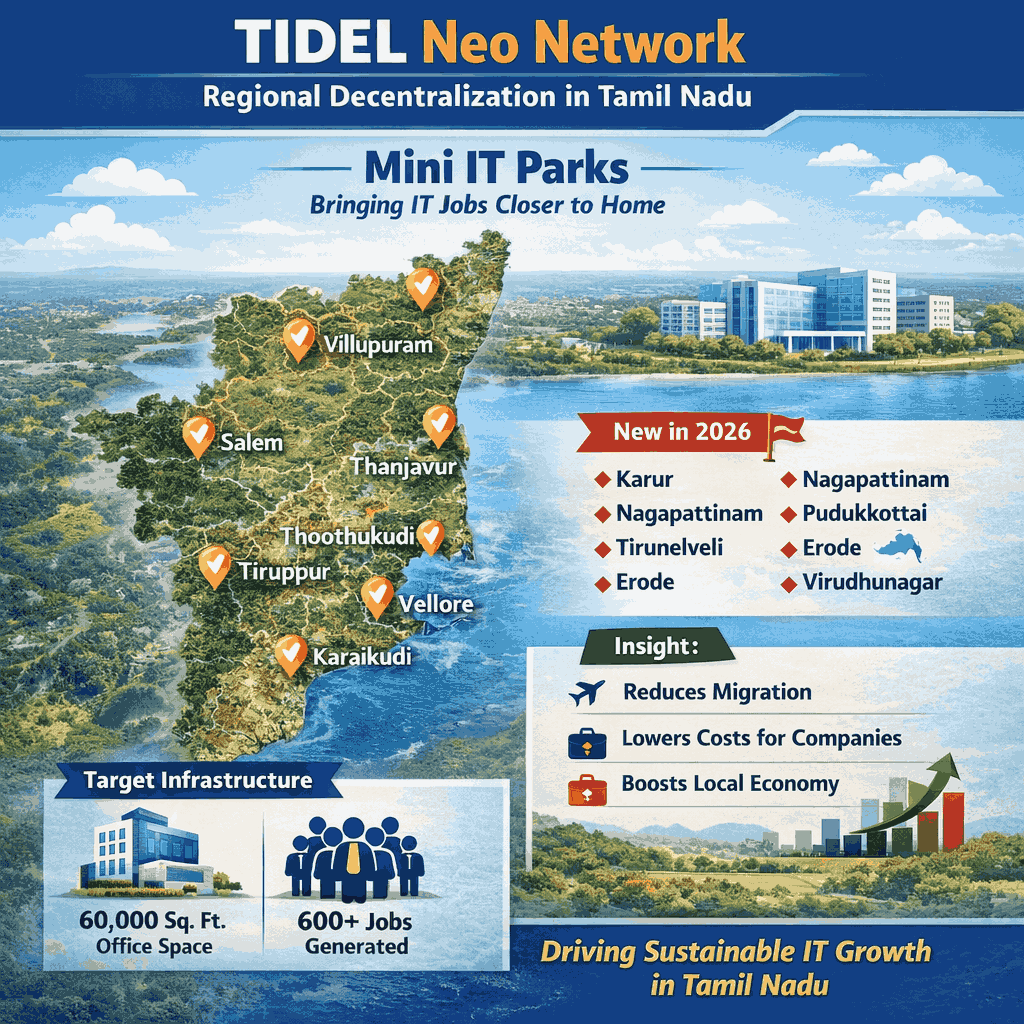
The government is moving beyond Chennai and Coimbatore to establish “Mini IT Parks” or TIDEL Neo facilities in smaller towns to provide local employment and reduce migration.
This initiative addresses one of the biggest challenges in India’s IT sector — urban concentration. By creating IT infrastructure closer to talent pools, the state is ensuring that skilled professionals can find opportunities within their own districts.
Operational Hubs:
Mini parks are currently active in:
- Villupuram
- Salem
- Thanjavur
- Thoothukudi
- Tiruppur
- Vellore
- Karaikudi
Recent Expansions:
New parks in 2026 include:
- Karur
- Nagapattinam
- Pudukkottai
- Tirunelveli
- Erode
- Virudhunagar
Target Infrastructure:
Each TIDEL Neo park is designed with:
- ~60,000 sq. ft. office space
- Capacity to generate ~600 jobs
👉 Insight: This model reduces migration, lowers operational costs for companies, and creates localized economic clusters, making the Tamil Nadu IT Growth Strategy highly sustainable.
2. Strategic Policies & Missions
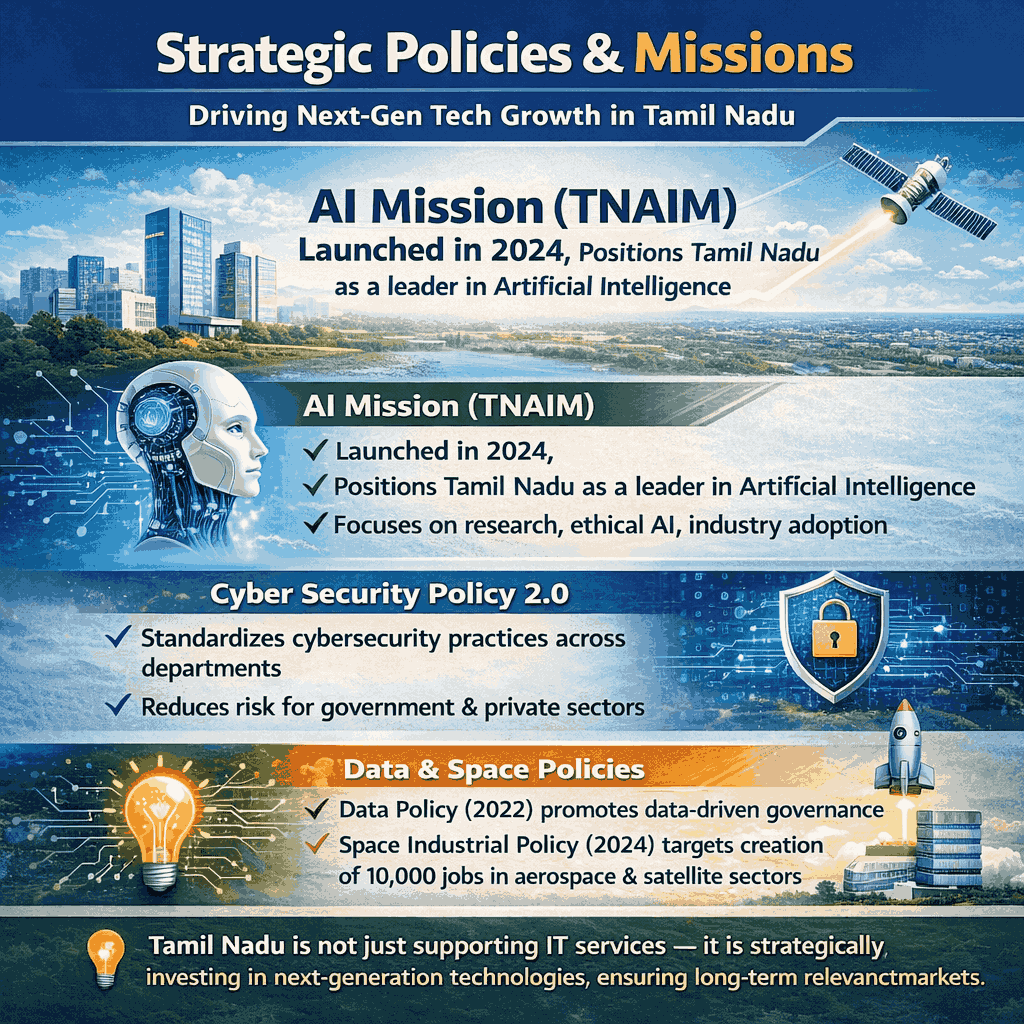
The state has introduced several policies to attract investment in high-growth tech sectors, ensuring long-term competitiveness.
AI Mission (TNAIM):
Launched in 2024, this initiative positions Tamil Nadu as a leader in Artificial Intelligence by focusing on research, ethical AI, and industry adoption.
Cyber Security Policy 2.0:
Strengthens digital infrastructure by standardizing cybersecurity practices across departments, reducing risk for both government and private sectors.
Data & Space Policies:
The Data Policy (2022) promotes data-driven governance and digital transformation.
The Space Industrial Policy (2024) targets the creation of 10,000 jobs in emerging aerospace and satellite sectors.
👉 Insight:
Tamil Nadu is not just supporting IT services — it is strategically investing in next-generation technologies, ensuring long-term relevance in global markets.
3. Digital Infrastructure & Connectivity
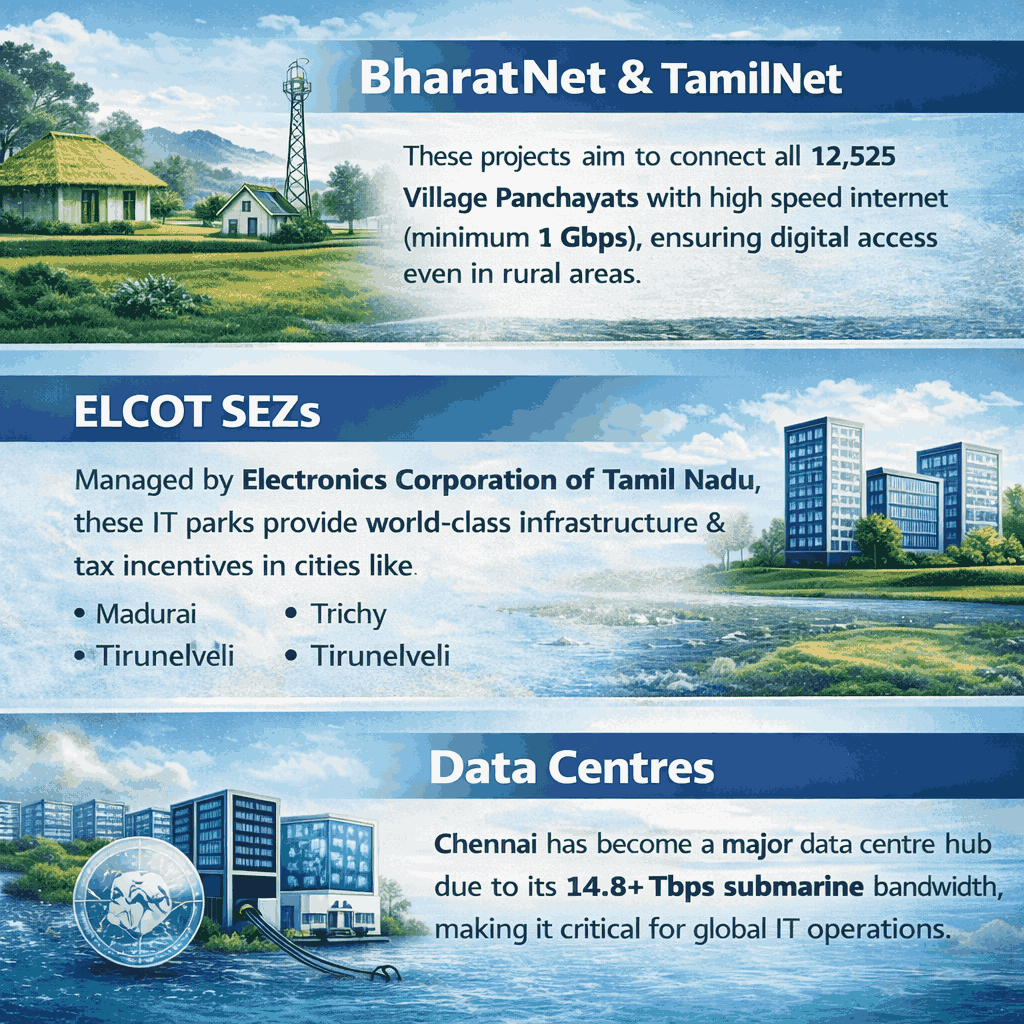
Digital infrastructure is the backbone of the Tamil Nadu IT ecosystem.
- BharatNet & TamilNet:
These projects aim to connect all 12,525 Village Panchayats with high-speed internet (minimum 1 Gbps), ensuring digital access even in rural areas. - ELCOT SEZs:
Managed by Electronics Corporation of Tamil Nadu, these IT parks provide world-class infrastructure and tax incentives in cities like:- Madurai
- Trichy
- Tirunelveli
- Hosur
- Data Centres:
Chennai has become a major data center hub due to its 14.8+ Tbps submarine bandwidth, making it critical for global IT operations.
👉 Insight:
Strong connectivity + SEZ infrastructure + data hubs = a globally competitive IT ecosystem.
4. Skilling and Talent Development
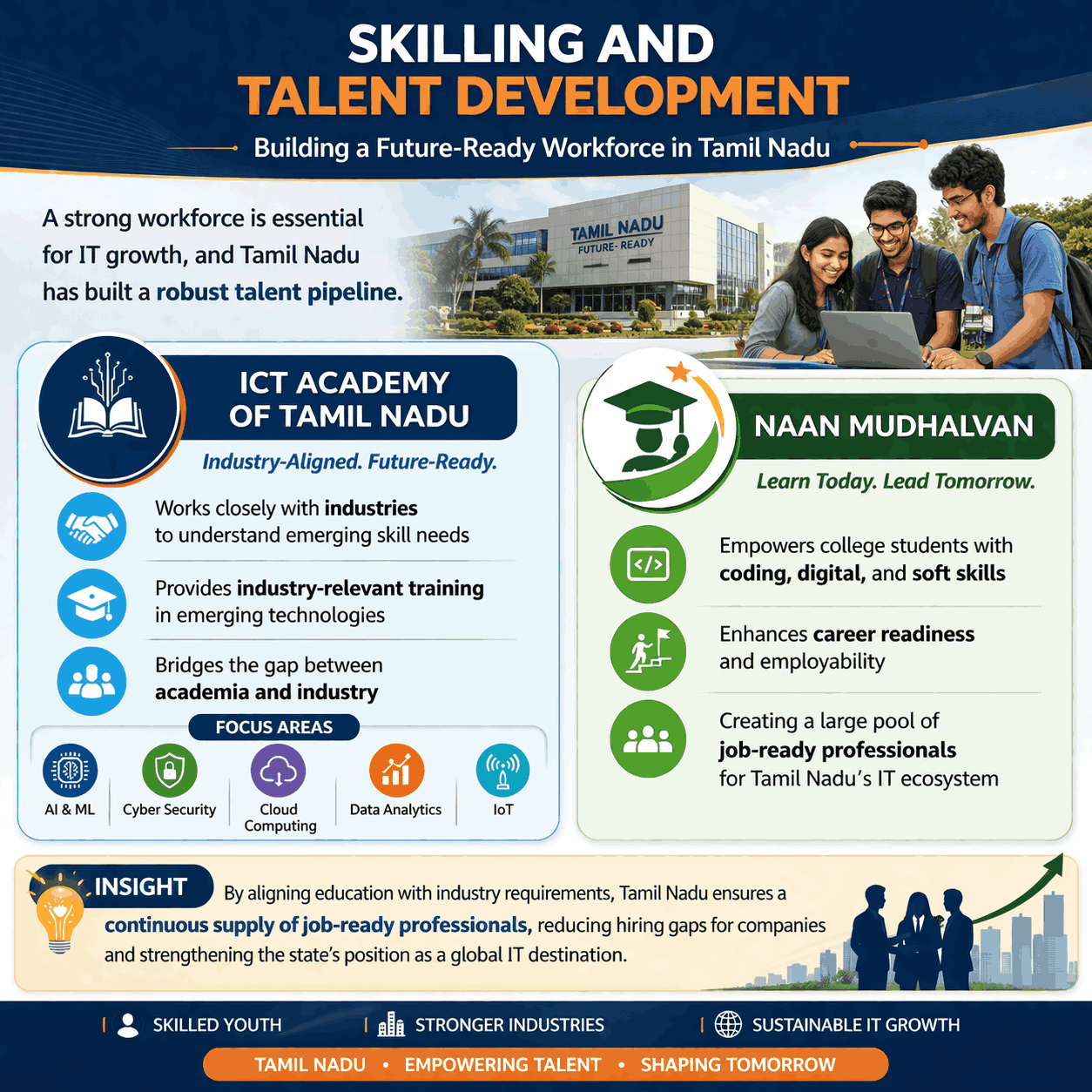
A strong workforce is essential for IT growth, and Tamil Nadu has built a robust talent pipeline.
- ICT Academy of Tamil Nadu:
Works closely with industries to ensure students are trained in emerging technologies and industry-relevant skills. - Naan Mudhalvan:
A large-scale initiative focusing on coding, digital skills, and career readiness among college students.
👉 Insight:
By aligning education with industry requirements, Tamil Nadu ensures a continuous supply of job-ready professionals, reducing hiring gaps for companies.
INFRASTRUCTURE
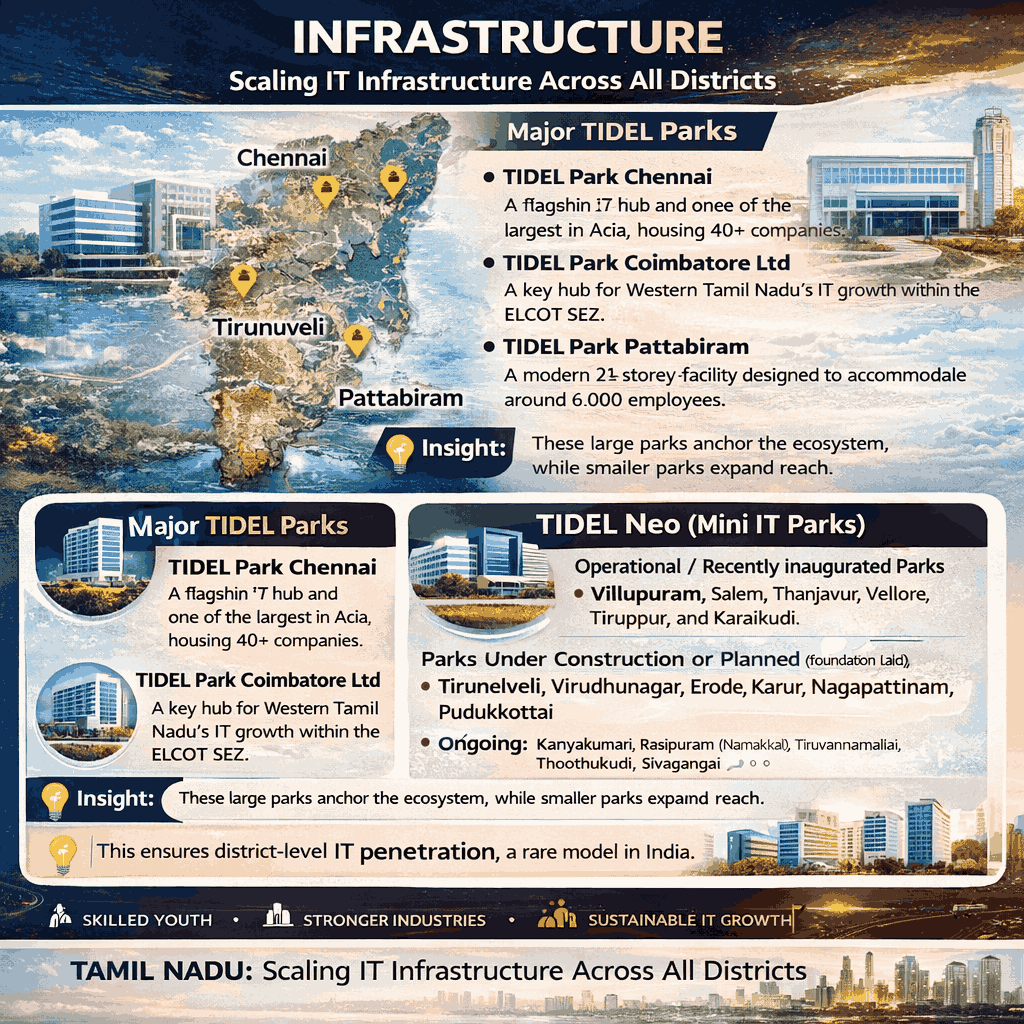
Tamil Nadu’s IT infrastructure is built around its premier TIDEL Parks in major cities and the rapidly expanding TIDEL Neo network in Tier-2 and Tier-3 towns. This dual approach ensures both scale and accessibility.
Major TIDEL Parks
- TIDEL Park Chennai
A flagship IT hub and one of the largest in Asia, housing 40+ companies. - TIDEL Park Coimbatore Ltd
A key hub for Western Tamil Nadu’s IT growth within the ELCOT SEZ. - TIDEL Park Pattabiram
A modern 21-storey facility designed to accommodate around 6,000 employees.
👉 Insight:
These large parks anchor the ecosystem, while smaller parks expand reach.
TIDEL Neo (Mini IT Parks)
TIDEL Neo parks are compact, scalable IT hubs designed to support startups and IT/ITeS companies.
Operational / Recently Inaugurated Parks
Villupuram, Salem, Thanjavur, Vellore, Tiruppur, and Karaikudi are already operational with modern facilities.
Parks Under Construction or Planned (Foundation Laid)
The government aims to establish at least one IT park in every district by 2030.
- Foundation Laid: Tirunelveli, Virudhunagar, Erode, Karur, Nagapattinam, Pudukkottai
- Ongoing: Kanyakumari, Rasipuram (Namakkal), Tiruvannamalai, Thoothukudi, Sivagangai
👉 Insight:
This ensures district-level IT penetration, a rare model in India.
Fiscal Incentives and Subsides
Tamil Nadu provides a structured package of incentives to attract IT/ITeS investments, especially in Tier-2 and Tier-3 regions.
Core Fiscal Incentives
- Enhanced Capital Subsidy:
+10% for Tier-2 and +25% for Tier-3 regions, with total subsidies ranging from ₹30 lakhs to ₹1.5 crores. - Electricity Tax Exemption:
100% exemption for up to 5 years. - Stamp Duty Concessions:
50% reimbursement, with up to 100% in certain government parks.
👉 Insight:
These incentives significantly reduce operational costs, making smaller cities highly attractive for IT companies.
Special Support for MSMEs & Startups
- Training support through TNSDC
- Lease rental subsidy (10%)
- Patent and certification reimbursement (50%)
👉 Insight:
Encourages startups and MSMEs to scale without heavy financial burden.
District Classifications (Examples)
Category B (Tier-2):
Coimbatore, Madurai, Trichy, Salem, Tirunelveli, Hosur
Category C (Tier-3):
Thanjavur, Villupuram, Dharmapuri, Ramanathapuram
👉 Insight:
Clear classification ensures targeted policy benefits and balanced regional growth.