Blog

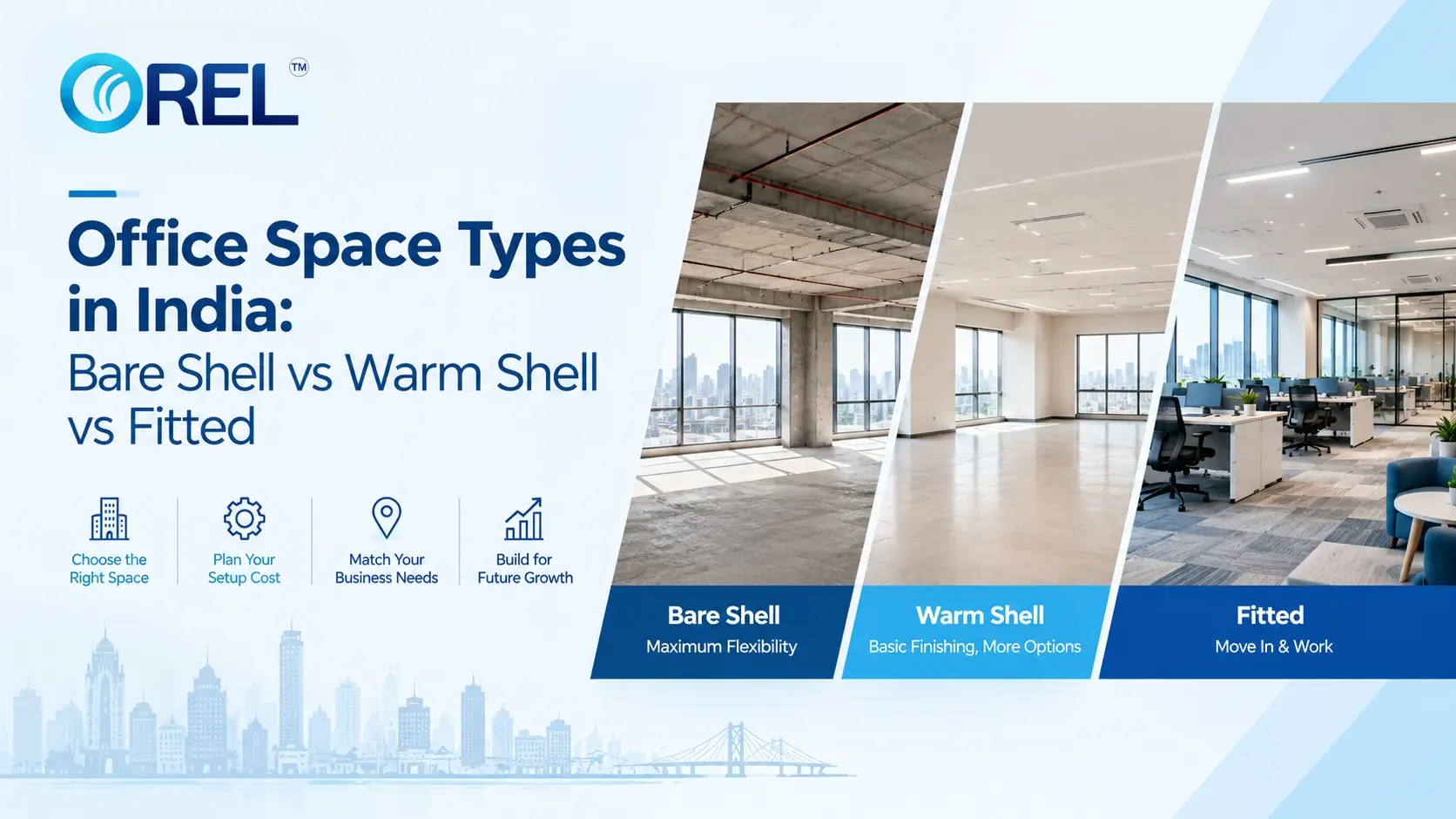
Office Space Types in India: Bare Shell vs Warm Shell vs Fitted


Choosing the right office space is an important decision for any business planning to lease a commercial property in India. Beyond location, rental cost and office size, businesses must understand the condition in which the property is handed over. The three common options are bare shell, warm shell and fitted office spaces, each offering different levels of readiness, customization and initial investment.

Understanding Bare Shell vs Warm Shell vs Fitted office spaces helps businesses estimate setup costs, plan their move-in timeline and choose a workspace that suits their operational requirements.

What Is the Difference Between Bare Shell, Warm Shell and Fitted Office Space?

A bare shell office is generally an unfinished commercial space, a warm shell office usually includes basic building infrastructure, and a fitted office has interior fit-outs such as workstations, cabins or meeting rooms. The exact specifications vary by property and landlord.
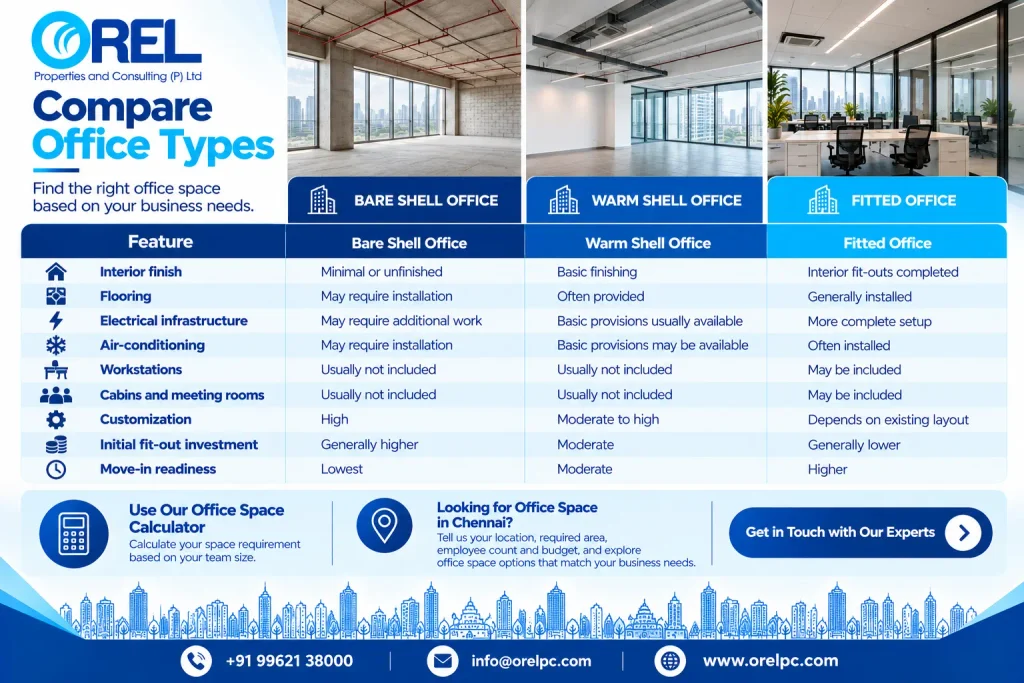
This comparison is a general guide. The actual handover condition depends on the property, lease agreement and inclusions specified by the landlord.

1. What Is a Bare Shell Office Space?

A bare shell office space is a commercial property handed over with minimal interior finishing. The building structure and essential provisions may be available, but the tenant generally needs to complete much of the interior work before the office becomes operational.

The exact condition varies. Some bare shell properties may include basic electrical connections, windows, lifts and common building facilities, while other specifications depend on the landlord’s handover terms.

Key Features of Bare Shell Offices

  • Minimal interior finishing
  • Greater freedom to design the office layout
  • Workstations and cabins generally need to be installed
  • Additional electrical and networking work may be required
  • Interior design and fit-out planning are usually the tenant’s responsibility

Advantages of Bare Shell Office Space

1. Greater design flexibility

Businesses can plan their workspace according to their brand identity, team structure and operational requirements.

2. Customized office layout

Companies can determine the placement of cabins, workstations, conference rooms, reception areas and collaboration zones.

3. Control over interior specifications

Businesses can select furniture, finishes, lighting and other interior elements according to their preferences and budget.

4. Suitable for long-term occupancy

Companies planning to occupy a property for several years may find the investment in a customized office worthwhile, subject to the lease terms and fit-out arrangements.

Disadvantages of Bare Shell Office Space

  • Higher initial interior investment
  • Longer setup and fit-out timeline
  • Need to coordinate contractors and vendors
  • Additional project management responsibilities
  • Potential delays before employees can move in

Who Should Choose a Bare Shell Office?

Bare shell offices may suit:

  • Large corporations
  • IT and technology companies with specific infrastructure needs
  • Businesses planning a customized corporate headquarters
  • Companies with dedicated interior design teams
  • Organizations expecting long-term occupancy

For example, a technology company planning a 15,000 sq. ft. office may prefer a bare shell property if it needs a specific workstation density, server infrastructure, meeting-room configuration and branded interiors.

2. What Is a Warm Shell Office Space?

A warm shell office space is generally a commercial property that has undergone basic finishing and has some essential building services or infrastructure in place, but does not necessarily include a complete office interior.

Depending on the property, a warm shell office may have finished flooring, ceilings, lighting provisions, electrical infrastructure and air-conditioning provisions. However, these inclusions should always be verified before signing the lease.

A warm shell property offers a middle ground between an unfinished bare shell space and a fully fitted office.

Key Features of Warm Shell Office Space

  • Basic interior finishing
  • Some essential building services in place
  • Less initial preparation than many bare shell properties
  • Scope to customize workstations and cabins
  • Additional interior work may still be required

Advantages of Warm Shell Office Space

1. Balanced setup costs

Because some finishing work is already completed, businesses may spend less on initial preparation than they would for a comparable bare shell property.

2. Faster office setup

A warm shell property may require fewer construction activities, depending on the available infrastructure and proposed layout.

3. Customization opportunities

Businesses can still design their workstations, meeting rooms, cabins and branding elements around their requirements.

4. Greater control over the workplace

Companies can retain flexibility over important interior decisions without starting every aspect of the fit-out from scratch.

Disadvantages of Warm Shell Office Space

  • Additional furniture and interior work may be necessary
  • Existing infrastructure may need upgrades
  • Handover specifications can vary considerably
  • The final setup cost depends on the work remaining

Who Should Choose a Warm Shell Office?

Warm shell offices may suit:

  • Growing businesses
  • Medium-sized companies
  • IT and professional services firms
  • Businesses seeking a balance between customization and setup time
  • Companies that want some flexibility without undertaking a complete interior project

For example, a business leasing 5,000 sq. ft. may choose a warm shell office with basic flooring and electrical provisions, then install its own workstations, meeting rooms and branding.

3. What Is a Fitted Office Space?

A fitted office space is a commercial office with interior fit-outs already installed. Depending on the property, these may include workstations, cabins, meeting rooms, flooring, lighting, air-conditioning and pantry facilities.

The term does not guarantee that every item required for immediate occupation is included. Businesses should check the actual inventory and handover specifications.

Key Features of Fitted Office Space

  • Existing interior fit-outs
  • Workstations or cabins may be available
  • Meeting rooms may already be installed
  • Electrical and lighting arrangements are often more complete
  • Less interior work may be required before occupation

Advantages of Fitted Office Space

1. Faster move-in

Businesses may be able to occupy the property sooner because much of the interior work is already completed.

2. Lower initial setup effort

Companies can reduce the need to coordinate multiple interior contractors and furniture suppliers.

3. Easier budget planning

Existing fit-outs can make it easier to estimate the initial expenditure, provided the inclusions and any required modifications are clearly documented.

4. Suitable for immediate business requirements

Businesses expanding quickly or relocating teams may benefit from a property that already has a functional office layout.

Disadvantages of Fitted Office Space

  • Existing layouts may not suit every business
  • Modifications can increase costs
  • Furniture and fit-outs may show signs of wear
  • The property may offer less design flexibility
  • The rent or other commercial terms may reflect the existing fit-out

Who Should Choose a Fitted Office?

Fitted offices may suit:

  • Businesses planning a quick relocation
  • Established companies opening a new branch
  • Startups that want to reduce setup responsibilities
  • Consulting and professional services firms
  • Companies seeking an office with existing cabins and meeting rooms

For example, a consulting company with 25 employees may prefer a fitted office that already includes workstations, two meeting rooms and manager cabins.

4. What Is a Fully Fitted Office Space?

A fully fitted office space generally includes a more complete interior setup designed for office operations. It may include workstations, private cabins, conference rooms, lighting, electrical infrastructure, air-conditioning and pantry facilities.

However, a fully fitted office is not automatically a fully furnished or plug-and-play office. Equipment, furniture, internet, operational services and other inclusions may differ between properties.

Before finalizing a property, confirm which items are included, which are chargeable and which must be arranged separately.

Fully Fitted Office vs Plug and Play Office Space

A plug-and-play office is generally intended to be ready for occupation with minimal additional setup. It may include furniture, internet infrastructure, meeting rooms and essential workplace facilities, depending on the provider.

A fully fitted office describes the physical interior fit-out, while a plug-and-play office emphasizes operational readiness.
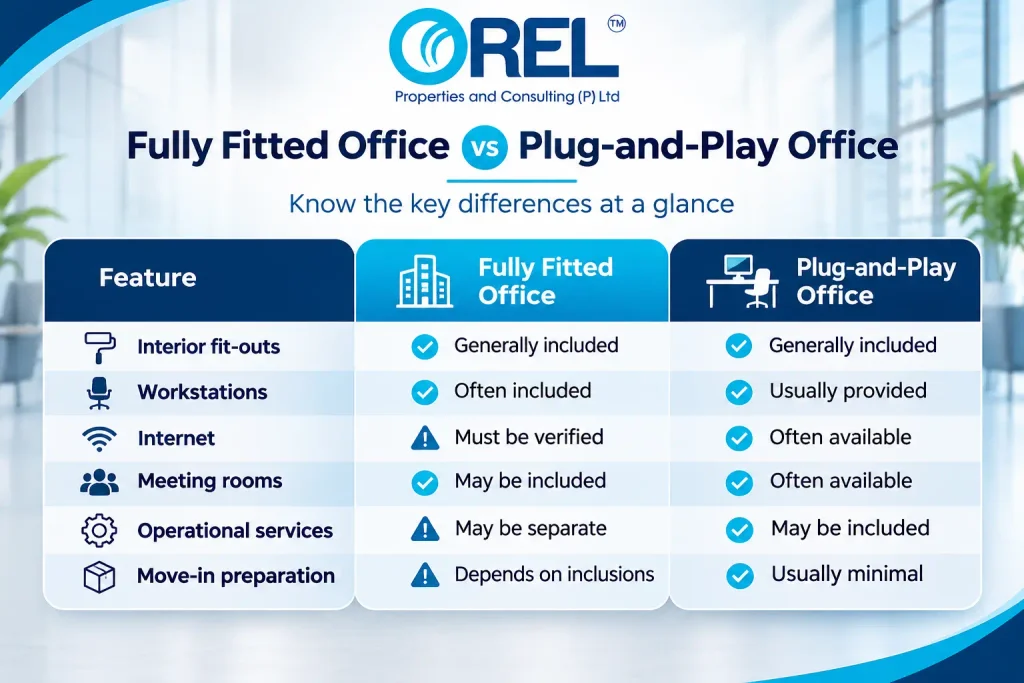
Fully Fitted Office vs Plug and Play Office Space

Businesses should request a detailed list of inclusions before deciding between these options.

5. Bare Shell vs Fully Furnished Office: Which Is Better?

When comparing bare shell vs fully furnished office options, the right choice depends on your budget, preferred layout, move-in timeline and expected occupancy period.
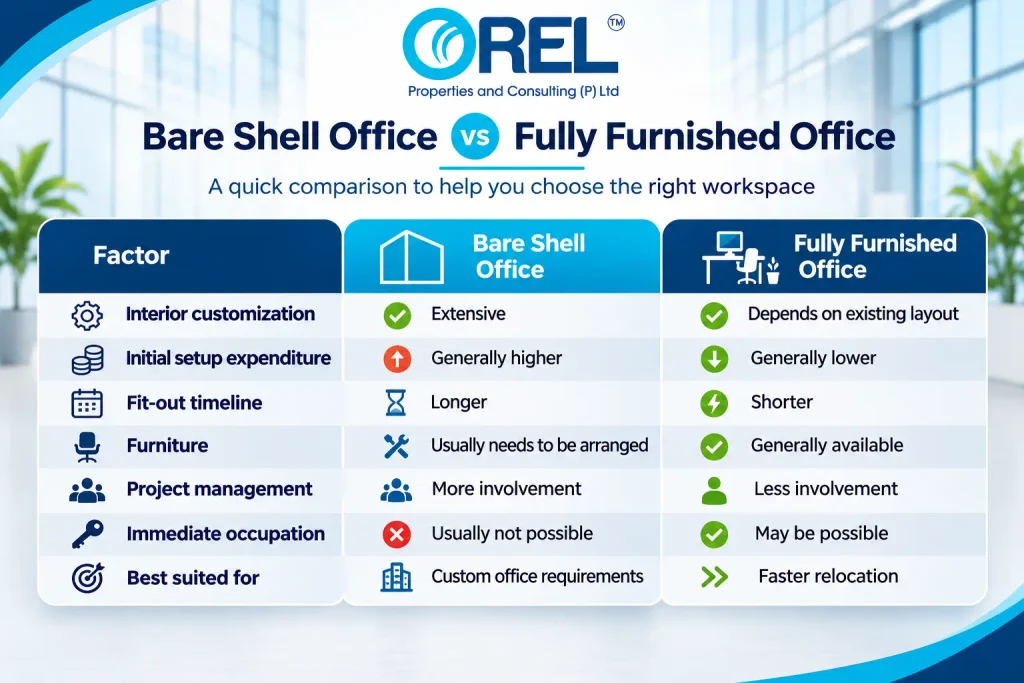
A bare shell office may be more suitable for a company that wants a highly customized workplace and has the time and budget to create it.

A fully furnished office may be more suitable for a business that prioritizes speed, convenience and reduced setup responsibilities.

Neither option is automatically cheaper. Compare the complete cost of occupying the property over your intended lease period.

6. How Much Does Each Office Type Cost?

The cost of a commercial office depends on several factors, including location, building grade, floor area, rent, fit-out specifications, parking, maintenance and lease terms.

The three office types also differ in their initial setup costs.

Bare Shell Office

The quoted rent may not include interior construction, furniture, electrical upgrades, networking or other tenant fit-outs. These expenses should be included in the initial budget.

Warm Shell Office

Some finishing and infrastructure may already be available, reducing the amount of work required. However, the remaining fit-out cost depends on the handover condition.

Fitted Office

Existing furniture and interior installations may reduce initial capital expenditure, but businesses should inspect their quality, suitability and maintenance requirements.

A Better Way to Compare Costs

Instead of comparing rent alone, calculate the total occupancy cost.

Total Occupancy Cost = Rent + Fit-Out Investment + Maintenance + Utilities + Other Applicable Charges

For a more accurate comparison, evaluate the costs over the expected lease period and include any fit-out contributions, rent-free periods, restoration obligations or other negotiated terms.

7. How to Choose the Right Office Type for Your Business

Use the following guide to shortlist the most suitable option.
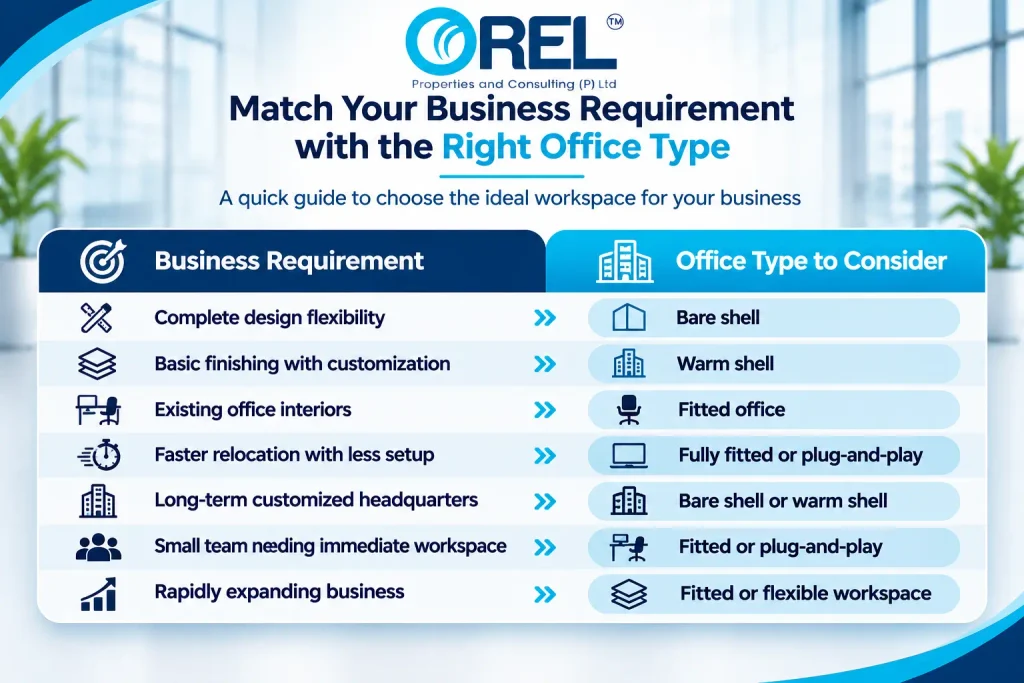
These are starting points rather than strict rules. A property inspection and cost comparison should determine the final decision.

Questions to Ask Before Leasing

Before signing a lease, confirm:

  1. What exactly is included in the handover?
  2. Are flooring, ceiling and lighting completed?
  3. Is air-conditioning installed and operational?
  4. Are workstations, cabins and meeting rooms included?
  5. Is internet connectivity available?
  6. Who pays for additional fit-out work?
  7. Are there restrictions on modifying the interiors?
  8. Who is responsible for repairs and maintenance?
  9. What are the lease duration and lock-in period?
  10. What restoration work is required when the lease ends?

These questions can help prevent unexpected costs and delays.

8. Office Space Options for Businesses in Chennai

Businesses searching for commercial office space in Chennai should evaluate the handover condition alongside location, connectivity, building quality and employee accessibility.

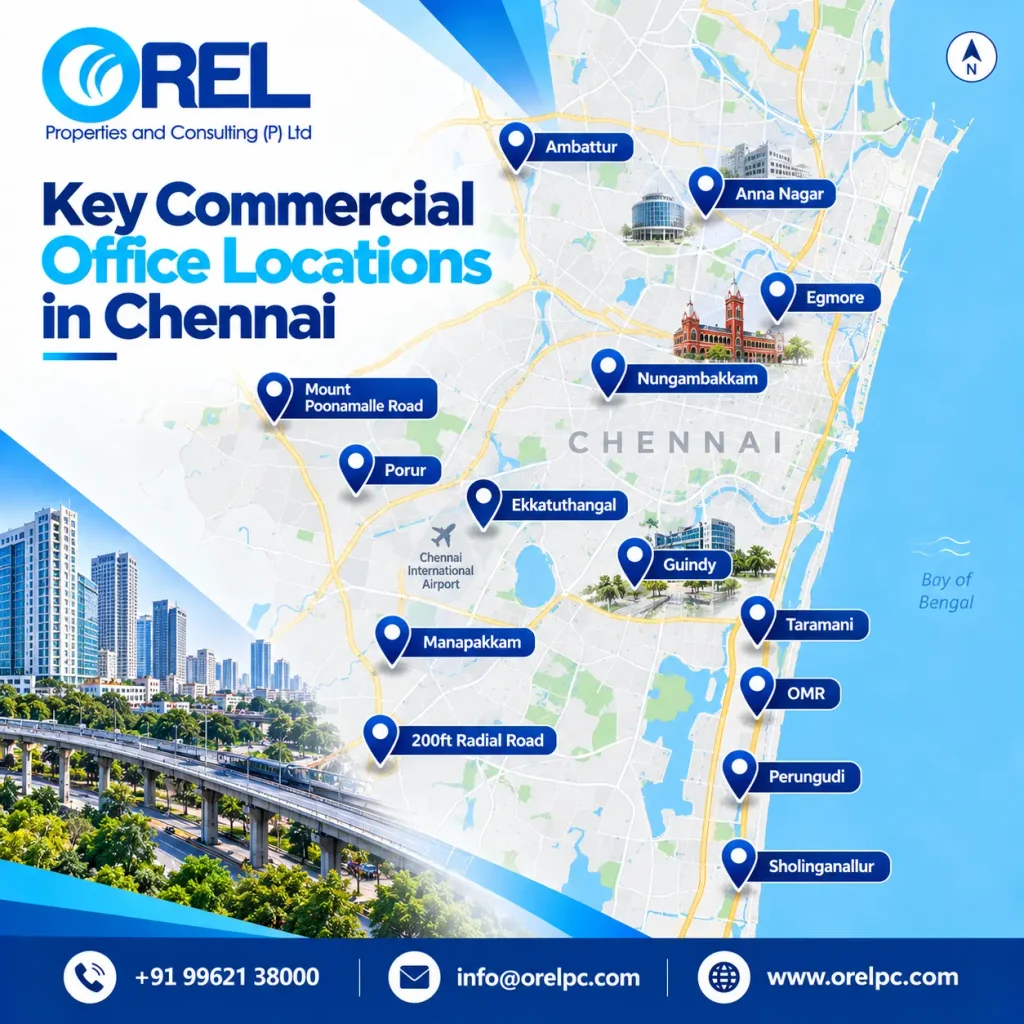
Established commercial districts and IT corridors such as Guindy, Anna Nagar, OMR, Perungudi, Taramani, Sholinganallur, Nungambakkam, Porur and Ekkatuthangal may be relevant depending on the company’s operational needs.

When comparing properties, consider:

  • Proximity to Metro stations and major roads
  • Employee commuting convenience
  • Parking availability
  • Building amenities and security
  • Floor plate and usable area
  • Natural light and ventilation
  • Fit-out requirements
  • Total occupancy cost
  • Future expansion possibilities

A well-located office with the right handover condition can help businesses balance setup time, workplace quality and long-term costs.

9. Common Mistakes to Avoid When Choosing an Office Space

Comparing Only the Monthly Rent

A lower rent may be offset by substantial interior expenses, maintenance charges or infrastructure upgrades.

Assuming Warm Shell Means Move-In Ready

Warm shell specifications vary. Verify the actual condition rather than relying only on the property label.

Assuming Fully Fitted Means Fully Operational

Existing interiors do not guarantee that internet, equipment, furniture, security access or other operational services are included.

Ignoring Fit-Out Restrictions

Review the landlord’s rules regarding structural changes, electrical work, signage and reinstatement before investing in interiors.

Overlooking Future Business Growth

Consider whether the office layout can support your anticipated workforce and operational requirements.

Failing to Document Handover Specifications

Ask for a written inventory of the facilities, fixtures, furniture and services included in the agreement.

10. How OREL Properties & Consulting Can Help

Finding the right commercial property involves more than selecting a location and negotiating rent. Businesses must also understand the property’s handover condition, fit-out requirements, amenities and suitability for their operations.

OREL Properties & Consulting helps businesses explore commercial office spaces based on their location, area, workforce, infrastructure and operational requirements.

Whether you are looking for a bare shell property to customize, a warm shell office with basic finishing or a fully fitted office space in Chennai, evaluating these factors can help you shortlist properties more effectively.

Looking for commercial office space in Chennai?

Contact OREL Properties & Consulting to discuss your office requirements and explore suitable commercial workspace options.

Frequently Asked Questions

What is the difference between bare shell, warm shell and fitted office space?

A bare shell office generally has minimal interior finishing, a warm shell office typically includes basic finishing and some building infrastructure, and a fitted office has existing interior installations such as workstations or cabins. The exact inclusions depend on the property and lease agreement.

Which is better: bare shell or warm shell office space?

Bare shell space is generally better for businesses seeking extensive customization, while warm shell space may suit businesses that want basic finishing completed before installing their own office interiors. Compare the remaining fit-out work and total cost before deciding.

What is a warm shell office space?

A warm shell office space is generally a commercial property with basic finishing and some essential infrastructure already provided. It may still require workstations, cabins, meeting rooms and other interior fit-outs.

What is a fully fitted office space?

A fully fitted office space generally includes completed office interiors and may provide workstations, cabins, meeting rooms, lighting and air-conditioning. The exact inclusions vary, so businesses should verify the handover specifications.

What is the difference between a fully fitted office and a plug-and-play office?

A fully fitted office has existing interior fit-outs, while a plug-and-play office is intended to be ready for occupation with minimal additional setup. Plug-and-play spaces may also include internet, meeting facilities and operational services.

Is a bare shell office cheaper than a fully furnished office?

A bare shell office may have a different rental structure, but it usually requires additional investment in interiors, furniture and infrastructure. A fully furnished office may reduce initial setup costs. Compare rent, fit-outs and other expenses over the intended lease period to identify the more economical option.

Which office type is best for startups?

Fitted or plug-and-play offices may suit startups that want to begin operations quickly and limit initial setup responsibilities. Startups with specialized design requirements or plans for long-term occupancy may prefer bare shell or warm shell properties.

Which office type is suitable for IT companies?

IT companies can choose any of the three options depending on their network infrastructure, power requirements, workstation density, meeting facilities and customization needs. A detailed technical assessment should be completed before leasing.

What should I check before leasing a commercial office?

Check the handover condition, usable area, building infrastructure, power backup, air-conditioning, parking, fit-out restrictions, lease duration, lock-in period, maintenance charges and restoration requirements.

How do I choose the right office space in Chennai?

Compare the location, connectivity, office size, building amenities, handover condition, fit-out budget and total occupancy cost. The best option is the one that meets your operational requirements while supporting your business plans.

Conclusion

Understanding Bare Shell vs Warm Shell vs Fitted office spaces helps businesses make informed commercial property decisions.

A bare shell office offers greater customization, a warm shell office provides a balance between basic finishing and flexibility, and a fitted office can reduce the effort required to prepare a workspace for occupation. A plug-and-play office may offer an even more operationally ready solution, depending on its inclusions.

Before choosing an office, evaluate the complete cost, handover specifications, customization requirements, move-in timeline and expected lease period.

For businesses exploring commercial office space in Chennai, OREL Properties & Consulting can help identify workspace options aligned with their location, size and operational needs.
How to Choose an Office Space in Chennai: 10 Key Factors


Choosing the right office space in Chennai is an important decision for any business. Whether you are a startup, a growing company, an IT organisation, or an established enterprise, the right workplace can improve employee productivity, support business growth, and create a positive impression on clients.

Chennai is one of India’s major commercial and IT destinations, offering a wide range of office spaces, from traditional commercial buildings and Grade A office spaces to coworking spaces and fully managed offices. However, finding the right office space for rent in Chennai requires more than comparing rental prices. Businesses must evaluate location, connectivity, infrastructure, office layout, amenities, lease terms, and future expansion opportunities.

In this guide, OREL Properties and Consulting Pvt Ltd explains the 10 key factors to consider when choosing an office space in Chennai to help you make a well-informed business decision.

Why Choosing the Right Office Space in Chennai Matters

The right commercial office space can influence your company’s operational efficiency, employee satisfaction, recruitment, and long-term expenses. Chennai’s established IT corridors, commercial districts, and developing business hubs provide options for businesses with different budgets and space requirements.

Popular locations to explore include:

  • Guindy: Suitable for businesses seeking access to established commercial and industrial areas.
  • OMR (Old Mahabalipuram Road): A major IT corridor with office developments and access to technology companies.
  • Taramani: An established technology and research hub.
  • Perungudi: An option for IT companies and businesses operating along OMR.
  • Sholinganallur: Offers commercial office options along the southern IT corridor.
  • Anna Nagar: An established urban location with road connectivity and supporting amenities.
  • Ambattur: A location worth considering for businesses connected to industrial and manufacturing sectors.
  • Porur: Offers access to commercial developments and important road networks.

The best location depends on your business model, employee commute patterns, client requirements, and budget.

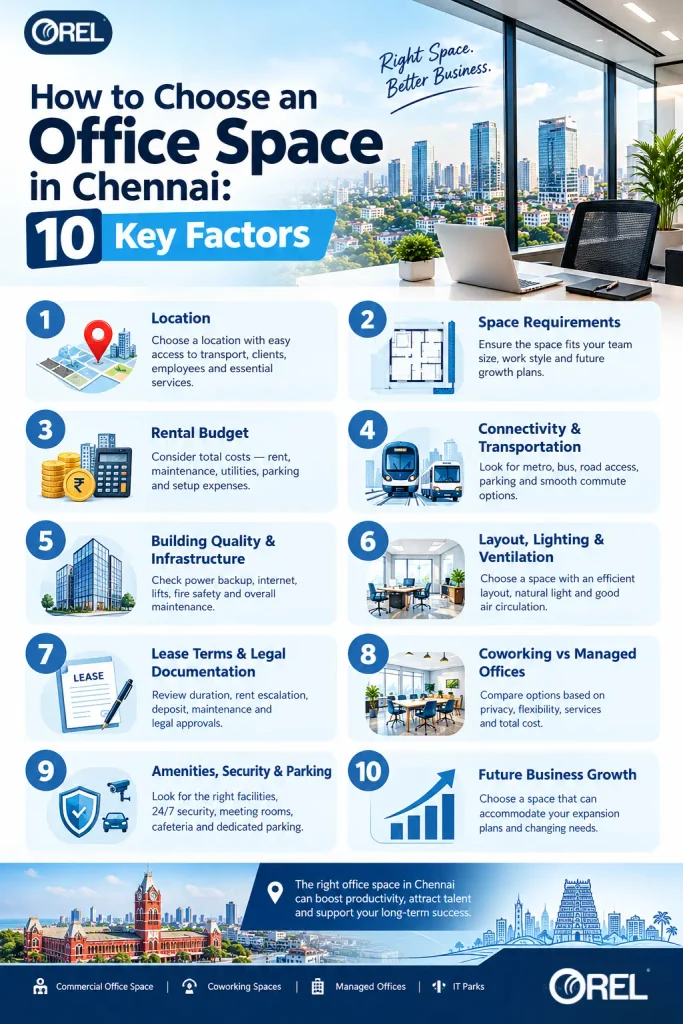
10 Key Factors to Consider When Choosing an Office Space in Chennai

1. Choose the Right Location

Location is one of the most important factors when selecting an office space in Chennai. A strategically located workplace can improve accessibility for employees, clients, vendors, and business partners.

Before finalising a location, evaluate its proximity to major roads, public transportation, residential areas, restaurants, banks, and other essential services.

For example, companies looking for office space along the IT corridor may consider OMR, Perungudi, or Sholinganallur. Businesses that require access to central commercial areas may explore Guindy or Anna Nagar, depending on their operational needs.

What to check:

  • Distance from major roads and public transportation.
  • Accessibility for employees and visitors.
  • Availability of nearby restaurants and essential services.
  • Proximity to clients, vendors, and business partners.
  • Suitability of the neighbourhood for your industry.

2. Determine Your Office Space Requirements

Before searching for commercial office space for rent in Chennai, calculate how much space your business actually needs.

An office that is too small can create overcrowding and limit collaboration, while an unnecessarily large office can increase rental and maintenance expenses.

Your space requirements will depend on employee strength, work arrangements, meeting room requirements, reception areas, storage, and future recruitment plans.

Consider the following when estimating your office space requirement:

  • Number of employees.
  • Workstations and private offices.
  • Conference and meeting rooms.
  • Reception and waiting areas.
  • Pantry and breakout spaces.
  • Storage and support areas.
  • Potential future expansion.

A space-planning exercise can help determine the appropriate carpet area and overall leasable area. Remember that carpet area and chargeable or leasable area may differ significantly.

Calculate Your Office Space Requirements

Not sure how much office space your business needs? Use our Office Space Calculator to estimate the ideal workspace based on your employee count, workstation requirements, meeting rooms, and other facilities.

A space-planning exercise can help you determine the appropriate carpet area and overall leasable area before comparing commercial office properties. Keep in mind that carpet area and chargeable or leasable area can differ significantly depending on the building layout and the area calculation method.

By estimating your requirements in advance, you can shortlist suitable office spaces in Chennai, compare rental costs more effectively, and choose a workspace that supports your business’s current operations and future growth.

Expert tip: Ask the property consultant for a floor plan and clarify the usable area before comparing properties.

3. Set a Realistic Office Rental Budget

Rental price is a major consideration when choosing an office space in Chennai. However, the monthly rent is only one component of the total occupancy cost.

Businesses should calculate the complete cost of leasing and operating the office before signing an agreement.

Potential expenses include:

  • Monthly rent and security deposit.
  • Common area maintenance (CAM) charges.
  • Electricity and backup power expenses.
  • Internet and telecommunications.
  • Parking charges.
  • Interior fit-out and furnishing costs.
  • Housekeeping and security services.
  • Applicable taxes and other contractual charges.

When comparing office spaces, evaluate the total monthly cost rather than the advertised rental rate alone.

Example: An office with a lower base rent may become more expensive if it requires extensive interior work, additional maintenance payments, or costly infrastructure upgrades.

4. Evaluate Connectivity and Transportation

Transportation accessibility plays a major role in employee convenience and business operations. An office that is difficult to reach can increase commuting time, affect attendance, and create challenges for client visits.

When evaluating office space for rent in Chennai, check the availability of metro stations, suburban railway stations, bus services, and major roads where relevant.

Also consider peak-hour traffic, access to parking, and the availability of safe pedestrian routes.

Key connectivity factors:

  • Distance to public transportation.
  • Road access during peak hours.
  • Availability of employee and visitor parking.
  • Connectivity to residential neighbourhoods.
  • Accessibility for clients and business partners.

For businesses with employees travelling from different parts of Chennai, choosing a location with convenient transportation links can improve the overall workplace experience.

5. Check Building Quality and Infrastructure

A professional office environment requires dependable infrastructure. Before leasing an office, inspect the building’s construction quality, electrical systems, ventilation, lifts, safety provisions, and common areas.

Grade A commercial office spaces may offer modern building systems, professional facility management, and corporate-oriented amenities. However, the actual facilities vary from building to building, so inspect each property individually.

Important infrastructure features include:

  • Reliable electricity and backup power.
  • Air-conditioning and ventilation.
  • High-speed internet connectivity options.
  • Adequate lifts and staircases.
  • Fire safety systems and emergency exits.
  • Well-maintained common areas.
  • Accessibility and security provisions.

If your business depends on servers, specialised equipment, or uninterrupted operations, check the building’s power capacity and technical infrastructure carefully.

Expert tip: Arrange a physical site visit and verify that the facilities match your operational requirements.

6. Assess Office Layout, Lighting, and Ventilation

The internal layout of an office affects productivity, employee comfort, and the efficient use of space.

An effective office design should provide sufficient room for workstations, meetings, collaboration, and quiet work. Natural lighting and proper ventilation can also contribute to a more comfortable workplace.

When inspecting an office, consider whether its layout supports your company’s working style.

Evaluate the following:

  • Efficient workstation arrangement.
  • Natural light and ventilation.
  • Availability of meeting rooms.
  • Privacy for confidential discussions.
  • Noise levels and sound insulation.
  • Pantry and breakout areas.
  • Flexibility for future layout changes.

For businesses planning to customise the interiors, confirm which alterations are permitted by the landlord and whether approvals are required.

Expert tip: Request a floor plan and calculate how many functional workstations can fit comfortably within the usable area.

7. Review Lease Terms and Legal Documentation

Before finalising a commercial office lease in Chennai, carefully review the lease agreement and associated documents. Commercial lease terms can affect your financial commitments and flexibility for several years.

Do not rely solely on verbal assurances. Ensure that the important terms are documented clearly.

Key terms to review:

  • Lease duration and renewal conditions.
  • Monthly rent and escalation clauses.
  • Security deposit and refund conditions.
  • Notice period and early termination provisions.
  • Maintenance responsibilities.
  • Fit-out permissions and reinstatement obligations.
  • Parking rights and access provisions.
  • Permitted use of the premises.
  • Responsibility for repairs and utilities.

Also verify the landlord’s ownership or authority to lease the property, relevant property documents, and applicable building approvals.

Depending on the property and transaction, registration, stamp duty, tax, and other legal requirements may apply.

Expert tip: Have a qualified property lawyer review the lease agreement before signing or paying a substantial deposit.

8. Compare Coworking and Managed Office Spaces

Traditional leased offices are not the only option available to businesses in Chennai. Coworking spaces and fully managed offices can provide alternatives for companies that want to reduce setup time or avoid managing every aspect of the workplace themselves.

The right option depends on your team size, budget, privacy requirements, and expected occupancy period.

Traditional office space

  • Greater control over layout and branding.
  • Suitable for businesses seeking a dedicated premises.
  • May require separate investment in interiors and facilities.

Coworking space

  • Shared workplace infrastructure.
  • Potential access to meeting rooms and common amenities.
  • May suit freelancers, startups, and smaller teams.

Fully managed office space

  • May include furniture, utilities, housekeeping, and facility management.
  • Can reduce the time required to establish an operational office.
  • Offers a more turnkey arrangement, depending on the provider.

Compare the total cost, privacy, scalability, contract flexibility, and included services before making a decision.

Expert tip: Ask for a detailed list of inclusions and exclusions so that you can compare different office formats accurately.

9. Evaluate Amenities, Security, and Parking

Amenities can make a significant difference to daily office operations. The right facilities improve employee convenience and help create a professional environment for visitors.

Depending on your business requirements, look for:

  • Dedicated parking for employees and visitors.
  • 24/7 access, where required and permitted.
  • Security personnel and access control.
  • Reception and visitor management facilities.
  • Meeting and conference rooms.
  • Cafeteria or nearby food options.
  • Housekeeping and waste management.
  • Power backup and building maintenance.
  • Accessibility features.

Not every office requires every amenity. Prioritise the facilities that support your team’s daily activities and avoid paying extra for services your business will rarely use.

Expert tip: Confirm whether amenities are included in the rent or charged separately.

10. Plan for Future Business Growth

An office should support your business not only today but also over the coming years. Choosing a space without considering future requirements may result in another relocation, additional fit-out expenses, and operational disruption.

Before leasing an office, assess your growth plans and determine whether the premises can accommodate them.

Consider these questions:

  • Will your employee count increase?
  • Can the office accommodate additional workstations?
  • Is another floor or adjoining space available?
  • Does the lease permit expansion or subleasing?
  • Can the layout be modified as your business changes?
  • Will the location continue to suit your clients and employees?

If rapid expansion is expected, a flexible lease or managed office arrangement may be worth considering.

Expert tip: Balance your current space requirements with realistic growth projections rather than leasing substantially more space than you need.

Common Mistakes to Avoid When Renting Office Space in Chennai

Businesses searching for office space often overlook important details during the selection process. Avoid these common mistakes:

  1. Choosing an office based only on the rental price.
  2. Underestimating the space required per employee.
  3. Ignoring peak-hour traffic and commuting challenges.
  4. Failing to inspect the property in person.
  5. Overlooking maintenance charges and other hidden costs.
  6. Signing a lease without reviewing the legal terms.
  7. Ignoring internet connectivity and power backup.
  8. Selecting an office without considering future expansion.
  9. Assuming that all amenities are included in the rent.
  10. Failing to compare multiple properties before deciding.

A structured evaluation process can help businesses reduce avoidable costs and select an office that meets their operational needs.

How OREL Properties and Consulting Pvt Ltd Can Help

Finding the right commercial office space requires an understanding of business requirements, local market conditions, location advantages, and lease considerations.

OREL Properties and Consulting Pvt Ltd helps businesses explore office space options in Chennai based on their location preferences, space requirements, budget, and operational objectives.

Whether you are looking for a conventional commercial office, a Grade A office space, a coworking environment, or a fully managed office, a requirement-driven property search can help you identify suitable options more efficiently.

Our approach focuses on helping businesses evaluate property options, compare important features, and make informed real estate decisions.

If you are planning to lease an office in Chennai, define your requirements first and seek professional assistance to shortlist properties that align with your business goals.

Conclusion

Choosing the right office space in Chennai involves much more than finding a vacant commercial property. Businesses must evaluate location, space requirements, rental budget, connectivity, building infrastructure, office layout, lease terms, amenities, and future expansion plans.

By considering these 10 key factors, you can identify an office that supports employee productivity, improves operational efficiency, and aligns with your long-term business objectives.

Whether you are a startup establishing your first workplace or an established company expanding its operations, careful planning can help you find the right office space for rent in Chennai.

Looking for commercial office space in Chennai? Connect with OREL Properties and Consulting Pvt Ltd to explore suitable office options for your business.

Frequently Asked Questions (FAQs)

1. How do I choose the right office space in Chennai?

Start by defining your budget, employee count, preferred location, space requirements, and essential amenities. Compare shortlisted properties based on connectivity, infrastructure, lease terms, and total occupancy costs before making a decision.

2. Which locations are suitable for renting office space in Chennai?

OMR, Guindy, Taramani, Perungudi, Sholinganallur, Anna Nagar, Porur, and Ambattur are among the locations businesses may consider. The most suitable area depends on your industry, employee commute patterns, budget, and client accessibility.

3. How much office space does a company need?

The requirement depends on the number of employees, workstation layout, meeting rooms, common areas, and working arrangements. Calculate the usable area required for your operations and confirm whether the quoted property area refers to carpet area, built-up area, or super built-up area.

4. What costs should I consider when renting commercial office space?

In addition to monthly rent, consider the security deposit, maintenance charges, electricity, internet, parking, fit-out expenses, housekeeping, and applicable taxes or other contractual charges.

5. Is a coworking space better than a traditional office?

Coworking may suit businesses that need shared facilities and flexible arrangements. A traditional office may be preferable when a company requires greater control over branding, layout, privacy, and operations. Fully managed offices provide another option, depending on the services included.

6. What should I check before signing an office lease?

Review the lease duration, rental escalation, deposit refund terms, notice period, maintenance responsibilities, fit-out permissions, permitted use, and renewal conditions. Verify the landlord’s authority to lease the property and seek legal advice before signing.

7. Why is location important when selecting an office in Chennai?

Location affects employee commuting, client accessibility, transportation costs, business visibility, and proximity to commercial or technology hubs. Choosing a suitable location can improve operational convenience and support business growth.

Commercial Office Space for Lease in Chennai: What to Know


What Should You Know Before Leasing an Office Space in Chennai?

Finding the right office space for lease in Chennai involves more than comparing rental prices. Businesses should evaluate the location, office size, building quality, connectivity, parking, amenities, lease terms, operating costs and potential for future expansion.

Chennai has a diverse commercial real estate market, with office spaces available across established business districts and emerging commercial corridors. The right office location can improve employee accessibility, client convenience and long-term business efficiency.

Whether you are a startup looking for a compact workspace or an established company searching for a larger corporate office, understanding the key factors involved in leasing can help you make a better decision.

What Is the Difference Between Office Space for Lease and Office Space for Rent?

The terms lease and rent are often used interchangeably, but they can represent different arrangements depending on the agreement.

An office lease generally involves a longer-term contractual arrangement between the property owner and the business. It can provide greater stability for companies planning to occupy a property for several years.

An office rental arrangement may offer greater flexibility depending on the landlord, property and agreement.

When searching online, businesses may use terms such as:

  • office space for lease in Chennai
  • office space for rent in Chennai
  • office space on lease in Chennai
  • commercial office space in Chennai
  • commercial office for rent
  • office space near business districts

Therefore, businesses should focus on the actual terms and conditions of the agreement rather than relying only on the terminology used in a property listing.

Why Choose an Office Space for Lease in Chennai?

Chennai is an important business and technology hub with established commercial areas, IT corridors and well-connected business districts.

Leasing an office can provide businesses with a dedicated professional environment while allowing them to select a location based on their workforce and operational requirements.

Key advantages include:

  • Professional workplace for employees
  • Better environment for client meetings
  • Greater control over office layout
  • Opportunity to customize the workspace
  • Long-term location stability
  • Access to commercial building amenities
  • Better brand visibility in suitable locations
  • Potential to plan workspace around future growth

For businesses expecting to operate from the same location for several years, a suitable commercial lease can provide greater stability than frequently changing workspaces.

What Should You Consider Before Leasing an Office in Chennai?

Before finalizing an office space for lease in Chennai, evaluate the property from both a business and operational perspective.

1. Location

Location is one of the most important factors when selecting commercial office space.

Consider:

  • Employee commute
  • Accessibility by road
  • Public transportation
  • Metro connectivity
  • Proximity to residential areas
  • Client accessibility
  • Nearby restaurants and essential services
  • Availability of parking

A well-connected location can make the office more convenient for both employees and visitors.

2. Office Size

Your office should provide sufficient space for your current workforce while allowing for reasonable future growth.

Start by calculating:

Number of Employees × Planned Space Per Employee = Approximate Office Requirement

For example:

50 employees × 100 sq. ft. = 5,000 sq. ft.

The final requirement should also account for meeting rooms, cabins, reception areas, pantry facilities, storage and circulation space.

Choosing an office that is too small can create operational challenges, while leasing significantly more space than necessary can increase occupancy costs.

3. Office Layout and Floor Plate

The usable layout of an office is just as important as the total square footage.

A property with an efficient floor plate can provide better space utilization.

Check:

  • Column placement
  • Workstation layout
  • Floor-to-ceiling height
  • Natural light
  • Ventilation
  • Entry and exit points
  • Lift access
  • Common areas
  • Emergency exits
  • Meeting-room possibilities

A well-designed floor plate can help businesses accommodate more functional workspace without unnecessarily increasing the total area.

4. Building Quality and Amenities

When evaluating commercial office space for lease in Chennai, look beyond the office floor itself.

Consider the overall building.

Important features may include:

  • Reception
  • Security
  • Elevators
  • Power backup
  • Parking
  • Fire safety systems
  • CCTV
  • Maintenance
  • Common areas
  • Visitor management
  • HVAC or air-conditioning provisions

These facilities can significantly influence the usability and professional experience of the workplace.

5. Parking Availability

Parking can be an important consideration for Chennai businesses.

Before signing a lease, clarify:

  • Number of car parking spaces
  • Two-wheeler parking
  • Visitor parking
  • Parking allocation
  • Additional parking charges
  • Parking availability during peak hours

If your business regularly receives clients or vendors, visitor parking can also be an important consideration.

6. Connectivity

Accessibility can influence employee satisfaction and client convenience.

When comparing office properties, consider proximity to:

  • Metro stations
  • Major roads
  • Bus routes
  • Railway stations
  • Airports
  • Residential neighbourhoods
  • Other commercial hubs

For companies with employees commuting from different parts of Chennai, a centrally accessible or well-connected office can provide a practical advantage.

7. Lease Terms and Conditions

Never evaluate an office based only on the monthly rent.

Before signing the agreement, understand the complete commercial structure.

Review:

  • Monthly rent
  • Security deposit
  • Lease duration
  • Lock-in period
  • Rent escalation
  • Maintenance charges
  • Common area charges
  • Parking charges
  • Utility expenses
  • Taxes and applicable charges
  • Renewal terms
  • Exit conditions
  • Restoration requirements

A clear understanding of these costs helps businesses calculate their actual occupancy expenses.

8. Fit-Out and Interior Costs

A property may look attractive during a site visit, but businesses should also consider the cost of preparing the office for occupation.

Depending on the property, you may need to budget for:

  • Workstations
  • Cabins
  • Meeting rooms
  • Electrical work
  • Lighting
  • Networking
  • Branding
  • Furniture
  • Pantry setup
  • Interior design
  • Air-conditioning

A fully fitted or managed office may reduce the time and investment required to start operations.

There is no single solution that works for every company.

A business expecting stable long-term operations may prefer a conventional lease, while a startup or rapidly changing team may benefit from a flexible office arrangement.

How Much Office Space Does Your Business Need?

Your office space requirement should be based on your employee count, working model and operational needs.
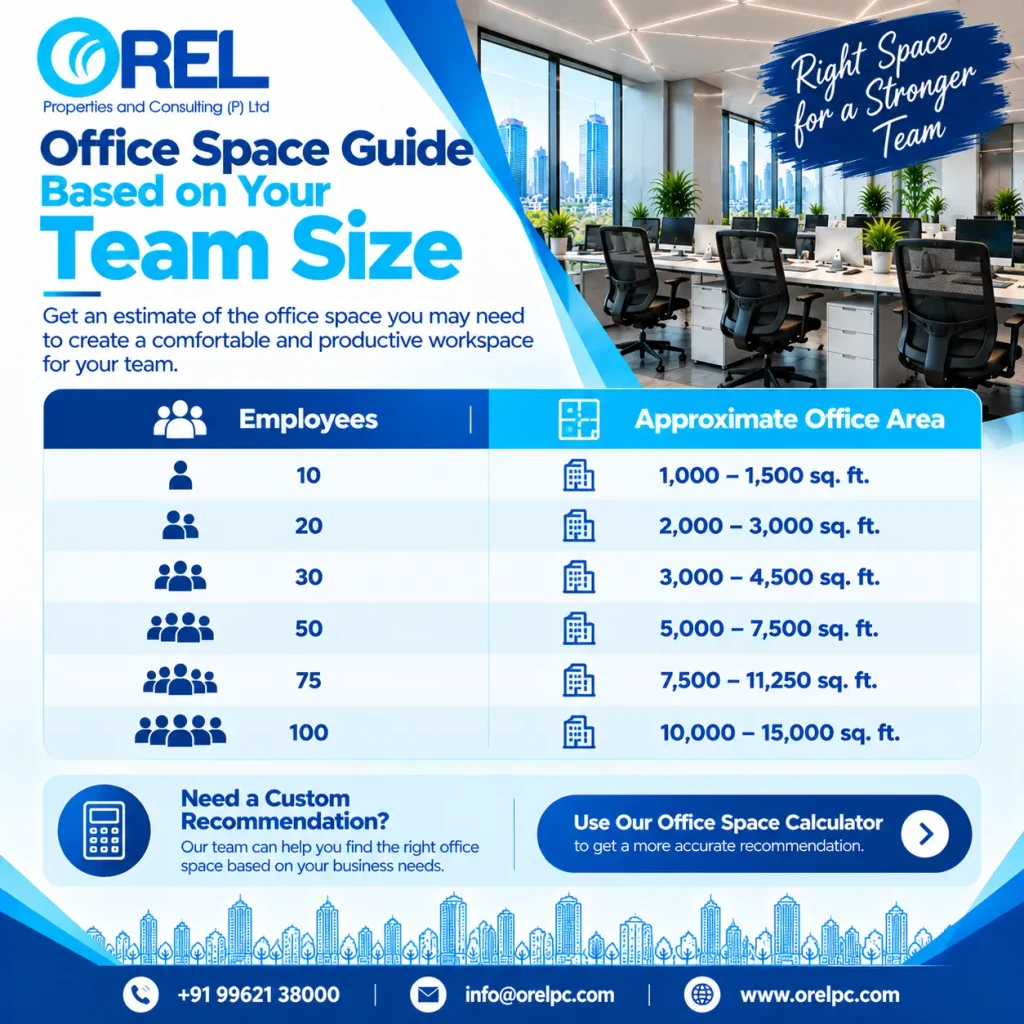
As an initial planning guide:

These are planning estimates. Your actual requirement can vary depending on workstation density, private cabins, meeting rooms, common areas and hybrid working.

Should You Choose a Fully Fitted Office or a Bare-Shell Office?

This is another important decision when looking for an office space for lease in Chennai.

Fully Fitted Office

A fully fitted office may already include:

  • Workstations
  • Cabins
  • Meeting rooms
  • Lighting
  • Electrical infrastructure
  • Air-conditioning
  • Pantry
  • Networking infrastructure

Advantages

  • Faster occupation
  • Lower initial setup effort
  • Reduced interior planning
  • Easier move-in process

Bare-Shell Office

A bare-shell property gives the business greater freedom to design the workplace according to its brand and operational requirements.

Advantages

  • Customized office design
  • Greater control over layout
  • Ability to create a unique workplace
  • Suitable for companies with specific infrastructure requirements

The right choice depends on your budget, timeline, brand requirements and expected occupancy period.

Which Businesses Need Commercial Office Space in Chennai?

Different types of businesses may require commercial office space, including:

  • IT companies
  • Software companies
  • Startups
  • Financial services firms
  • Consulting companies
  • Professional service firms
  • Educational companies
  • Healthcare businesses
  • Marketing agencies
  • Engineering companies
  • Corporate offices
  • Back-office operations

Each business can have different requirements for office size, layout, connectivity and amenities.

What Are the Best Locations for Office Space in Chennai?

The ideal location depends on your employees, clients and business operations.

When searching for office space, businesses may consider established commercial and IT corridors such as:

The best location is not necessarily the one with the lowest rent. It should provide a balance between accessibility, business requirements, property quality and total occupancy cost.

Common Mistakes to Avoid When Leasing Office Space

Choosing Based Only on Rent

A lower monthly rent does not always mean lower overall occupancy costs.

Consider maintenance, parking, utilities, fit-out and other expenses.

Ignoring Future Growth

If your team is expanding, make sure the workspace can support future requirements.

Not Checking Accessibility

An office that is difficult for employees or clients to reach can create long-term challenges.

Underestimating Meeting Space

A business may have enough desk space but still lack sufficient meeting rooms.

Not Reviewing the Lease Agreement

Understand all commercial terms before signing.

Choosing the Wrong Floor Layout

Poor column placement or inefficient floor plates can reduce usable workspace.

Ignoring Parking

Parking requirements should be discussed before finalizing the property.

Why Work With a Commercial Property Consultant?

Finding an appropriate commercial office space for lease in Chennai can involve comparing multiple properties, understanding commercial terms and evaluating whether a property actually fits your business requirements.

A professional property consultant can help businesses assess:

  • Location suitability
  • Office size
  • Property specifications
  • Building facilities
  • Parking
  • Connectivity
  • Lease requirements
  • Expansion potential

This can make the property search more structured and help businesses shortlist spaces based on their actual requirements.

Find the Right Office Space in Chennai with OREL Properties & Consulting

At OREL Properties & Consulting, businesses can explore commercial office spaces based on their location, size, workforce and operational requirements.

Whether you are searching for an office space for lease in Chennai, a fully fitted commercial workspace or office space for rent in Chennai, selecting the right property requires careful evaluation of both the workplace and the commercial terms.

From established business locations to growing commercial corridors, OREL Properties & Consulting can help businesses identify office space options suited to their requirements.

Looking for Office Space in Chennai?

Tell us your preferred location, required area, employee count and budget, and explore office space options that match your business needs.

Use our Office Space Calculator to estimate your space requirements based on your workforce and plan your next workspace more effectively.

Contact OREL Properties & Consulting to find your next commercial office space in Chennai.

Frequently Asked Questions About Office Space for Lease in Chennai

What is the average cost of office space for lease in Chennai?

Office lease costs vary significantly depending on the location, building grade, office size, amenities, fit-out, parking and other commercial terms. Businesses should compare the total occupancy cost, rather than looking only at the quoted rent.

What should I check before leasing an office in Chennai?

Check the location, usable area, floor layout, connectivity, parking, building facilities, power backup, maintenance costs, lease duration, security deposit, lock-in period, escalation and other agreement terms.

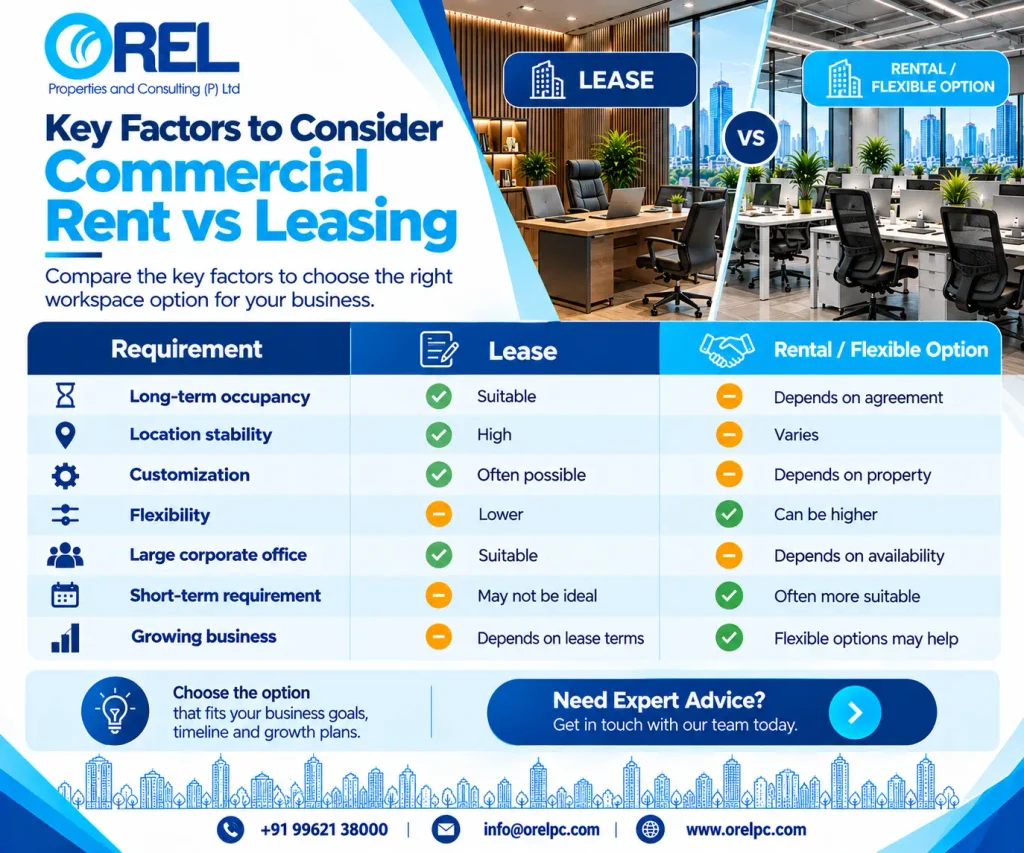
Is it better to lease or rent an office in Chennai?

The better option depends on your business requirements. A longer-term lease may suit companies looking for location stability, while flexible rental or managed-office solutions may be more suitable for businesses that prioritize flexibility.

How much office space do I need for 50 employees?

As an initial planning estimate, 50 employees may require approximately 5,000–7,500 sq. ft., depending on the workspace model, meeting rooms, cabins and common facilities.

Where can I find office space for lease in Chennai?

Office spaces are available across several commercial and business locations in Chennai, including Guindy, Anna Nagar, OMR, Taramani, Perungudi, Sholinganallur, Nungambakkam, Egmore, Porur and other commercial corridors.

What is the difference between commercial office space for lease and coworking space?

A conventional commercial lease generally gives a business greater control over its dedicated premises, while coworking typically provides shared facilities and flexible workspace options. The appropriate choice depends on the company’s size, budget, growth plans and desired flexibility.

Can startups lease commercial office space in Chennai?

Yes. Startups can consider conventional offices, fully fitted offices, managed offices and coworking spaces depending on their team size, budget and expected growth.

How long should an office lease be?

There is no single ideal lease duration. Businesses should select a term based on their expected occupancy period, growth plans, financial commitments and the commercial terms offered by the property owner.

Conclusion

Choosing the right office space for lease in Chennai requires careful consideration of location, size, accessibility, building quality, parking, amenities, fit-out requirements and lease conditions.

Whether you are searching for commercial office space for lease in Chennai, office space for rent in Chennai or office space on lease in Chennai, the right property should support your current operations while allowing your business to grow.

Before signing an agreement, evaluate the complete occupancy cost, workplace requirements and long-term suitability of the property.

For businesses looking for commercial office space in Chennai, OREL Properties & Consulting can help you identify office solutions aligned with your business requirements.

Office Space Requirement: How Much Space Do I Need Per Employee? | OREL


If you are planning a new office, one of the first questions to answer is: How much office space do I need to lease or can I plan per employee basis?

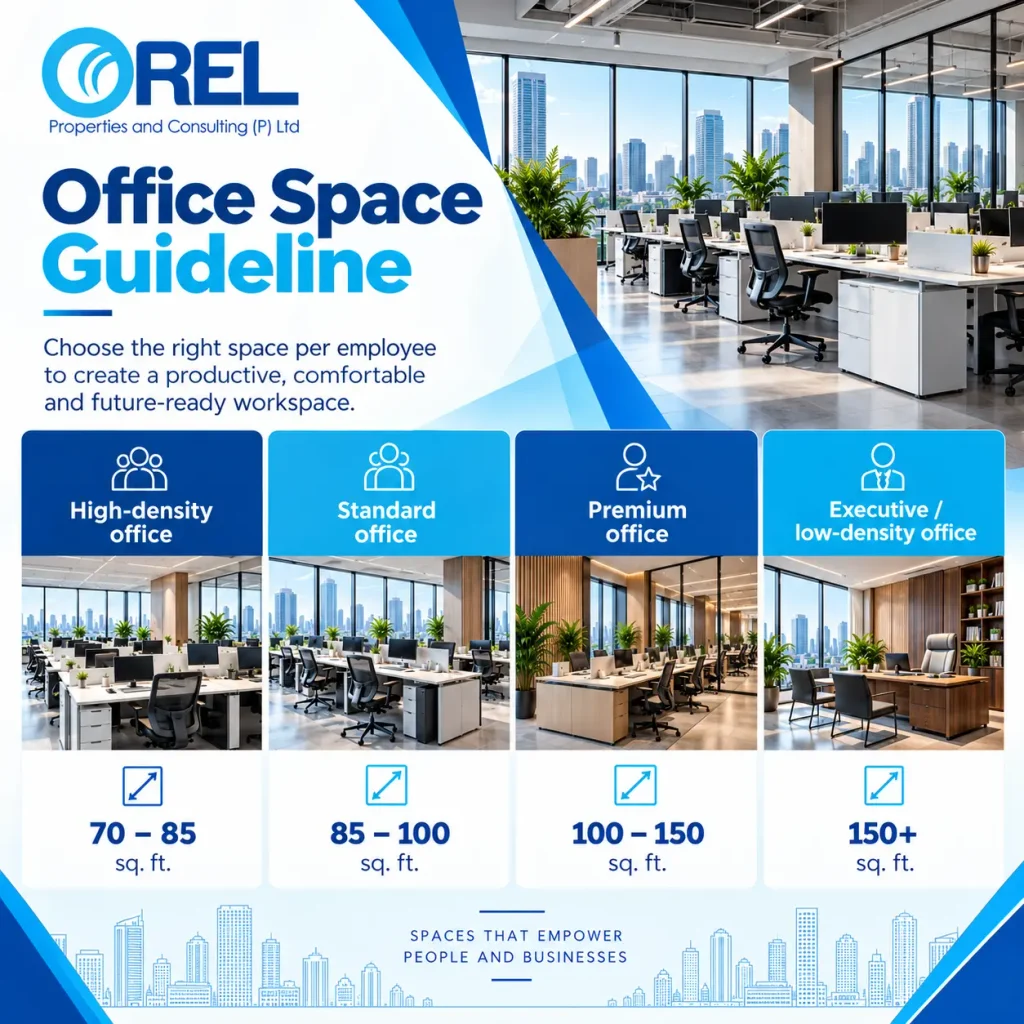
As a general planning guideline, businesses can consider around 90–100 sq. ft. of office space per employee as per standard to meet fire norms, aisle spacing requirements etc.,, although the ideal requirement depends on the type of business, office layout, working model, meeting rooms, employee amenities and future growth.

For example, a company with 50 employees may require approximately 4,000–5000 sq. ft. of office space to have well laid out office space with collaborative areas and discussion, meeting rooms as a starting point.

How Much Office Space Do I Need Per Employee?

For most businesses, 85–100 sq. ft. (of Super Built up lease or leased area) per employee is a practical starting range when planning an office.

These figures are planning estimates rather than fixed requirements. Your actual office space requirement depends on how the space will be used. You can also use our Office Space Calculator to estimate your space requirements quickly and accurately.

A company with an open-plan layout may need less space per employee, while a consulting or client-facing business with private cabins and multiple meeting rooms may require more.

How to Calculate Your Office Space Requirement

A simple formula can help you estimate your initial requirement:

Office Space Requirement = Number of Employees × Space Per Employee

For example:

50 employees × 100 sq. ft. = 5,000 sq. ft.

Therefore, a 50-person company could begin its search with approximately 5,000 sq. ft. of office space.

However, the calculation should also account for common areas and business-specific requirements such as meeting rooms, cabins, reception areas, pantry facilities and storage.

The Important factor to note is that in a Building when Leasing it is leasing at super built up area, which includes 25% to 30% loading for your common areas of the building , such as lift lobbies, artiums, washrooms, AHU and electrical rooms amenities zone etc. This might also play an important point as it will affect the total carpet or usable office space for the fit-outs.

What Should Be Included in Your Office Space?

Your total office requirement may include:

  • Employee workstations
  • Private cabins
  • Meeting rooms
  • Conference rooms
  • Reception and waiting areas
  • Pantry and dining areas
  • Breakout spaces
  • Collaboration zones
  • Storage
  • IT/server rooms
  • Circulation and walkways
  • Employee amenities

This is why selecting an office based only on the number of workstations can result in insufficient space.

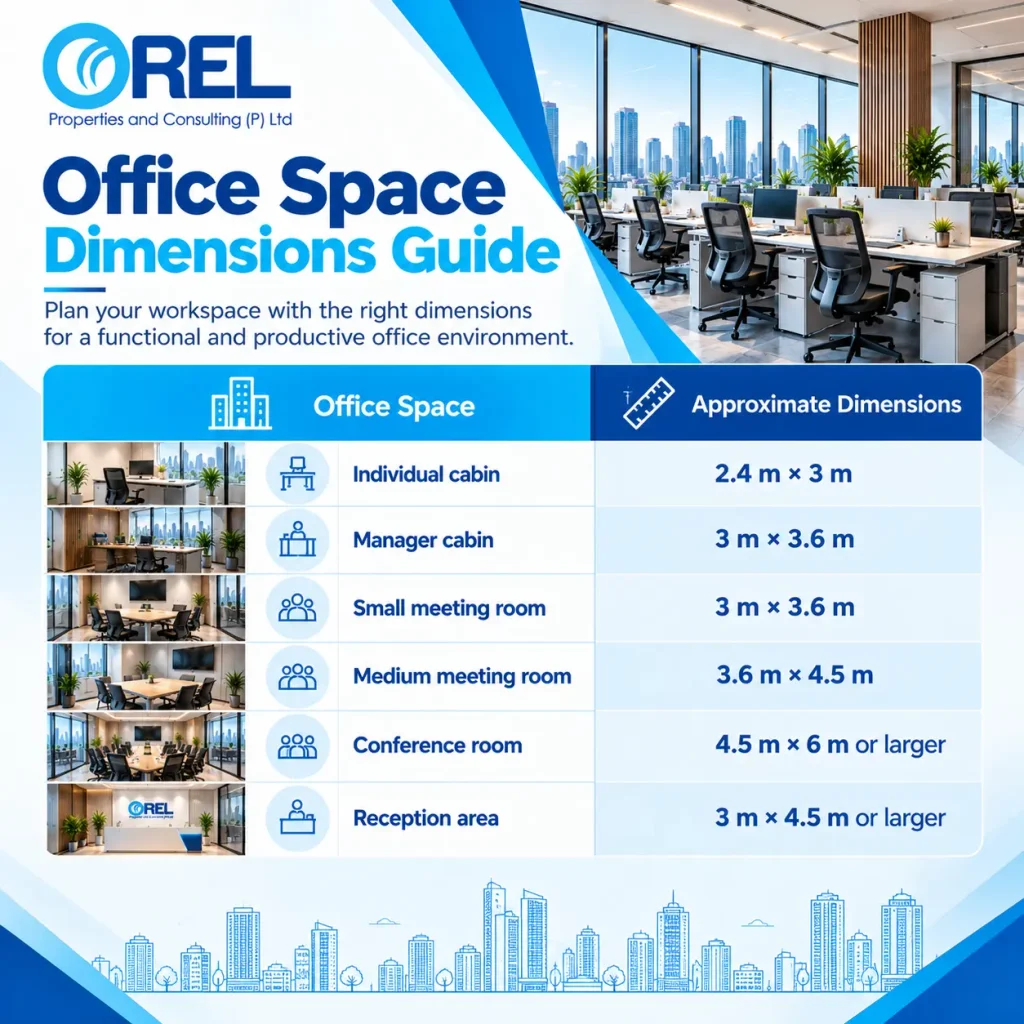
What Is the Standard Office Room Size in Meters?

There is no single standard office room size in meters because room dimensions depend on the purpose of the room, furniture, occupancy and circulation requirements.

As a general planning reference:

For example, a 3 m × 3 m room provides approximately 9 sq. m. of floor area, equivalent to approximately 97 sq. ft.

The actual room dimensions should be finalized based on the furniture layout, number of occupants and overall office design.

How Much Space Does One Employee Need at a Workstation?

The workstation itself generally occupies much less space than the total office allocation per employee.

A typical workstation may require approximately 4–6 sq. m., depending on the desk configuration, chair, storage and circulation.

The remaining space within the overall office allocation can accommodate:

  • Meeting rooms
  • Walkways
  • Collaboration areas
  • Reception
  • Pantry
  • Storage
  • Breakout areas

Therefore, when calculating your office space requirement, don’t calculate only the desk dimensions.

Office Space Requirement Based on Work Style

Your workplace model can significantly affect the amount of space you need.

Traditional Office

Employees have assigned workstations and typically work from the office every day.

Planning range: Approximately 85–100+ sq. ft. per employee. You can also use our Office Space Calculator to estimate your space requirements quickly and accurately.

Hybrid Office

Employees divide their working time between the office and remote locations.

A hybrid model may reduce the number of permanent workstations required.

Planning range: Approximately 100–120 sq. ft. per employee, depending on occupancy.

Hot-Desking Office

Employees use shared workstations instead of having permanently assigned desks.

This can reduce the total workspace required if office attendance is consistently below 100%

Coworking or Managed Office

Coworking and managed office solutions allow businesses to select workspace according to their current team size and scale as the company grows.

This can be useful for startups, growing companies and businesses that do not want to commit to a large conventional office.

What Are the Key Co Working Space Requirements?

When evaluating co working space requirements, businesses should look beyond the number of desks available.

Important factors include:

1. Number of Workstations

Determine how many employees need to work from the office at the same time.

2. Private Offices

Managers, leadership teams and client-facing employees may require private cabins.

3. Meeting Rooms

Consider how frequently your team conducts internal meetings, client meetings and presentations.

4. Internet Connectivity

Reliable, high-speed internet is essential for modern businesses, particularly IT and technology companies.

5. Power Backup

Power backup can help maintain business continuity.

6. Pantry and Breakout Areas

Employee amenities can improve workplace comfort and productivity.

7. Reception and Administrative Support

Managed and coworking offices may provide reception and administrative services.

8. Location and Accessibility

Employees and clients should be able to reach the workspace conveniently.

9. Parking

Adequate parking can be an important consideration for employees, clients and visitors.

10. Scalability

Choose a workspace that can accommodate future employee growth without requiring an immediate relocation.

How Much Office Space Does a 100-Person Company Need?

For 100 employees, a basic planning range is approximately 8500–10,000 sq. ft.

The final requirement depends on:

  • Number of permanent workstations
  • Hybrid working percentage
  • Number of cabins
  • Meeting-room requirements
  • Conference facilities
  • Employee amenities
  • Storage
  • Reception requirements
  • Future expansion

For a growing company, it can be more cost-effective to select a flexible office that allows additional space to be added later.

Should You Plan Office Space for Future Growth?

Yes.

One of the most common mistakes businesses make is choosing an office based only on their current employee count.

For example, if your company currently has 40 employees but expects to reach 60 employees within two years, planning for future growth can reduce the need for another relocation.

However, leasing significantly more space than you need can also increase your rental and operating costs.

The objective is to find the right balance between:

Current headcount + future growth + workplace model + business requirements.

Factors That Affect Your Office Space Requirement

The number of employees is only one factor.

Business Type

An IT company, consulting firm, financial services company and creative agency may all have different space requirements.

Employee Density

Higher-density layouts can accommodate more employees within a smaller footprint.

Meeting Room Requirements

Businesses that frequently meet clients may require additional meeting and conference rooms.

Hybrid Working

Hybrid work can reduce the number of permanently assigned workstations.

Employee Amenities

Pantries, lounges, breakout areas and collaboration spaces can increase the overall requirement.

Office Location

Location affects rental costs, employee commute, accessibility and client convenience.

For businesses in Chennai, proximity to major business districts, Metro connectivity, roads, public transport and other commercial infrastructure can be important when selecting an office.

Office Space Planning for Businesses in Chennai

Chennai has several established and emerging commercial business corridors suitable for companies looking for office space.

When evaluating a commercial office in Chennai, businesses should consider:

  • Connectivity to major roads
  • Metro and public transport access
  • Proximity to residential areas
  • Parking availability
  • Building quality
  • Office floor plate
  • Natural light and ventilation
  • Power backup
  • Security
  • Building amenities
  • Expansion possibilities

The right location can help businesses improve accessibility for employees and clients while supporting long-term growth.

Why Choosing the Right Office Size Matters

Choosing the right office size can help businesses manage both employee experience and occupancy costs.

An office that is too small may result in:

  • Crowded workstations
  • Insufficient meeting rooms
  • Poor circulation
  • Limited employee amenities
  • Lack of expansion space

An office that is too large can result in:

  • Higher rental costs
  • Higher maintenance expenses
  • Unused workspace
  • Increased operating costs

A well-planned office provides enough room for employees to work comfortably while avoiding unnecessary space.

How OREL Properties & Consulting Can Help

Finding the right commercial office space requires more than comparing rental prices.

OREL Properties & Consulting helps businesses explore commercial office spaces, coworking spaces and managed office solutions based on their business requirements.

Whether you need a compact office for a growing startup or a larger workspace for an established team, factors such as employee count, location, layout, amenities, accessibility and future expansion should be considered before making a decision.

If you are looking for office space for rent in Chennai, OREL Properties & Consulting can help you identify workspace options that align with your business requirements.

Looking for the right office space in Chennai? Contact OREL Properties & Consulting to discuss your requirements.

Frequently Asked Questions About Office Space Requirements

1. How much office space do I need per employee?

A practical starting point is 85–100 sq. ft. per employee. The actual requirement depends on the office layout, working model, meeting rooms, amenities and business type.

2. Is 70 sq. ft. per employee enough?

Yes, 70 sq. ft. per employee can work for a compact or high-density office, particularly when the company uses an efficient layout or hybrid working model. Businesses requiring more private rooms and amenities may need additional space.

3. How much office space do I need for 50 employees?

A 50-person company may require approximately 4,000–5000 sq. ft., based on 85-100 sq. ft. per employee.

4. How much office space do I need for 100 employees?

A 100-person company may require approximately 8500–10,000 sq. ft., depending on the office layout and workplace model.

5. What is the standard office room size in meters?

There is no universal standard. An individual office cabin may commonly be around 2.4 m × 3 m, while manager cabins and meeting rooms may require larger dimensions.

6. What are the main co working space requirements?

Key coworking requirements include adequate workstations, meeting rooms, reliable internet, power backup, reception, pantry facilities, breakout areas, parking and convenient accessibility.

7. Should I choose office space based only on employee count?

No. Employee count is only one factor. You should also consider meeting rooms, cabins, common areas, amenities, hybrid working and future employee growth.

8. How can I calculate my office space requirement?

Multiply your expected number of employees by your planned space per employee. You can also use our Office Space Calculator to estimate your space requirements quickly and accurately.

Example:

50 employees × 100 sq. ft. = 5,000 sq. ft.

Then adjust the requirement based on meeting rooms, cabins, amenities, circulation and future growth.

Conclusion

Determining your office space requirement is an important step when leasing or planning a workplace.

As a general starting point, businesses can consider 85–100 sq. ft. per employee. However, the ideal office size depends on your workforce, working style, business type, meeting requirements, amenities and future growth plans.

Whether you are considering a traditional office, coworking space or managed office, the goal should be to create a workspace that is comfortable, productive, scalable and cost-efficient.

For businesses searching for commercial office space in Chennai, OREL Properties & Consulting can help you explore workspace options based on your business requirements.

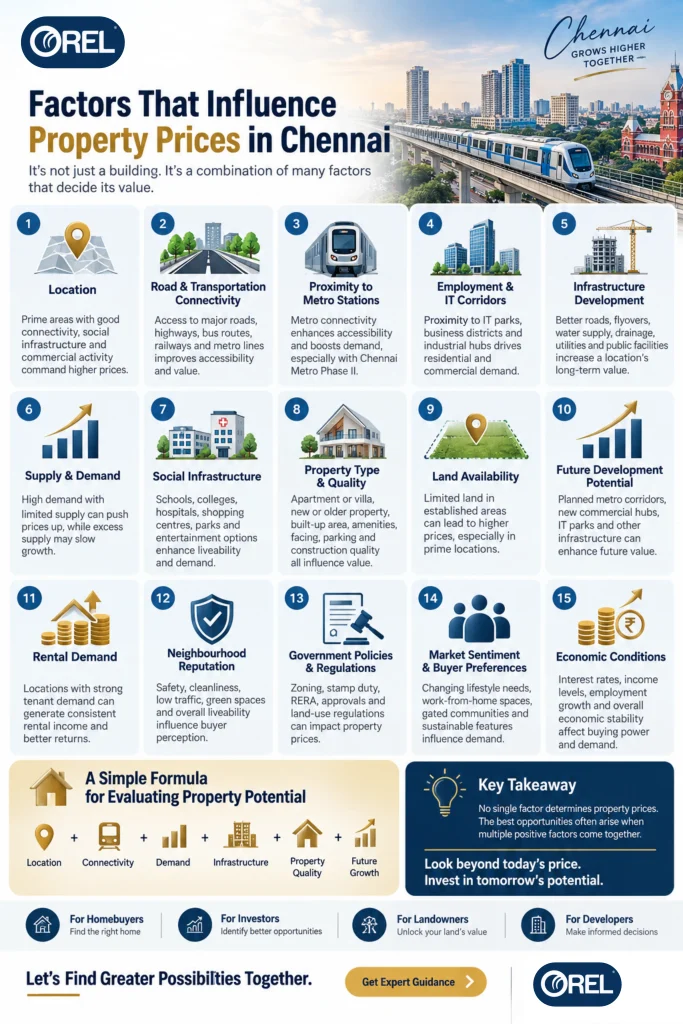
Factors That Influence Property Prices in Chennai


Chennai’s real estate market has evolved significantly over the years. From established residential neighbourhoods and premium localities to emerging IT corridors and infrastructure-led growth zones, property prices across the city can vary considerably.

But what actually determines the price of a property in Chennai?

The answer is not based on a single factor. Location, connectivity, infrastructure, demand, property type, neighbourhood development, employment opportunities, and future growth potential all influence property values.

For homebuyers, investors, landowners, and developers, understanding these factors can help in making more informed real estate decisions.

What Determines Property Prices in Chennai?

Property prices are generally influenced by a combination of the property’s location, physical characteristics, surrounding infrastructure, market demand, and future development prospects.

Some locations command a premium because they offer excellent connectivity and established social infrastructure, while emerging areas may attract buyers because of their future growth potential.

Here are some of the major factors that influence property prices in Chennai.

1. Location

Location is one of the most important factors influencing property prices in Chennai.

Properties in established neighbourhoods with good connectivity, social infrastructure, employment opportunities, and commercial activity generally attract stronger demand.

For example, areas close to major business districts, IT corridors, educational institutions, hospitals, shopping destinations, and transportation networks can command higher property values.

Location also affects the type of demand a property receives.

A residential property near an IT employment hub may appeal strongly to working professionals, while a property in a well-established family-oriented neighbourhood may attract long-term homeowners.

Therefore, when evaluating a property, it is important to look beyond the property itself and understand the characteristics of the surrounding location.

2. Road and Transportation Connectivity

Connectivity plays a major role in determining how attractive a location is to buyers and tenants.

Properties with convenient access to major roads, highways, bus routes, railway stations, and metro stations can benefit from improved accessibility.

Chennai’s expanding metro network is an important example. Chennai Metro Phase II is planned across 118.9 km with 128 stations and three corridors, connecting Madhavaram with SIPCOT, Lighthouse with Poonamallee Bypass, and Madhavaram with Sholinganallur. The project is proposed for completion by the end of 2028.

Infrastructure projects such as these can influence how people perceive the accessibility and future potential of surrounding neighbourhoods.

However, proximity to a metro station or major road should not automatically be considered a guarantee of price appreciation. The overall location, current demand, property pricing, and quality of infrastructure should also be evaluated.

3. Proximity to Metro Stations

Metro connectivity has become an increasingly relevant consideration for Chennai property buyers.

A metro station can improve access to employment centres, commercial districts, educational institutions, and other parts of the city.

Chennai Metro Rail Limited is also pursuing property development around certain metro locations. Current CMRL projects include property development near Thirumangalam Metro Station and integrated property development around several Phase II underground stations.

This demonstrates how transportation infrastructure and real estate development can increasingly complement each other.

For investors, the key question should not simply be “Is the property near a metro station?”

Instead, consider:

  • How convenient is the actual access?
  • Is the station operational or proposed?
  • What employment hubs can be reached?
  • What is the current property price?
  • Is rental demand strong?
  • What other infrastructure exists nearby?

4. Employment and IT Corridors

Employment opportunities are a major driver of residential demand.

Locations close to major IT parks, business districts, industrial clusters, and commercial hubs can attract professionals looking for homes closer to their workplaces.

Chennai’s established and emerging employment corridors have therefore played an important role in shaping residential and commercial real estate demand.

When a location attracts companies and employment opportunities, it can create demand for:

  • Apartments
  • Independent houses
  • Rental homes
  • Co-living spaces
  • Retail outlets
  • Restaurants
  • Office spaces
  • Commercial properties

This relationship between employment and housing demand is one reason investors should examine the economic activity surrounding a property before making a purchase.

5. Infrastructure Development

Infrastructure can significantly influence the long-term attractiveness of a neighbourhood.

Infrastructure includes much more than metro rail.

Important factors include:

  • Roads
  • Flyovers
  • Public transportation
  • Water supply
  • Drainage
  • Electricity
  • Sewage systems
  • Schools
  • Hospitals
  • Shopping facilities
  • Parks and recreational spaces

A location with improving infrastructure may become more attractive to buyers over time.

Chennai’s ongoing metro expansion is one example of large-scale infrastructure development. CMRL’s Phase II construction is currently progressing across multiple corridors, while the organisation is also planning associated property-development projects.

6. Supply and Demand

Basic market economics also influences property prices.

When demand for properties in a particular location is high while available supply is limited, prices may experience upward pressure.

On the other hand, locations with significant property supply but limited buyer or tenant demand may experience slower price growth.

Demand can be influenced by several factors, including:

  • Population growth
  • Employment opportunities
  • New infrastructure
  • Migration
  • Rental demand
  • Educational institutions
  • Commercial development
  • Lifestyle preferences

Understanding the balance between supply and demand is therefore important before investing.

7. Social Infrastructure

People don’t buy homes only for the building. They also buy into the surrounding lifestyle and convenience.

The availability of schools, colleges, hospitals, supermarkets, restaurants, shopping centres, banks, parks, and entertainment facilities can influence property demand.

Families, in particular, may prioritise access to reputed schools and healthcare facilities.

Similarly, younger professionals may place greater importance on restaurants, shopping, entertainment, public transportation, and proximity to workplaces.

A neighbourhood with well-developed social infrastructure can therefore command stronger buyer interest.

8. Property Type and Quality

Not all properties in the same location have the same value.

Property prices can vary depending on:

  • Apartment vs independent house
  • New construction vs older property
  • Built-up area
  • Land area
  • Floor level
  • Facing
  • Parking availability
  • Construction quality
  • Amenities
  • Age of the building
  • Maintenance
  • Layout and design

For example, two apartments located in the same neighbourhood can have significantly different prices because of differences in construction quality, amenities, floor area, parking, or building age.

Therefore, location should always be evaluated together with the property’s physical characteristics.

9. Land Availability

Land availability is another important factor affecting property prices.

In established parts of Chennai, vacant land can be limited. When demand remains strong and land supply is restricted, land prices can become significantly higher.

This is particularly relevant for prime residential and commercial locations.

The availability of larger plots can also influence development opportunities. Developers may place a premium on strategically located land that offers suitable access, development potential, and favourable surrounding infrastructure.

10. Future Development Potential

A property’s current surroundings are important, but its future surroundings can be equally significant.

Before investing, buyers should examine planned or ongoing developments such as:

  • Metro corridors
  • Road expansion
  • New commercial hubs
  • IT parks
  • Educational institutions
  • Hospitals
  • Industrial developments
  • Transit hubs
  • Retail developments

However, investors should distinguish between officially approved projects and unverified future proposals.

For example, CMRL currently publishes official project information, tenders, environmental documents, and property-development initiatives related to Phase II. Buyers should rely on verified sources rather than marketing claims when assessing future infrastructure.

11. Rental Demand

Rental potential is an important consideration for investors.

A property located near employment hubs, educational institutions, transportation networks, and commercial areas may have a larger potential tenant pool.

Rental demand can influence an investor’s decision because a property generating consistent rental income may provide an additional return alongside potential long-term appreciation.

However, investors should calculate rental yield rather than assuming that high property prices automatically mean high rental returns.

Consider:

Annual Rental Income ÷ Property Purchase Price × 100 = Gross Rental Yield

Maintenance costs, property taxes, vacancy periods, and other expenses should also be considered when evaluating the actual return.

12. Neighbourhood Reputation and Liveability

The overall reputation of a neighbourhood can influence buyer perception.

Factors such as:

  • Safety
  • Cleanliness
  • Traffic
  • Noise levels
  • Flooding risk
  • Water availability
  • Green spaces
  • Community environment
  • Road conditions

can all affect how desirable a location is.

Two properties with similar specifications can command very different prices if they are located in neighbourhoods with different levels of liveability.

13. Government Policies and Regulations

Government policies and regulations can also influence the real estate market.

Changes related to:

  • Development regulations
  • Zoning
  • Stamp duty
  • Registration
  • Building approvals
  • RERA requirements
  • Infrastructure policies
  • Land-use regulations

can affect development costs, buyer decisions, and property values.

Homebuyers should therefore ensure that a property has the necessary approvals and documentation before making a purchase.

14. Market Sentiment and Buyer Preferences

Real estate markets are also influenced by changing buyer preferences.

For example, buyers may increasingly look for:

  • Gated communities
  • Larger homes
  • Work-from-home spaces
  • Premium amenities
  • Sustainable features
  • Better connectivity
  • Security
  • Smart-home features

Market research can help identify changing consumer behaviour and demand patterns. Knight Frank India, for example, maintains ongoing research covering residential trends, market assessment, demand estimation, and consumer behaviour.

Understanding what buyers actually want can be just as important as looking at historical property prices.

15. Economic Conditions

The broader economy can also affect real estate prices.

Factors such as:

  • Interest rates
  • Employment growth
  • Income levels
  • Inflation
  • Credit availability
  • Business activity
  • Consumer confidence

can influence people’s ability and willingness to purchase property.

When employment and income prospects are strong, housing demand may increase. Conversely, economic uncertainty can make buyers more cautious.

How Can You Evaluate Whether a Chennai Property Is Fairly Priced?

Before purchasing a property, don’t look only at the quoted price.

Evaluate the property using multiple parameters:

Location

Is the property located in an established or emerging growth area?

Connectivity

How easily can residents access major roads, metro stations, railway stations, and employment hubs?

Comparable Prices

How does the asking price compare with similar properties nearby?

Rental Potential

What rent can the property realistically generate?

Infrastructure

Are roads, drainage, water supply, schools, hospitals, and other facilities available?

Future Development

Are there officially planned infrastructure or commercial projects nearby?

Property Quality

What is the age, construction quality, layout, maintenance condition, and amenity offering?

Legal Documentation

Are the title, approvals, encumbrance records, and other relevant documents in order?

A Simple Formula for Evaluating Property Potential

A useful way to think about property value is:

Property Potential = Location + Connectivity + Demand + Infrastructure + Property Quality + Future Growth

No single factor determines the future value of a property.

A premium location with poor infrastructure may have limitations. Similarly, an emerging location with excellent future infrastructure may offer potential but also involve greater uncertainty.

The best opportunities often arise when several positive factors come together.

Chennai’s Real Estate Market: Looking Beyond Today’s Price

Chennai continues to attract residential and commercial real estate interest, and current market research continues to track residential and office trends across the city’s evolving market. Knight Frank India’s H1 2026 research includes Chennai among the major Indian markets covered in its residential and office analysis.

At the same time, infrastructure investment continues to reshape the city’s connectivity. Chennai Metro Phase II is a significant example, with 118.9 km of planned network and 128 stations across three corridors.

For buyers and investors, this means that evaluating a property requires looking beyond today’s price.

The right question is not simply “How much does this property cost?”

It is:

“What factors support this property’s current value, and what could influence its value in the future?”

Final Thoughts

Property prices in Chennai are influenced by a combination of location, connectivity, infrastructure, employment opportunities, supply and demand, social infrastructure, property quality, rental demand, land availability, and future development potential.

While no factor can guarantee property appreciation, understanding these influences can help buyers make more informed decisions.

For investors, the goal should not simply be to find the cheapest property. Instead, look for the right combination of price, location, demand, connectivity, quality, and long-term potential.

At OREL Properties and Consulting Pvt Ltd, we help buyers, investors, landowners, and developers evaluate real estate opportunities based on location, market potential, connectivity, and long-term value.

Whether you are looking for residential property, commercial space, land, or a strategic real estate investment in Chennai, understanding the factors behind property pricing is the first step towards making a smarter decision.

Why Apartments Near Chennai’s IT Corridors Continue to Outperform the Real Estate Market


Imagine buying a home today that not only gives you a comfortable lifestyle but also grows in value year after year while generating strong rental income. That’s exactly why apartments near Chennai’s IT corridors have become one of the city’s most reliable real estate investments.

Unlike speculative property markets, IT-driven residential zones grow because of one simple factor—people. Every new technology company, office expansion, and employment opportunity creates a fresh demand for housing. When jobs increase, homes become valuable.

At OREL Properties and Consulting Pvt Ltd, we’ve observed a clear trend: residential properties located within a 5–10 km radius of Chennai’s major IT hubs consistently attract stronger buyer interest, lower vacancy rates, and better long-term appreciation than many other locations.

The IT Ecosystem: The Real Engine Behind Property Appreciation

Many people think real estate prices rise because of infrastructure alone. In reality, infrastructure follows employment.

Every time an IT park expands or a multinational company establishes a new campus, thousands of professionals begin searching for homes nearby. This demand fuels:

  • Higher apartment prices
  • Faster project sales
  • Better rental occupancy
  • Improved civic infrastructure
  • Growth of schools, hospitals, malls, and entertainment hubs

This cycle repeats itself, creating sustainable appreciation rather than short-term price spikes.

The “20-Minute Lifestyle” Is Changing Homebuying Decisions

Today’s homebuyers value time as much as money.

Most professionals prefer living within a short commute rather than spending hours in traffic. Apartments close to IT corridors allow residents to reach offices, schools, healthcare facilities, shopping centres, and recreational spaces within 20 minutes.

This lifestyle advantage has become one of the strongest drivers of residential demand across Chennai.

Chennai’s High-Performance Residential Corridors

OMR – The Technology Growth Belt

OMR continues to be Chennai’s largest technology corridor, home to global IT companies, business parks, and innovation centres.

Why buyers choose OMR:

  • Continuous employment growth
  • Premium gated communities
  • Upcoming Metro connectivity
  • High rental demand
  • Excellent social infrastructure

Investment hotspots include Sholinganallur, Perungudi, Navalur, and Siruseri. The Large IT Campus developments in this corridor are TATA Ramanujam IT Park, TIDEL, Golbal infocity, WTC, Brookfields Milliena and also Large IT captive campuses of Infosys, TCS, Hexaware, Cognizant etc, are also situvated.

Guindy & Velachery – Central Connectivity Meets Corporate Growth

Professionals working in Guindy prefer living close to their workplaces due to excellent road, rail, and Metro connectivity.

The area offers:

  • Mature residential neighborhoods
  • Premium apartment projects
  • Strong resale demand
  • High-end lifestyle amenities
  • In this pocket Olympia Tech park, Cyberhub, upcoming Baashyam project along with multiple standalone buildings of SKCL, Kochar and RR Group make this a preferred in City IT destination along with fully developed infrastructure.
Why Apartments Near Chennai's IT Corridors
Why Apartments Near Chennai’s IT Corridors

Porur & Mount-Poonamallee Corridor – Chennai’s Emerging Business Zone

With leading IT parks, healthcare institutions, and commercial developments, this corridor has rapidly transformed into a preferred residential destination.

Investors benefit from:

  • Competitive entry prices
  • Excellent appreciation potential
  • Growing rental market
  • Improved road connectivity
  • The major IT campuses are DLF Cybercity , RMZ One paramount, Raheja Commerzone, ASV, FinCity , Casagrand along with massive upcoming projects making this corridor a major IT hub.

Ambattur & Anna Nagar West – The New Investment Opportunity

Once known primarily for manufacturing, Ambattur has evolved into a modern employment hub with IT companies, industrial parks, and commercial developments.

Combined with Anna Nagar’s premium residential appeal, the region offers a balanced mix of affordability and long-term growth.

Notable developments IT PRojects in this region include Ambit IT park, Arihant tech park and Hexaware campus. The upcoming IT Buildings from Voora and GK shetty developers with add to the exsisitng developed IT infrastructure in this location.

What Makes IT Corridor Apartments a Safer Investment?

Unlike seasonal real estate markets, IT-driven locations create consistent housing demand throughout the year.

Key advantages include:

Stable Rental Income

Apartments near IT hubs attract working professionals, reducing vacancy periods and providing dependable rental returns.

Better Capital Growth

As employment expands and infrastructure improves, property values generally increase steadily over time.

Easier Resale

Homes in established IT corridors often appeal to both investors and end-users, making resale easier than in isolated locations.

Superior Lifestyle

Residents enjoy access to quality schools, hospitals, shopping malls, restaurants, fitness centres, and entertainment options—all within close proximity.

Metro Expansion Is Creating the Next Wave of Growth

The ongoing Chennai Metro Phase II project is expected to strengthen connectivity between residential neighbourhoods and employment centres.

For investors, this means:

  • Reduced commute times
  • Increased buyer demand
  • Improved accessibility
  • Higher future appreciation potential

Properties purchased before major infrastructure becomes fully operational often experience stronger long-term value growth.

Choosing the Right Apartment: Think Beyond the Price

A lower price does not always mean a better investment.

Before purchasing, evaluate:

  • Distance from major employment hubs
  • Builder credibility
  • RERA compliance
  • Quality of construction
  • Rental demand
  • Future infrastructure projects
  • Community amenities
  • Connectivity to Metro and arterial roads

A well-located apartment can outperform a cheaper property in a less strategic location over the long term.

How OREL Properties and Consulting Pvt Ltd Helps You Invest Smarter

At OREL Properties and Consulting Pvt Ltd, we don’t simply recommend apartments—we analyse market trends, infrastructure growth, employment patterns, rental demand, and appreciation potential to help clients make confident investment decisions.

Our services include:

  • Personalised property consultation
  • Residential investment planning
  • Premium apartment recommendations
  • Builder and project evaluation
  • Legal and documentation assistance
  • Site visits and negotiation support
  • End-to-end property buying guidance

Whether you’re purchasing your first home or expanding your investment portfolio, our experienced consultants help you choose properties with lasting value.

Final Thoughts

Successful real estate investing isn’t about buying the cheapest apartment—it’s about buying in the right location at the right time.

Chennai’s IT corridors continue to reshape the city’s residential landscape by creating sustained demand, improving infrastructure, and attracting long-term investment.

If you’re looking for an apartment that offers modern living, excellent rental potential, and strong appreciation prospects, investing near Chennai’s IT corridors could be one of your smartest financial decisions.

Understanding RERA Guidelines for Homebuyers in Tamil Nadu


Buying a home is one of the biggest financial decisions anyone makes. Whether you’re purchasing your first apartment, investing in a villa, or buying residential land, understanding the legal framework is essential. One of the most important regulations protecting homebuyers today is the Real Estate (Regulation and Development) Act (RERA).

If you’re planning to invest in Tamil Nadu real estate, knowing the RERA guidelines for homebuyers can help you avoid fraud, delayed projects, hidden charges, and legal disputes.

At OREL Properties and Consulting Pvt Ltd, we believe informed buyers make better investment decisions. This guide explains everything you need to know about Tamil Nadu RERA, your rights as a buyer, and how RERA ensures transparency in real estate transactions.

What is RERA?

The Real Estate (Regulation and Development) Act, 2016 (RERA) was introduced by the Government of India to regulate the real estate sector and protect homebuyers.

In Tamil Nadu, the act is implemented through the Tamil Nadu Real Estate Regulatory Authority (TNRERA).

The primary objective of RERA is to:

  • Increase transparency
  • Ensure timely project completion
  • Protect buyers from unfair practices
  • Improve accountability among developers
  • Standardize real estate transactions

Today, buying a RERA-approved property offers significantly greater legal protection compared to unregistered projects.

Why RERA Matters for Homebuyers ?

Before RERA, buyers often faced issues such as:

  • Project delays
  • False advertisements
  • Hidden costs
  • Unauthorized changes in layouts
  • Poor construction quality
  • Lack of legal accountability

RERA has addressed these challenges by making developers legally responsible for fulfilling their commitments.

For buyers in Chennai and across Tamil Nadu, this means greater confidence and reduced investment risk.

Understanding RERA Guidelines for Homebuyers in Tamil Nadu

Key RERA Guidelines Every Homebuyer Should Know

1. Every Eligible Project Must Be Registered

Residential and commercial projects that meet the registration criteria must be registered with TNRERA before being marketed or sold. The current registration criteria is real estate project registration with TNRERA is mandatory for all residential and commercial projects where the total land area exceeds 500 square meters or the number of proposed apartments exceeds eight units across all phases.

A registered project receives a unique RERA registration number.

Always verify this number before making any payment.

2. Complete Project Information Must Be Public

Developers are required to disclose important project details, including:

  • Approved building plans
  • Land ownership documents
  • Government approvals
  • Construction progress
  • Project completion timeline
  • Number of units
  • Amenities offered

This ensures buyers have access to accurate and verified information.

3. Carpet Area Must Be Clearly Defined

RERA standardizes the definition of carpet area, ensuring buyers pay only for the usable internal area of the apartment.

This eliminates confusion caused by varying methods of calculating built-up or super built-up areas.

4. Developers Must Follow the Promised Timeline

One of RERA’s biggest advantages is accountability for project completion.

If a builder fails to deliver possession within the committed timeframe without valid reasons, buyers may be entitled to compensation as provided under the Act.

5. Advance Payment is Regulated

Builders cannot demand a large advance before signing a formal sale agreement.

This protects buyers from making substantial payments without proper legal documentation.

6. Changes Require Buyer Consent

Developers cannot make major changes to:

  • Apartment layout
  • Floor plan
  • Building specifications
  • Common amenities

without obtaining the required consent from affected buyers, as applicable under RERA.

7. Complaint Resolution Mechanism

If a buyer experiences issues such as:

  • Delay in possession
  • False promises
  • Construction defects
  • Agreement violations

they can file a complaint before the appropriate RERA authority for resolution.

How to Verify a RERA-Registered Project

Before investing, follow these simple steps:

Check the Project Registration

Verify the project’s RERA registration number.

Review Legal Documents

Check approvals, ownership records, and project documentation.

Examine Construction Progress

Compare the actual site progress with the developer’s updates.

Read Project Details Carefully

Review:

  • Completion date
  • Unit specifications
  • Amenities
  • Building plans

Consult a Trusted Real Estate Consultant

Professional guidance helps identify potential risks and ensures informed decision-making.

Benefits of Buying a RERA – approved Property

Greater Transparency

All project details are publicly available, reducing misinformation.

Legal Protection

Buyers have access to a structured legal framework for dispute resolution.

Timely Delivery

Developers are accountable for meeting declared project timelines.

Reduced Risk

Registered projects are subject to regulatory oversight, improving buyer confidence.

Better Financial Planning

Clear agreements and regulated payment structures help avoid unexpected expenses.

Documents Every Homebuyer Should Verify

Before purchasing property, ensure you review, the below (indicative list):

  • RERA Registration Certificate
  • Sale Agreement
  • Title Documents
  • Building Plan Approval
  • Completion Timeline
  • Occupancy Certificate (when applicable)
  • Encumbrance Certificate
  • Property Tax Records
  • Bank Approval (if applicable)

Proper document verification and detailed due diligence helps prevent future legal complications.

Common Mistakes Homebuyers Should Avoid

Many buyers make avoidable mistakes, including:

  • Purchasing without verifying RERA registration
  • Ignoring legal documentation
  • Focusing only on price
  • Not checking the builder’s track record
  • Skipping site visits
  • Overlooking project completion timelines
  • Not understanding the sale agreement

Conducting thorough due diligence can significantly reduce investment risks.

Conclusion

Understanding the RERA guidelines for homebuyers in Tamil Nadu is essential for making a safe and informed property purchase. RERA has transformed the real estate sector by promoting transparency, accountability, and buyer protection.

Whether you’re purchasing your dream home or making a long-term investment, choosing a compliant project and seeking professional guidance can make all the difference.

OREL Properties and Consulting Pvt Ltd is committed to helping buyers navigate the property market with confidence. From identifying quality developments to supporting due diligence, our team is here to help you make secure and rewarding real estate investments in Chennai and across Tamil Nadu.

How Location Impacts Property Value in Chennai


When buying a property, one golden rule remains unchanged: Location is the most important factor. Whether you’re purchasing a luxury apartment, an independent villa, a commercial office, or a residential plot, the location significantly determines its current value and future appreciation.

Chennai’s real estate market has transformed rapidly over the past decade. Infrastructure development, metro connectivity, IT corridors, educational institutions, and commercial hubs have reshaped the city’s property landscape. Choosing the right location today can lead to substantial returns tomorrow.

At OREL Properties and Consulting Pvt Ltd, we help buyers and investors identify high-potential locations across Chennai that offer excellent value, lifestyle benefits, and long-term growth.

Why Location Matters in Real Estate

A property’s structure depreciates over time, but land value appreciates, especially in prime locations.

Location affects:

  • Property price
  • Rental income
  • Appreciation potential
  • Buyer demand
  • Resale value
  • Lifestyle convenience
  • Investment returns

Two identical apartments can differ in price by several lakhs simply because of their location.

1. Connectivity Increases Property Value

Easy access to transportation is one of the strongest drivers of property appreciation.

Properties located near:

  • Metro stations
  • Railway stations
  • Bus terminals
  • National highways
  • Outer Ring Road (ORR)
  • Chennai Bypass
  • Airport

typically experience higher demand and better resale value.

Chennai Locations Benefiting from Connectivity

  • Anna Nagar
  • Kilpauk
  • Velachery
  • Porur
  • Guindy
  • Sholinganallur
  • Perungudi
  • Tambaram
  • Pallavaram
  • Madhavaram

The ongoing expansion of Chennai Metro Phase 2 is expected to further boost property values in many emerging neighborhoods.

2. Proximity to IT Parks Creates Strong Demand

Employment hubs directly influence residential property prices.

Thousands of professionals prefer living close to their workplaces to reduce commuting time.

Major IT corridors include:

  • OMR (Old Mahabalipuram Road)
  • ECR
  • Siruseri SIPCOT
  • Guindy
  • Perungudi
  • Taramani
  • Ramanujan IT City

Nearby residential areas continue witnessing consistent appreciation because of growing housing demand.

Benefits include:

  • Better rental income
  • Low vacancy rates
  • Higher resale demand
  • Long-term appreciation

3. Educational Institutions Improve Property Demand

Families prioritize locations near reputed schools and colleges.

Properties close to educational institutions attract:

  • Homebuyers
  • Working professionals
  • Students
  • Investors seeking rental income

Areas such as:

  • Adyar
  • Anna Nagar
  • Kilpauk
  • Velachery
  • Tambaram

remain highly desirable because of educational infrastructure.

4. Healthcare Infrastructure Adds Value

Access to quality healthcare is another major factor influencing buyer decisions.

Locations near leading hospitals often command premium prices.

Examples include:

  • Kilpauk
  • Nungambakkam
  • Adyar
  • Porur
  • Guindy

Nearby hospitals provide convenience, safety, and long-term livability.

5. Commercial Development Drives Appreciation

Whenever commercial activity increases, surrounding residential property values often rise.

Examples include:

  • Business parks
  • Shopping malls
  • Retail centers
  • Corporate offices
  • Entertainment zones

Commercial growth creates employment, improves infrastructure, and increases demand for nearby housing.

6. Infrastructure Projects Increase Future Property Value

Infrastructure developments often trigger rapid appreciation.

Examples include:

  • Chennai Metro Rail Expansion
  • Outer Ring Road
  • Elevated Corridors
  • New Flyovers
  • Smart City Projects
  • Industrial Corridors

Properties purchased before project completion generally witness stronger capital appreciation.

This is why investors closely monitor upcoming government infrastructure initiatives.

How Location Impacts Property Value in Chennai (2)

7. Safety and Neighborhood Quality Matter

A premium neighborhood attracts premium buyers.

Factors include:

  • Wide roads
  • Clean surroundings
  • Low crime rate
  • Green spaces
  • Well-maintained streets
  • Gated communities
  • Reliable civic amenities

Locations with better living standards consistently retain higher property values.

8. Social Infrastructure Makes a Big Difference

People prefer neighborhoods that provide daily conveniences.

Look for areas with:

  • Supermarkets
  • Restaurants
  • Banks
  • Parks
  • Shopping malls
  • Fitness centers
  • Entertainment options

The more convenient the lifestyle, the higher the property demand.

9. Rental Potential Depends on Location

Rental yield is heavily influenced by location.

Areas close to:

  • IT companies
  • Colleges
  • Hospitals
  • Commercial hubs
  • Industrial zones

usually generate stronger rental income.

Popular rental locations include:

  • OMR
  • Perungudi
  • Velachery
  • Guindy
  • Sholinganallur
  • Pallikaranai

Investors should evaluate both rental demand and future appreciation before purchasing.

10. Future Growth Potential Is Key

Many buyers focus only on today’s property prices.

Smart investors evaluate future development.

Questions to ask include:

  • Is a metro station planned nearby?
  • Are new roads being constructed?
  • Is commercial development increasing?
  • Are reputed builders entering the area?
  • Is the government investing in infrastructure?

Buying early in emerging locations often delivers better long-term returns.

Prime Locations in Chennai with Strong Appreciation Potential

Anna Nagar

A premium residential destination with excellent connectivity, reputed schools, hospitals, and commercial establishments.

Best for:

  • Luxury homes
  • Commercial properties
  • Long-term investment

Kilpauk

A centrally located neighborhood with strong residential demand, educational institutions, and healthcare facilities.

Best for:

  • Independent houses
  • Residential plots
  • Boutique commercial developments

OMR

One of Chennai’s fastest-growing real estate corridors.

Best for:

  • Apartments
  • Rental investments
  • IT professionals

Porur

Benefiting from metro expansion, improved road connectivity, and commercial development.

Best for:

  • Families
  • First-time buyers
  • Long-term appreciation

Sholinganallur

A preferred destination for professionals working in the IT sector.

Best for:

  • Rental income
  • Apartments
  • Investors

Madhavaram

An emerging hotspot driven by metro connectivity and infrastructure improvements.

Best for:

  • Early-stage investment
  • Residential plots
  • Future appreciation

Common Mistakes Buyers Make

Avoid these common errors:

  • Choosing the cheapest property instead of the best location.
  • Ignoring future infrastructure projects.
  • Not checking neighborhood development plans.
  • Overlooking commute times.
  • Focusing only on the building rather than the surrounding area.
  • Ignoring rental demand.
  • Buying without understanding local market trends.

How OREL Properties Helps You Choose the Right Location

At OREL Properties and Consulting Pvt Ltd, we understand that buying property is more than selecting a home—it’s making a long-term investment.

Our experienced consultants help clients:

  • Identify high-growth investment locations
  • Compare residential and commercial properties
  • Evaluate future appreciation potential
  • Analyze rental income opportunities
  • Verify legal documentation
  • Find premium properties across Chennai

Whether you’re buying your first home, investing in land, or expanding your commercial portfolio, our local expertise ensures you make informed decisions.

Conclusion

Location remains the single most important factor influencing property value in Chennai. A well-located property offers better appreciation, stronger rental income, improved resale potential, and a higher quality of life.

As Chennai continues to grow through expanding infrastructure, metro connectivity, and commercial development, investing in the right location today can lead to significant returns in the future.

With expert guidance from OREL Properties and Consulting Pvt Ltd, you can confidently identify properties that align with your investment goals and lifestyle needs.

Pre-Launch vs Ready-to-Move Properties: Which Is Better?


Introduction

Buying a property is one of the most important financial decisions you will make. Whether you are a first-time homebuyer, an investor, or someone upgrading to a better lifestyle, one question often arises: Should you buy a pre-launch property or a ready-to-move property?

Both options have their advantages and challenges. The right choice depends on your budget, investment goals, risk appetite, and timeline. At OREL Properties and Consulting Pvt Ltd, we help buyers make informed real estate decisions by evaluating every aspect of a property purchase.

In this guide, we compare pre-launch vs ready-to-move properties to help you decide which option is better for your needs.

What Is a Pre-Launch Property?

A pre-launch property is a project that is announced by the developer before construction is completed, and sometimes even before construction begins. Builders often offer attractive prices during this phase to generate initial funding and market interest.

Key features of pre-launch properties

  • Lower initial pricing
  • Flexible payment plans
  • Potential for price appreciation
  • Opportunity to choose preferred units

What Is a Ready-to-Move Property?

A ready-to-move property is a completed property that is available for immediate possession. Buyers can inspect the property, verify construction quality, and move in soon after completing the purchase process.

Key features of ready-to-move properties

  • Immediate possession
  • No construction uncertainty
  • Existing infrastructure and amenities
  • Easier property evaluation

Advantages of Buying a Pre-Launch Property

Lower purchase price

One of the biggest advantages is the discounted pricing offered during the pre-launch stage. Buyers may purchase the property at a significantly lower rate compared to future project phases.

Higher appreciation potential

If the project is located in a developing area with upcoming infrastructure, the property value can increase substantially by the time construction is completed.

Better unit selection

Early buyers often have access to the best units in terms of:

  • Floor level
  • View
  • Ventilation
  • Corner units
  • Parking options
Pre-Launch VS Ready to Move

Flexible payment options

Many developers provide construction-linked payment plans, reducing the immediate financial burden.

Risks of Buying a Pre-Launch Property

Construction delays

Project completion may take several years, affecting possession timelines.

Regulatory risks

Always verify:

  • RERA registration
  • Land approvals
  • Building permissions
  • Developer credibility

Market uncertainty

Future appreciation depends on market conditions, infrastructure development, and demand in the location.

Advantages of Buying a Ready-to-Move Property

Immediate possession

This is ideal for families who need a home immediately or investors seeking rental income.

No construction risk

You know exactly what you are buying. There is no uncertainty regarding project completion.

Easier financing

Banks generally process loans more comfortably for completed projects with clear documentation.

Better decision-making

You can inspect:

  • Construction quality
  • Common areas
  • Amenities
  • Neighborhood
  • Traffic conditions
  • Water availability

Disadvantages of Ready-to-Move Properties

Higher purchase price

Completed properties often cost more than pre-launch units in the same project.

Limited inventory

Popular configurations and premium units may already be sold.

Lower appreciation potential

A significant portion of the appreciation may have already occurred during construction.

Which Option Is Better for Investors?

For investors, pre-launch properties can offer higher returns if:

  • The developer has a strong reputation
  • The project is RERA-approved
  • The location has growth potential
  • Infrastructure development is planned nearby

Areas near metro corridors, IT parks, commercial hubs, and upcoming transportation projects often provide better appreciation opportunities.

Which Option Is Better for End Users?

For homebuyers who plan to live in the property, ready-to-move homes are often the safer choice because they provide:

  • Immediate occupancy
  • Better transparency
  • Reduced financial uncertainty
  • No waiting period

Chennai Real Estate Perspective

In Chennai, the choice between pre-launch and ready-to-move depends heavily on location.

Pre-launch may be attractive in

  • Emerging suburban corridors
  • Metro expansion zones
  • New IT and industrial corridors
  • Infrastructure-driven growth areas

Ready-to-move may be preferable in

  • Anna Nagar
  • Kilpauk
  • Nungambakkam
  • Adyar
  • Velachery
  • Established residential neighborhoods

These locations offer established social infrastructure, schools, hospitals, transport connectivity, and stronger rental demand.

A Smart Buyer’s Checklist

Before purchasing a pre-launch property:

  • Verify RERA registration
  • Check developer track record
  • Review legal approvals
  • Understand payment schedules
  • Evaluate project completion history

Before purchasing a ready-to-move property:

  • Inspect the property personally
  • Verify completion certificate
  • Check occupancy certificate
  • Review maintenance costs
  • Confirm title documents

How OREL Properties and Consulting Pvt Ltd Can Help

Choosing between a pre-launch and a ready-to-move property requires market knowledge, legal verification, financial analysis, and location assessment.

OREL Properties and Consulting Pvt Ltd provides:

  • Property investment consulting
  • Residential property buying assistance
  • Comparative market analysis
  • Legal due diligence support
  • RERA verification
  • End-to-end property consulting services

Our experts help you evaluate both investment potential and long-term livability before making a purchase decision.

Conclusion

There is no universal answer to whether pre-launch or ready-to-move properties are better. The ideal choice depends on your financial goals.

Choose a pre-launch property if you want lower pricing, higher appreciation potential, and can wait for possession.

Choose a ready-to-move property if you want immediate occupancy, lower risk, and greater transparency.

The best investment is not simply the cheaper property—it is the property that aligns with your long-term objectives. With expert guidance from OREL Properties and Consulting Pvt Ltd, you can make a confident and profitable real estate decision in Chennai.

Luxury Living in Chennai: What Defines a Premium Home?


The concept of luxury living has evolved significantly over the years. Today, a premium home is not just about spacious interiors or an upscale address—it is about a complete lifestyle experience. Chennai, one of India’s fastest-growing metropolitan cities, has witnessed a remarkable rise in luxury residential developments that cater to the aspirations of high-net-worth individuals, business professionals, and discerning homebuyers.

From beachfront residences along East Coast Road to ultra-modern apartments in emerging business districts, luxury homes in Chennai offer a blend of comfort, exclusivity, convenience, and long-term value. But what exactly defines a premium home in Chennai?

In this blog, OREL Properties and Consulting Pvt Ltd explores the essential elements that make a property truly luxurious and why premium residential investments continue to attract buyers across the city.

The Growing Demand for Luxury Homes in Chennai

The luxury real estate market in Chennai has experienced steady growth due to increasing disposable incomes, infrastructure development, and changing lifestyle preferences. Homebuyers today seek properties that provide privacy, security, wellness amenities, and seamless connectivity to major business hubs.

Whether it is an elegant villa, a penthouse, or a high-rise luxury apartment, premium housing projects are designed to deliver an unmatched living experience while serving as valuable long-term assets.

Prime Location: The Foundation of Luxury Living

One of the most important characteristics of a premium home is its location. Luxury properties are typically situated in highly sought-after neighborhoods that offer excellent connectivity, social infrastructure, and exclusivity.

Popular Luxury Residential Locations in Chennai

  • Boat Club Road
  • Poes Garden
  • Adyar
  • Besant Nagar
  • ECR (East Coast Road)
  • OMR (Old Mahabalipuram Road)
  • Anna Nagar
  • Nungambakkam
  • Alwarpet

These areas offer proximity to business districts, premium schools, healthcare facilities, shopping destinations, and entertainment centers, making them ideal for luxury living.

Spacious and Thoughtfully Designed Interiors

A premium home is characterized by superior architectural planning and efficient space utilization. Luxury homebuyers prioritize comfort, aesthetics, and functionality.

Key Interior Features

  • Large living and dining spaces
  • High ceilings for enhanced ventilation
  • Floor-to-ceiling windows
  • Premium flooring materials
  • Designer kitchens
  • Walk-in wardrobes
  • Spacious balconies and terraces
  • Private study and entertainment rooms

Modern luxury residences are designed to maximize natural light and provide panoramic city or waterfront views.

World-Class Amenities That Elevate Lifestyle

Luxury living extends beyond the apartment walls. Premium residential projects in Chennai now offer a wide range of lifestyle amenities designed to promote wellness, recreation, and community living.

Essential Luxury Amenities

  • Infinity swimming pools
  • Modern fitness centers
  • Clubhouses
  • Yoga and meditation zones
  • Landscaped gardens
  • Children’s play areas
  • Indoor games facilities
  • Multipurpose halls
  • Rooftop lounges
  • Co-working spaces

These amenities enhance the overall living experience and provide residents with convenience and exclusivity.

Luxury Living in Chennai

Smart Home Technology and Automation

Technology has become a defining feature of modern luxury homes. Smart home systems allow residents to control various aspects of their homes with ease.

Common Smart Features

  • App-controlled lighting
  • Smart security systems
  • Digital door locks
  • Voice-controlled appliances
  • Energy management systems
  • Automated climate control

These innovations improve security, efficiency, and comfort while creating a future-ready living environment.

Superior Security and Privacy

Privacy and security are essential elements of luxury living. Premium residential communities invest heavily in advanced security infrastructure to ensure peace of mind.

Security Features Include

  • 24/7 surveillance systems
  • CCTV monitoring
  • Access-controlled entry points
  • Video door phones
  • Trained security personnel
  • Visitor management systems

Gated communities and private residences offer residents a safe and secure lifestyle.

Premium Construction Quality and Finishes

The quality of construction plays a crucial role in defining a luxury property. Premium homes are built using high-grade materials and international-quality specifications.

High-End Finishes Include

  • Imported marble flooring
  • Designer sanitary fittings
  • Modular kitchens
  • Premium electrical fixtures
  • Luxury bathroom accessories
  • Branded appliances

Attention to detail and craftsmanship contribute significantly to the property’s value and appeal.

Wellness-Focused Living Spaces

Post-pandemic homebuyers prioritize health and wellness more than ever before. Luxury residential developments are incorporating wellness-oriented designs to improve quality of life.

Wellness Features

  • Open green spaces
  • Walking tracks
  • Meditation areas
  • Air purification systems
  • Natural ventilation
  • Sports facilities

These elements promote physical and mental well-being while creating a balanced lifestyle.

Exclusive Community Living

A premium home often provides access to a like-minded community of professionals, entrepreneurs, and business leaders. This exclusivity enhances networking opportunities and creates a prestigious living environment.

Luxury residential communities are designed to foster social interactions while maintaining privacy and comfort.

Investment Value of Luxury Homes in Chennai

Apart from offering a superior lifestyle, luxury properties serve as strong investment assets.

Why Luxury Homes Are Valuable Investments

  • High appreciation potential
  • Strong rental demand
  • Premium location advantage
  • Limited supply in prime areas
  • Long-term wealth creation

As Chennai continues to expand through infrastructure projects, metro connectivity, and commercial development, luxury residential properties are expected to witness sustained demand and value growth.

Emerging Trends in Chennai’s Luxury Real Estate Market

The luxury housing segment is continuously evolving. Some of the latest trends include:

  • Branded residences
  • Smart integrated townships
  • Waterfront developments
  • Sustainable luxury communities
  • Sky villas and penthouses
  • Mixed-use luxury developments

These trends are reshaping the premium housing landscape and creating new opportunities for investors and homebuyers.

How to Choose the Right Luxury Home

Before investing in a premium property, consider the following factors:

Checklist for Luxury Homebuyers

✔ Location and connectivity

✔ Developer reputation

✔ Construction quality

✔ Amenities and facilities

✔ Future infrastructure growth

✔ Security provisions

✔ Sustainability features

✔ Resale and rental potential

Working with experienced real estate consultants can simplify the decision-making process and help identify properties that align with your lifestyle and investment goals.

Why Choose OREL Properties and Consulting Pvt Ltd?

At OREL Properties and Consulting Pvt Ltd, we specialize in helping clients discover premium residential properties across Chennai’s most desirable locations. Our team provides expert guidance, market insights, and personalized solutions to help buyers make informed real estate decisions.

Whether you are searching for a luxury apartment, villa, penthouse, or investment property, we ensure a seamless and transparent property-buying experience.

Conclusion

Luxury living in Chennai is no longer defined solely by an upscale address. Today’s premium homes combine prime locations, sophisticated design, world-class amenities, smart technology, sustainability, and long-term investment value.

As Chennai’s luxury real estate market continues to grow, investing in a premium home offers both an elevated lifestyle and a strategic financial asset. By understanding the factors that define true luxury, buyers can make confident decisions and secure properties that meet their aspirations.

Partner with OREL Properties and Consulting Pvt Ltd to explore the finest luxury homes in Chennai and find a residence that reflects your lifestyle, comfort, and investment goals.