Choosing the right office space in Chennai is an important decision for any business. Whether you are a startup, a growing company, an IT organisation, or an established enterprise, the right workplace can improve employee productivity, support business growth, and create a positive impression on clients.

Chennai is one of India’s major commercial and IT destinations, offering a wide range of office spaces, from traditional commercial buildings and Grade A office spaces to coworking spaces and fully managed offices. However, finding the right office space for rent in Chennai requires more than comparing rental prices. Businesses must evaluate location, connectivity, infrastructure, office layout, amenities, lease terms, and future expansion opportunities.

In this guide, OREL Properties and Consulting Pvt Ltd explains the 10 key factors to consider when choosing an office space in Chennai to help you make a well-informed business decision.

Why Choosing the Right Office Space in Chennai Matters

The right commercial office space can influence your company’s operational efficiency, employee satisfaction, recruitment, and long-term expenses. Chennai’s established IT corridors, commercial districts, and developing business hubs provide options for businesses with different budgets and space requirements.

Popular locations to explore include:

  • Guindy: Suitable for businesses seeking access to established commercial and industrial areas.
  • OMR (Old Mahabalipuram Road): A major IT corridor with office developments and access to technology companies.
  • Taramani: An established technology and research hub.
  • Perungudi: An option for IT companies and businesses operating along OMR.
  • Sholinganallur: Offers commercial office options along the southern IT corridor.
  • Anna Nagar: An established urban location with road connectivity and supporting amenities.
  • Ambattur: A location worth considering for businesses connected to industrial and manufacturing sectors.
  • Porur: Offers access to commercial developments and important road networks.

The best location depends on your business model, employee commute patterns, client requirements, and budget.

10 Key Factors to Consider When Choosing an Office Space in Chennai

1. Choose the Right Location

Location is one of the most important factors when selecting an office space in Chennai. A strategically located workplace can improve accessibility for employees, clients, vendors, and business partners.

Before finalising a location, evaluate its proximity to major roads, public transportation, residential areas, restaurants, banks, and other essential services.

For example, companies looking for office space along the IT corridor may consider OMR, Perungudi, or Sholinganallur. Businesses that require access to central commercial areas may explore Guindy or Anna Nagar, depending on their operational needs.

What to check:

  • Distance from major roads and public transportation.
  • Accessibility for employees and visitors.
  • Availability of nearby restaurants and essential services.
  • Proximity to clients, vendors, and business partners.
  • Suitability of the neighbourhood for your industry.

2. Determine Your Office Space Requirements

Before searching for commercial office space for rent in Chennai, calculate how much space your business actually needs.

An office that is too small can create overcrowding and limit collaboration, while an unnecessarily large office can increase rental and maintenance expenses.

Your space requirements will depend on employee strength, work arrangements, meeting room requirements, reception areas, storage, and future recruitment plans.

Consider the following when estimating your office space requirement:

  • Number of employees.
  • Workstations and private offices.
  • Conference and meeting rooms.
  • Reception and waiting areas.
  • Pantry and breakout spaces.
  • Storage and support areas.
  • Potential future expansion.

A space-planning exercise can help determine the appropriate carpet area and overall leasable area. Remember that carpet area and chargeable or leasable area may differ significantly.

Calculate Your Office Space Requirements

Not sure how much office space your business needs? Use our Office Space Calculator to estimate the ideal workspace based on your employee count, workstation requirements, meeting rooms, and other facilities.

A space-planning exercise can help you determine the appropriate carpet area and overall leasable area before comparing commercial office properties. Keep in mind that carpet area and chargeable or leasable area can differ significantly depending on the building layout and the area calculation method.

By estimating your requirements in advance, you can shortlist suitable office spaces in Chennai, compare rental costs more effectively, and choose a workspace that supports your business’s current operations and future growth.

Expert tip: Ask the property consultant for a floor plan and clarify the usable area before comparing properties.

3. Set a Realistic Office Rental Budget

Rental price is a major consideration when choosing an office space in Chennai. However, the monthly rent is only one component of the total occupancy cost.

Businesses should calculate the complete cost of leasing and operating the office before signing an agreement.

Potential expenses include:

  • Monthly rent and security deposit.
  • Common area maintenance (CAM) charges.
  • Electricity and backup power expenses.
  • Internet and telecommunications.
  • Parking charges.
  • Interior fit-out and furnishing costs.
  • Housekeeping and security services.
  • Applicable taxes and other contractual charges.

When comparing office spaces, evaluate the total monthly cost rather than the advertised rental rate alone.

Example: An office with a lower base rent may become more expensive if it requires extensive interior work, additional maintenance payments, or costly infrastructure upgrades.

4. Evaluate Connectivity and Transportation

Transportation accessibility plays a major role in employee convenience and business operations. An office that is difficult to reach can increase commuting time, affect attendance, and create challenges for client visits.

When evaluating office space for rent in Chennai, check the availability of metro stations, suburban railway stations, bus services, and major roads where relevant.

Also consider peak-hour traffic, access to parking, and the availability of safe pedestrian routes.

Key connectivity factors:

  • Distance to public transportation.
  • Road access during peak hours.
  • Availability of employee and visitor parking.
  • Connectivity to residential neighbourhoods.
  • Accessibility for clients and business partners.

For businesses with employees travelling from different parts of Chennai, choosing a location with convenient transportation links can improve the overall workplace experience.

5. Check Building Quality and Infrastructure

A professional office environment requires dependable infrastructure. Before leasing an office, inspect the building’s construction quality, electrical systems, ventilation, lifts, safety provisions, and common areas.

Grade A commercial office spaces may offer modern building systems, professional facility management, and corporate-oriented amenities. However, the actual facilities vary from building to building, so inspect each property individually.

Important infrastructure features include:

  • Reliable electricity and backup power.
  • Air-conditioning and ventilation.
  • High-speed internet connectivity options.
  • Adequate lifts and staircases.
  • Fire safety systems and emergency exits.
  • Well-maintained common areas.
  • Accessibility and security provisions.

If your business depends on servers, specialised equipment, or uninterrupted operations, check the building’s power capacity and technical infrastructure carefully.

Expert tip: Arrange a physical site visit and verify that the facilities match your operational requirements.
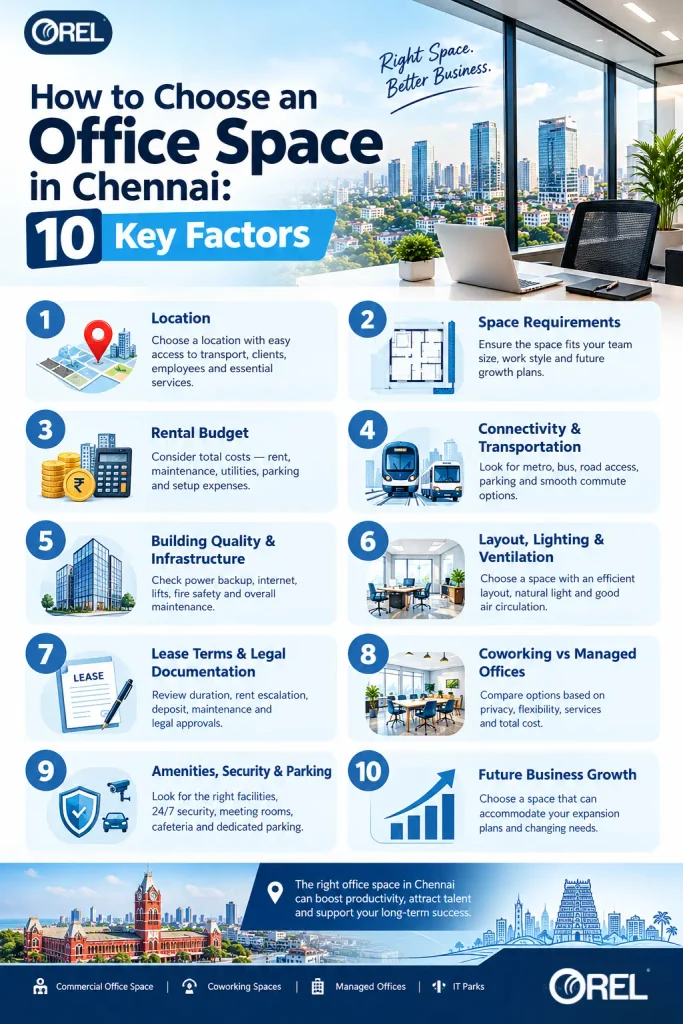
6. Assess Office Layout, Lighting, and Ventilation

The internal layout of an office affects productivity, employee comfort, and the efficient use of space.

An effective office design should provide sufficient room for workstations, meetings, collaboration, and quiet work. Natural lighting and proper ventilation can also contribute to a more comfortable workplace.

When inspecting an office, consider whether its layout supports your company’s working style.

Evaluate the following:

  • Efficient workstation arrangement.
  • Natural light and ventilation.
  • Availability of meeting rooms.
  • Privacy for confidential discussions.
  • Noise levels and sound insulation.
  • Pantry and breakout areas.
  • Flexibility for future layout changes.

For businesses planning to customise the interiors, confirm which alterations are permitted by the landlord and whether approvals are required.

Expert tip: Request a floor plan and calculate how many functional workstations can fit comfortably within the usable area.

7. Review Lease Terms and Legal Documentation

Before finalising a commercial office lease in Chennai, carefully review the lease agreement and associated documents. Commercial lease terms can affect your financial commitments and flexibility for several years.

Do not rely solely on verbal assurances. Ensure that the important terms are documented clearly.

Key terms to review:

  • Lease duration and renewal conditions.
  • Monthly rent and escalation clauses.
  • Security deposit and refund conditions.
  • Notice period and early termination provisions.
  • Maintenance responsibilities.
  • Fit-out permissions and reinstatement obligations.
  • Parking rights and access provisions.
  • Permitted use of the premises.
  • Responsibility for repairs and utilities.

Also verify the landlord’s ownership or authority to lease the property, relevant property documents, and applicable building approvals.

Depending on the property and transaction, registration, stamp duty, tax, and other legal requirements may apply.

Expert tip: Have a qualified property lawyer review the lease agreement before signing or paying a substantial deposit.

8. Compare Coworking and Managed Office Spaces

Traditional leased offices are not the only option available to businesses in Chennai. Coworking spaces and fully managed offices can provide alternatives for companies that want to reduce setup time or avoid managing every aspect of the workplace themselves.

The right option depends on your team size, budget, privacy requirements, and expected occupancy period.

Traditional office space

  • Greater control over layout and branding.
  • Suitable for businesses seeking a dedicated premises.
  • May require separate investment in interiors and facilities.

Coworking space

  • Shared workplace infrastructure.
  • Potential access to meeting rooms and common amenities.
  • May suit freelancers, startups, and smaller teams.

Fully managed office space

  • May include furniture, utilities, housekeeping, and facility management.
  • Can reduce the time required to establish an operational office.
  • Offers a more turnkey arrangement, depending on the provider.

Compare the total cost, privacy, scalability, contract flexibility, and included services before making a decision.

Expert tip: Ask for a detailed list of inclusions and exclusions so that you can compare different office formats accurately.

9. Evaluate Amenities, Security, and Parking

Amenities can make a significant difference to daily office operations. The right facilities improve employee convenience and help create a professional environment for visitors.

Depending on your business requirements, look for:

  • Dedicated parking for employees and visitors.
  • 24/7 access, where required and permitted.
  • Security personnel and access control.
  • Reception and visitor management facilities.
  • Meeting and conference rooms.
  • Cafeteria or nearby food options.
  • Housekeeping and waste management.
  • Power backup and building maintenance.
  • Accessibility features.

Not every office requires every amenity. Prioritise the facilities that support your team’s daily activities and avoid paying extra for services your business will rarely use.

Expert tip: Confirm whether amenities are included in the rent or charged separately.

10. Plan for Future Business Growth

An office should support your business not only today but also over the coming years. Choosing a space without considering future requirements may result in another relocation, additional fit-out expenses, and operational disruption.

Before leasing an office, assess your growth plans and determine whether the premises can accommodate them.

Consider these questions:

  • Will your employee count increase?
  • Can the office accommodate additional workstations?
  • Is another floor or adjoining space available?
  • Does the lease permit expansion or subleasing?
  • Can the layout be modified as your business changes?
  • Will the location continue to suit your clients and employees?

If rapid expansion is expected, a flexible lease or managed office arrangement may be worth considering.

Expert tip: Balance your current space requirements with realistic growth projections rather than leasing substantially more space than you need.

Common Mistakes to Avoid When Renting Office Space in Chennai

Businesses searching for office space often overlook important details during the selection process. Avoid these common mistakes:

  1. Choosing an office based only on the rental price.
  2. Underestimating the space required per employee.
  3. Ignoring peak-hour traffic and commuting challenges.
  4. Failing to inspect the property in person.
  5. Overlooking maintenance charges and other hidden costs.
  6. Signing a lease without reviewing the legal terms.
  7. Ignoring internet connectivity and power backup.
  8. Selecting an office without considering future expansion.
  9. Assuming that all amenities are included in the rent.
  10. Failing to compare multiple properties before deciding.

A structured evaluation process can help businesses reduce avoidable costs and select an office that meets their operational needs.

How OREL Properties and Consulting Pvt Ltd Can Help

Finding the right commercial office space requires an understanding of business requirements, local market conditions, location advantages, and lease considerations.

OREL Properties and Consulting Pvt Ltd helps businesses explore office space options in Chennai based on their location preferences, space requirements, budget, and operational objectives.

Whether you are looking for a conventional commercial office, a Grade A office space, a coworking environment, or a fully managed office, a requirement-driven property search can help you identify suitable options more efficiently.

Our approach focuses on helping businesses evaluate property options, compare important features, and make informed real estate decisions.

If you are planning to lease an office in Chennai, define your requirements first and seek professional assistance to shortlist properties that align with your business goals.

Conclusion

Choosing the right office space in Chennai involves much more than finding a vacant commercial property. Businesses must evaluate location, space requirements, rental budget, connectivity, building infrastructure, office layout, lease terms, amenities, and future expansion plans.

By considering these 10 key factors, you can identify an office that supports employee productivity, improves operational efficiency, and aligns with your long-term business objectives.

Whether you are a startup establishing your first workplace or an established company expanding its operations, careful planning can help you find the right office space for rent in Chennai.

Looking for commercial office space in Chennai? Connect with OREL Properties and Consulting Pvt Ltd to explore suitable office options for your business.

Frequently Asked Questions (FAQs)

1. How do I choose the right office space in Chennai?

Start by defining your budget, employee count, preferred location, space requirements, and essential amenities. Compare shortlisted properties based on connectivity, infrastructure, lease terms, and total occupancy costs before making a decision.

2. Which locations are suitable for renting office space in Chennai?

OMR, Guindy, Taramani, Perungudi, Sholinganallur, Anna Nagar, Porur, and Ambattur are among the locations businesses may consider. The most suitable area depends on your industry, employee commute patterns, budget, and client accessibility.

3. How much office space does a company need?

The requirement depends on the number of employees, workstation layout, meeting rooms, common areas, and working arrangements. Calculate the usable area required for your operations and confirm whether the quoted property area refers to carpet area, built-up area, or super built-up area.

4. What costs should I consider when renting commercial office space?

In addition to monthly rent, consider the security deposit, maintenance charges, electricity, internet, parking, fit-out expenses, housekeeping, and applicable taxes or other contractual charges.

5. Is a coworking space better than a traditional office?

Coworking may suit businesses that need shared facilities and flexible arrangements. A traditional office may be preferable when a company requires greater control over branding, layout, privacy, and operations. Fully managed offices provide another option, depending on the services included.

6. What should I check before signing an office lease?

Review the lease duration, rental escalation, deposit refund terms, notice period, maintenance responsibilities, fit-out permissions, permitted use, and renewal conditions. Verify the landlord’s authority to lease the property and seek legal advice before signing.

7. Why is location important when selecting an office in Chennai?

Location affects employee commuting, client accessibility, transportation costs, business visibility, and proximity to commercial or technology hubs. Choosing a suitable location can improve operational convenience and support business growth.
What Should You Know Before Leasing an Office Space in Chennai?

Finding the right office space for lease in Chennai involves more than comparing rental prices. Businesses should evaluate the location, office size, building quality, connectivity, parking, amenities, lease terms, operating costs and potential for future expansion.

Chennai has a diverse commercial real estate market, with office spaces available across established business districts and emerging commercial corridors. The right office location can improve employee accessibility, client convenience and long-term business efficiency.

Whether you are a startup looking for a compact workspace or an established company searching for a larger corporate office, understanding the key factors involved in leasing can help you make a better decision.

What Is the Difference Between Office Space for Lease and Office Space for Rent?

The terms lease and rent are often used interchangeably, but they can represent different arrangements depending on the agreement.

An office lease generally involves a longer-term contractual arrangement between the property owner and the business. It can provide greater stability for companies planning to occupy a property for several years.

An office rental arrangement may offer greater flexibility depending on the landlord, property and agreement.

When searching online, businesses may use terms such as:

  • office space for lease in Chennai
  • office space for rent in Chennai
  • office space on lease in Chennai
  • commercial office space in Chennai
  • commercial office for rent
  • office space near business districts

Therefore, businesses should focus on the actual terms and conditions of the agreement rather than relying only on the terminology used in a property listing.

Why Choose an Office Space for Lease in Chennai?

Chennai is an important business and technology hub with established commercial areas, IT corridors and well-connected business districts.

Leasing an office can provide businesses with a dedicated professional environment while allowing them to select a location based on their workforce and operational requirements.

Key advantages include:

  • Professional workplace for employees
  • Better environment for client meetings
  • Greater control over office layout
  • Opportunity to customize the workspace
  • Long-term location stability
  • Access to commercial building amenities
  • Better brand visibility in suitable locations
  • Potential to plan workspace around future growth

For businesses expecting to operate from the same location for several years, a suitable commercial lease can provide greater stability than frequently changing workspaces.

What Should You Consider Before Leasing an Office in Chennai?

Before finalizing an office space for lease in Chennai, evaluate the property from both a business and operational perspective.

1. Location

Location is one of the most important factors when selecting commercial office space.

Consider:

  • Employee commute
  • Accessibility by road
  • Public transportation
  • Metro connectivity
  • Proximity to residential areas
  • Client accessibility
  • Nearby restaurants and essential services
  • Availability of parking

A well-connected location can make the office more convenient for both employees and visitors.

2. Office Size

Your office should provide sufficient space for your current workforce while allowing for reasonable future growth.

Start by calculating:

Number of Employees × Planned Space Per Employee = Approximate Office Requirement

For example:

50 employees × 100 sq. ft. = 5,000 sq. ft.

The final requirement should also account for meeting rooms, cabins, reception areas, pantry facilities, storage and circulation space.

Choosing an office that is too small can create operational challenges, while leasing significantly more space than necessary can increase occupancy costs.

3. Office Layout and Floor Plate

The usable layout of an office is just as important as the total square footage.

A property with an efficient floor plate can provide better space utilization.

Check:

  • Column placement
  • Workstation layout
  • Floor-to-ceiling height
  • Natural light
  • Ventilation
  • Entry and exit points
  • Lift access
  • Common areas
  • Emergency exits
  • Meeting-room possibilities

A well-designed floor plate can help businesses accommodate more functional workspace without unnecessarily increasing the total area.

4. Building Quality and Amenities

When evaluating commercial office space for lease in Chennai, look beyond the office floor itself.

Consider the overall building.

Important features may include:

  • Reception
  • Security
  • Elevators
  • Power backup
  • Parking
  • Fire safety systems
  • CCTV
  • Maintenance
  • Common areas
  • Visitor management
  • HVAC or air-conditioning provisions

These facilities can significantly influence the usability and professional experience of the workplace.

5. Parking Availability

Parking can be an important consideration for Chennai businesses.

Before signing a lease, clarify:

  • Number of car parking spaces
  • Two-wheeler parking
  • Visitor parking
  • Parking allocation
  • Additional parking charges
  • Parking availability during peak hours

If your business regularly receives clients or vendors, visitor parking can also be an important consideration.

6. Connectivity

Accessibility can influence employee satisfaction and client convenience.

When comparing office properties, consider proximity to:

  • Metro stations
  • Major roads
  • Bus routes
  • Railway stations
  • Airports
  • Residential neighbourhoods
  • Other commercial hubs

For companies with employees commuting from different parts of Chennai, a centrally accessible or well-connected office can provide a practical advantage.

7. Lease Terms and Conditions

Never evaluate an office based only on the monthly rent.

Before signing the agreement, understand the complete commercial structure.

Review:

  • Monthly rent
  • Security deposit
  • Lease duration
  • Lock-in period
  • Rent escalation
  • Maintenance charges
  • Common area charges
  • Parking charges
  • Utility expenses
  • Taxes and applicable charges
  • Renewal terms
  • Exit conditions
  • Restoration requirements

A clear understanding of these costs helps businesses calculate their actual occupancy expenses.

8. Fit-Out and Interior Costs

A property may look attractive during a site visit, but businesses should also consider the cost of preparing the office for occupation.

Depending on the property, you may need to budget for:

  • Workstations
  • Cabins
  • Meeting rooms
  • Electrical work
  • Lighting
  • Networking
  • Branding
  • Furniture
  • Pantry setup
  • Interior design
  • Air-conditioning

A fully fitted or managed office may reduce the time and investment required to start operations.

There is no single solution that works for every company.

A business expecting stable long-term operations may prefer a conventional lease, while a startup or rapidly changing team may benefit from a flexible office arrangement.

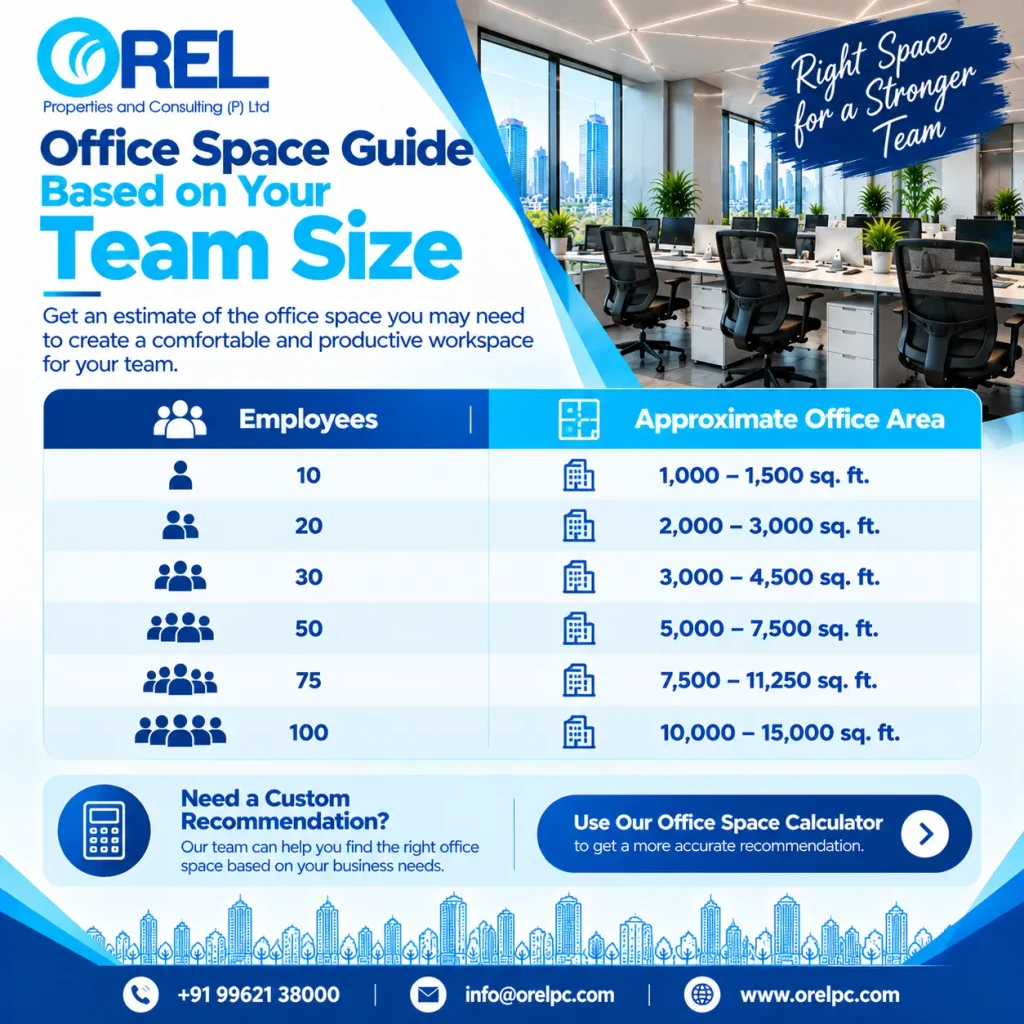
How Much Office Space Does Your Business Need?

Your office space requirement should be based on your employee count, working model and operational needs.

As an initial planning guide:

These are planning estimates. Your actual requirement can vary depending on workstation density, private cabins, meeting rooms, common areas and hybrid working.

Should You Choose a Fully Fitted Office or a Bare-Shell Office?

This is another important decision when looking for an office space for lease in Chennai.

Fully Fitted Office

A fully fitted office may already include:

  • Workstations
  • Cabins
  • Meeting rooms
  • Lighting
  • Electrical infrastructure
  • Air-conditioning
  • Pantry
  • Networking infrastructure

Advantages

  • Faster occupation
  • Lower initial setup effort
  • Reduced interior planning
  • Easier move-in process

Bare-Shell Office

A bare-shell property gives the business greater freedom to design the workplace according to its brand and operational requirements.

Advantages

  • Customized office design
  • Greater control over layout
  • Ability to create a unique workplace
  • Suitable for companies with specific infrastructure requirements

The right choice depends on your budget, timeline, brand requirements and expected occupancy period.

Which Businesses Need Commercial Office Space in Chennai?

Different types of businesses may require commercial office space, including:

  • IT companies
  • Software companies
  • Startups
  • Financial services firms
  • Consulting companies
  • Professional service firms
  • Educational companies
  • Healthcare businesses
  • Marketing agencies
  • Engineering companies
  • Corporate offices
  • Back-office operations

Each business can have different requirements for office size, layout, connectivity and amenities.

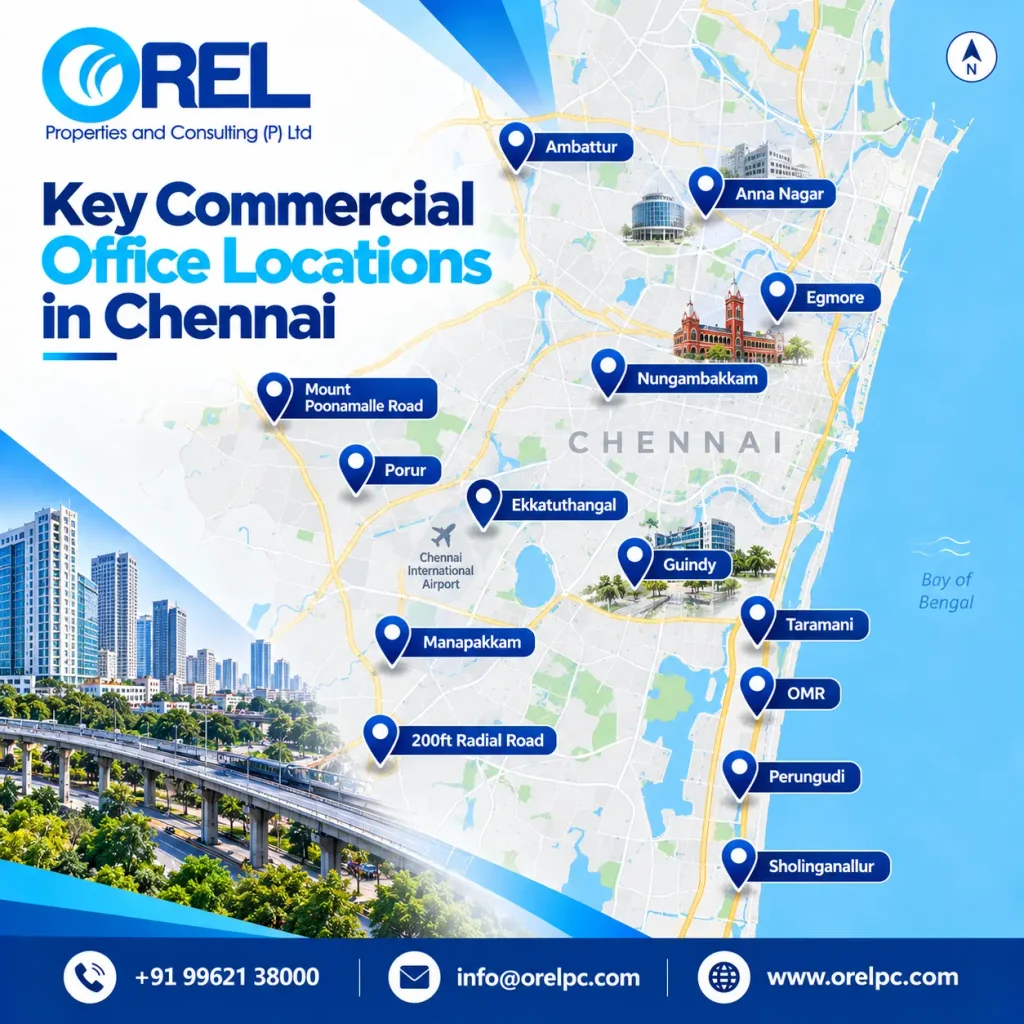
What Are the Best Locations for Office Space in Chennai?

The ideal location depends on your employees, clients and business operations.

When searching for office space, businesses may consider established commercial and IT corridors such as:

The best location is not necessarily the one with the lowest rent. It should provide a balance between accessibility, business requirements, property quality and total occupancy cost.

Common Mistakes to Avoid When Leasing Office Space

Choosing Based Only on Rent

A lower monthly rent does not always mean lower overall occupancy costs.

Consider maintenance, parking, utilities, fit-out and other expenses.

Ignoring Future Growth

If your team is expanding, make sure the workspace can support future requirements.

Not Checking Accessibility

An office that is difficult for employees or clients to reach can create long-term challenges.

Underestimating Meeting Space

A business may have enough desk space but still lack sufficient meeting rooms.

Not Reviewing the Lease Agreement

Understand all commercial terms before signing.

Choosing the Wrong Floor Layout

Poor column placement or inefficient floor plates can reduce usable workspace.

Ignoring Parking

Parking requirements should be discussed before finalizing the property.

Why Work With a Commercial Property Consultant?

Finding an appropriate commercial office space for lease in Chennai can involve comparing multiple properties, understanding commercial terms and evaluating whether a property actually fits your business requirements.

A professional property consultant can help businesses assess:

  • Location suitability
  • Office size
  • Property specifications
  • Building facilities
  • Parking
  • Connectivity
  • Lease requirements
  • Expansion potential

This can make the property search more structured and help businesses shortlist spaces based on their actual requirements.

Find the Right Office Space in Chennai with OREL Properties & Consulting

At OREL Properties & Consulting, businesses can explore commercial office spaces based on their location, size, workforce and operational requirements.

Whether you are searching for an office space for lease in Chennai, a fully fitted commercial workspace or office space for rent in Chennai, selecting the right property requires careful evaluation of both the workplace and the commercial terms.

From established business locations to growing commercial corridors, OREL Properties & Consulting can help businesses identify office space options suited to their requirements.

Looking for Office Space in Chennai?

Tell us your preferred location, required area, employee count and budget, and explore office space options that match your business needs.

Use our Office Space Calculator to estimate your space requirements based on your workforce and plan your next workspace more effectively.

Contact OREL Properties & Consulting to find your next commercial office space in Chennai.

Frequently Asked Questions About Office Space for Lease in Chennai

What is the average cost of office space for lease in Chennai?

Office lease costs vary significantly depending on the location, building grade, office size, amenities, fit-out, parking and other commercial terms. Businesses should compare the total occupancy cost, rather than looking only at the quoted rent.

What should I check before leasing an office in Chennai?

Check the location, usable area, floor layout, connectivity, parking, building facilities, power backup, maintenance costs, lease duration, security deposit, lock-in period, escalation and other agreement terms.

Is it better to lease or rent an office in Chennai?

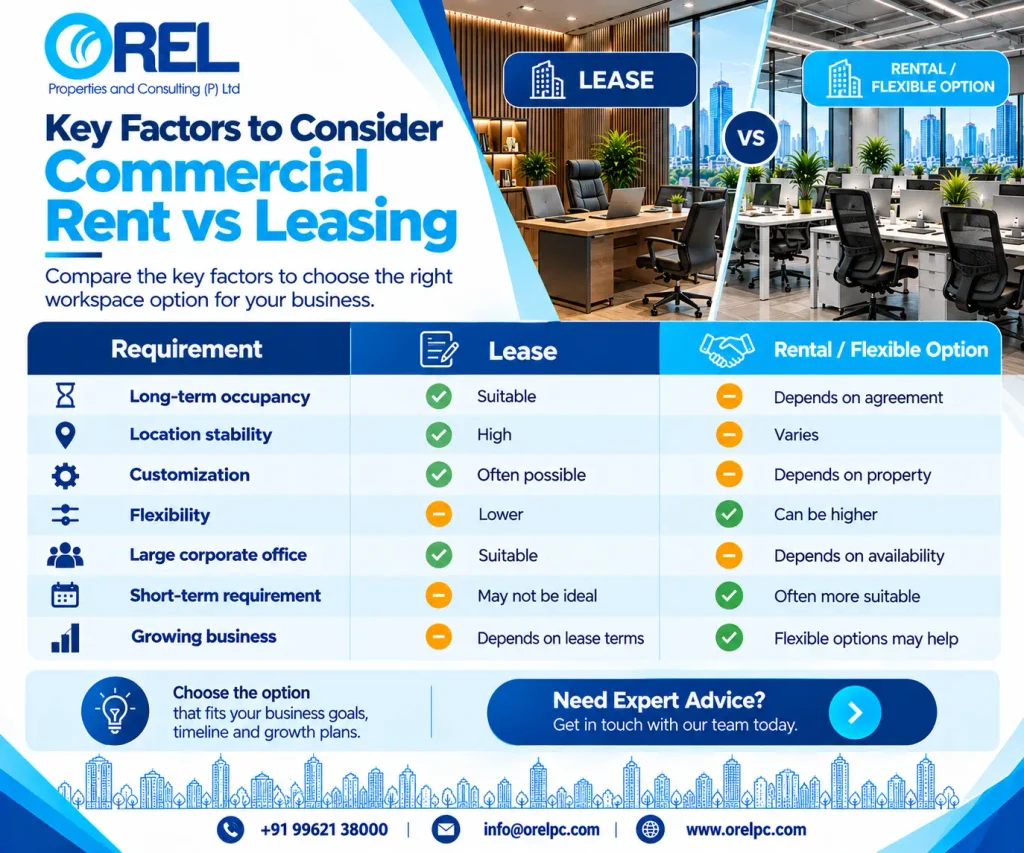
The better option depends on your business requirements. A longer-term lease may suit companies looking for location stability, while flexible rental or managed-office solutions may be more suitable for businesses that prioritize flexibility.

How much office space do I need for 50 employees?

As an initial planning estimate, 50 employees may require approximately 5,000–7,500 sq. ft., depending on the workspace model, meeting rooms, cabins and common facilities.

Where can I find office space for lease in Chennai?

Office spaces are available across several commercial and business locations in Chennai, including Guindy, Anna Nagar, OMR, Taramani, Perungudi, Sholinganallur, Nungambakkam, Egmore, Porur and other commercial corridors.

What is the difference between commercial office space for lease and coworking space?

A conventional commercial lease generally gives a business greater control over its dedicated premises, while coworking typically provides shared facilities and flexible workspace options. The appropriate choice depends on the company’s size, budget, growth plans and desired flexibility.

Can startups lease commercial office space in Chennai?

Yes. Startups can consider conventional offices, fully fitted offices, managed offices and coworking spaces depending on their team size, budget and expected growth.

How long should an office lease be?

There is no single ideal lease duration. Businesses should select a term based on their expected occupancy period, growth plans, financial commitments and the commercial terms offered by the property owner.

Conclusion

Choosing the right office space for lease in Chennai requires careful consideration of location, size, accessibility, building quality, parking, amenities, fit-out requirements and lease conditions.

Whether you are searching for commercial office space for lease in Chennai, office space for rent in Chennai or office space on lease in Chennai, the right property should support your current operations while allowing your business to grow.

Before signing an agreement, evaluate the complete occupancy cost, workplace requirements and long-term suitability of the property.

For businesses looking for commercial office space in Chennai, OREL Properties & Consulting can help you identify office solutions aligned with your business requirements.

If you are planning a new office, one of the first questions to answer is: How much office space do I need to lease or can I plan per employee basis?

As a general planning guideline, businesses can consider around 90–100 sq. ft. of office space per employee as per standard to meet fire norms, aisle spacing requirements etc.,, although the ideal requirement depends on the type of business, office layout, working model, meeting rooms, employee amenities and future growth.

For example, a company with 50 employees may require approximately 4,000–5000 sq. ft. of office space to have well laid out office space with collaborative areas and discussion, meeting rooms as a starting point.

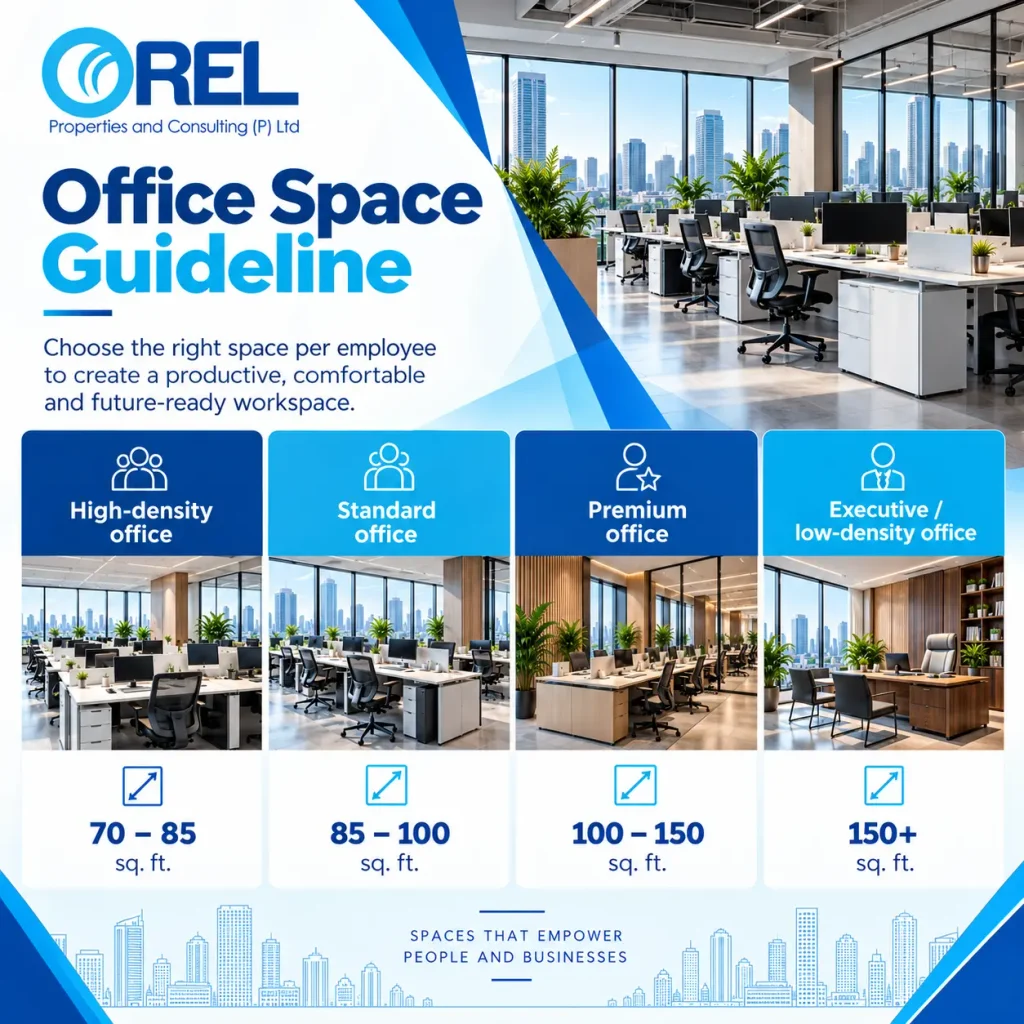
How Much Office Space Do I Need Per Employee?

For most businesses, 85–100 sq. ft. (of Super Built up lease or leased area) per employee is a practical starting range when planning an office.

These figures are planning estimates rather than fixed requirements. Your actual office space requirement depends on how the space will be used. You can also use our Office Space Calculator to estimate your space requirements quickly and accurately.

A company with an open-plan layout may need less space per employee, while a consulting or client-facing business with private cabins and multiple meeting rooms may require more.

How to Calculate Your Office Space Requirement

A simple formula can help you estimate your initial requirement:

Office Space Requirement = Number of Employees × Space Per Employee

For example:

50 employees × 100 sq. ft. = 5,000 sq. ft.

Therefore, a 50-person company could begin its search with approximately 5,000 sq. ft. of office space.

However, the calculation should also account for common areas and business-specific requirements such as meeting rooms, cabins, reception areas, pantry facilities and storage.

The Important factor to note is that in a Building when Leasing it is leasing at super built up area, which includes 25% to 30% loading for your common areas of the building , such as lift lobbies, artiums, washrooms, AHU and electrical rooms amenities zone etc. This might also play an important point as it will affect the total carpet or usable office space for the fit-outs.

What Should Be Included in Your Office Space?

Your total office requirement may include:

  • Employee workstations
  • Private cabins
  • Meeting rooms
  • Conference rooms
  • Reception and waiting areas
  • Pantry and dining areas
  • Breakout spaces
  • Collaboration zones
  • Storage
  • IT/server rooms
  • Circulation and walkways
  • Employee amenities

This is why selecting an office based only on the number of workstations can result in insufficient space.

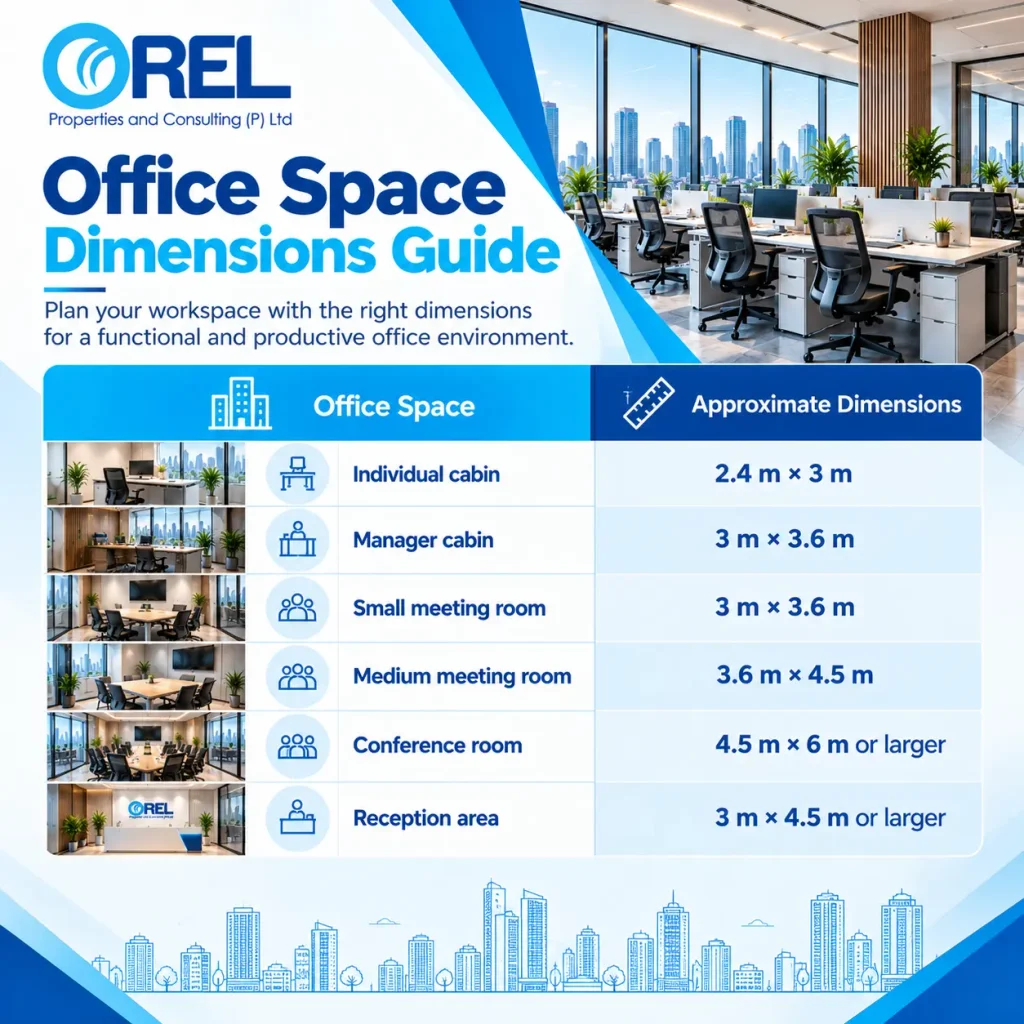
What Is the Standard Office Room Size in Meters?

There is no single standard office room size in meters because room dimensions depend on the purpose of the room, furniture, occupancy and circulation requirements.

As a general planning reference:

For example, a 3 m × 3 m room provides approximately 9 sq. m. of floor area, equivalent to approximately 97 sq. ft.

The actual room dimensions should be finalized based on the furniture layout, number of occupants and overall office design.

How Much Space Does One Employee Need at a Workstation?

The workstation itself generally occupies much less space than the total office allocation per employee.

A typical workstation may require approximately 4–6 sq. m., depending on the desk configuration, chair, storage and circulation.

The remaining space within the overall office allocation can accommodate:

  • Meeting rooms
  • Walkways
  • Collaboration areas
  • Reception
  • Pantry
  • Storage
  • Breakout areas

Therefore, when calculating your office space requirement, don’t calculate only the desk dimensions.

Office Space Requirement Based on Work Style

Your workplace model can significantly affect the amount of space you need.

Traditional Office

Employees have assigned workstations and typically work from the office every day.

Planning range: Approximately 85–100+ sq. ft. per employee. You can also use our Office Space Calculator to estimate your space requirements quickly and accurately.

Hybrid Office

Employees divide their working time between the office and remote locations.

A hybrid model may reduce the number of permanent workstations required.

Planning range: Approximately 100–120 sq. ft. per employee, depending on occupancy.

Hot-Desking Office

Employees use shared workstations instead of having permanently assigned desks.

This can reduce the total workspace required if office attendance is consistently below 100%

Coworking or Managed Office

Coworking and managed office solutions allow businesses to select workspace according to their current team size and scale as the company grows.

This can be useful for startups, growing companies and businesses that do not want to commit to a large conventional office.

What Are the Key Co Working Space Requirements?

When evaluating co working space requirements, businesses should look beyond the number of desks available.

Important factors include:

1. Number of Workstations

Determine how many employees need to work from the office at the same time.

2. Private Offices

Managers, leadership teams and client-facing employees may require private cabins.

3. Meeting Rooms

Consider how frequently your team conducts internal meetings, client meetings and presentations.

4. Internet Connectivity

Reliable, high-speed internet is essential for modern businesses, particularly IT and technology companies.

5. Power Backup

Power backup can help maintain business continuity.

6. Pantry and Breakout Areas

Employee amenities can improve workplace comfort and productivity.

7. Reception and Administrative Support

Managed and coworking offices may provide reception and administrative services.

8. Location and Accessibility

Employees and clients should be able to reach the workspace conveniently.

9. Parking

Adequate parking can be an important consideration for employees, clients and visitors.

10. Scalability

Choose a workspace that can accommodate future employee growth without requiring an immediate relocation.

How Much Office Space Does a 100-Person Company Need?

For 100 employees, a basic planning range is approximately 8500–10,000 sq. ft.

The final requirement depends on:

  • Number of permanent workstations
  • Hybrid working percentage
  • Number of cabins
  • Meeting-room requirements
  • Conference facilities
  • Employee amenities
  • Storage
  • Reception requirements
  • Future expansion

For a growing company, it can be more cost-effective to select a flexible office that allows additional space to be added later.

Should You Plan Office Space for Future Growth?

Yes.

One of the most common mistakes businesses make is choosing an office based only on their current employee count.

For example, if your company currently has 40 employees but expects to reach 60 employees within two years, planning for future growth can reduce the need for another relocation.

However, leasing significantly more space than you need can also increase your rental and operating costs.

The objective is to find the right balance between:

Current headcount + future growth + workplace model + business requirements.

Factors That Affect Your Office Space Requirement

The number of employees is only one factor.

Business Type

An IT company, consulting firm, financial services company and creative agency may all have different space requirements.

Employee Density

Higher-density layouts can accommodate more employees within a smaller footprint.

Meeting Room Requirements

Businesses that frequently meet clients may require additional meeting and conference rooms.

Hybrid Working

Hybrid work can reduce the number of permanently assigned workstations.

Employee Amenities

Pantries, lounges, breakout areas and collaboration spaces can increase the overall requirement.

Office Location

Location affects rental costs, employee commute, accessibility and client convenience.

For businesses in Chennai, proximity to major business districts, Metro connectivity, roads, public transport and other commercial infrastructure can be important when selecting an office.

Office Space Planning for Businesses in Chennai

Chennai has several established and emerging commercial business corridors suitable for companies looking for office space.

When evaluating a commercial office in Chennai, businesses should consider:

  • Connectivity to major roads
  • Metro and public transport access
  • Proximity to residential areas
  • Parking availability
  • Building quality
  • Office floor plate
  • Natural light and ventilation
  • Power backup
  • Security
  • Building amenities
  • Expansion possibilities

The right location can help businesses improve accessibility for employees and clients while supporting long-term growth.

Why Choosing the Right Office Size Matters

Choosing the right office size can help businesses manage both employee experience and occupancy costs.

An office that is too small may result in:

  • Crowded workstations
  • Insufficient meeting rooms
  • Poor circulation
  • Limited employee amenities
  • Lack of expansion space

An office that is too large can result in:

  • Higher rental costs
  • Higher maintenance expenses
  • Unused workspace
  • Increased operating costs

A well-planned office provides enough room for employees to work comfortably while avoiding unnecessary space.

How OREL Properties & Consulting Can Help

Finding the right commercial office space requires more than comparing rental prices.

OREL Properties & Consulting helps businesses explore commercial office spaces, coworking spaces and managed office solutions based on their business requirements.

Whether you need a compact office for a growing startup or a larger workspace for an established team, factors such as employee count, location, layout, amenities, accessibility and future expansion should be considered before making a decision.

If you are looking for office space for rent in Chennai, OREL Properties & Consulting can help you identify workspace options that align with your business requirements.

Looking for the right office space in Chennai? Contact OREL Properties & Consulting to discuss your requirements.

Frequently Asked Questions About Office Space Requirements

1. How much office space do I need per employee?

A practical starting point is 85–100 sq. ft. per employee. The actual requirement depends on the office layout, working model, meeting rooms, amenities and business type.

2. Is 70 sq. ft. per employee enough?

Yes, 70 sq. ft. per employee can work for a compact or high-density office, particularly when the company uses an efficient layout or hybrid working model. Businesses requiring more private rooms and amenities may need additional space.

3. How much office space do I need for 50 employees?

A 50-person company may require approximately 4,000–5000 sq. ft., based on 85-100 sq. ft. per employee.

4. How much office space do I need for 100 employees?

A 100-person company may require approximately 8500–10,000 sq. ft., depending on the office layout and workplace model.

5. What is the standard office room size in meters?

There is no universal standard. An individual office cabin may commonly be around 2.4 m × 3 m, while manager cabins and meeting rooms may require larger dimensions.

6. What are the main co working space requirements?

Key coworking requirements include adequate workstations, meeting rooms, reliable internet, power backup, reception, pantry facilities, breakout areas, parking and convenient accessibility.

7. Should I choose office space based only on employee count?

No. Employee count is only one factor. You should also consider meeting rooms, cabins, common areas, amenities, hybrid working and future employee growth.

8. How can I calculate my office space requirement?

Multiply your expected number of employees by your planned space per employee. You can also use our Office Space Calculator to estimate your space requirements quickly and accurately.

Example:

50 employees × 100 sq. ft. = 5,000 sq. ft.

Then adjust the requirement based on meeting rooms, cabins, amenities, circulation and future growth.

Conclusion

Determining your office space requirement is an important step when leasing or planning a workplace.

As a general starting point, businesses can consider 85–100 sq. ft. per employee. However, the ideal office size depends on your workforce, working style, business type, meeting requirements, amenities and future growth plans.

Whether you are considering a traditional office, coworking space or managed office, the goal should be to create a workspace that is comfortable, productive, scalable and cost-efficient.

For businesses searching for commercial office space in Chennai, OREL Properties & Consulting can help you explore workspace options based on your business requirements.

Leasing a commercial property is a major business decision that can directly impact your company’s operations, finances, employee productivity, and long-term growth. Whether you are planning to rent an office space, retail showroom, warehouse, coworking setup, or industrial property, it is essential to evaluate every aspect carefully before signing the lease agreement.

Many businesses focus only on rental cost and location, but a successful commercial lease involves much more. From legal verification and hidden charges to infrastructure facilities and future expansion possibilities, every detail matters.

At OREL Properties and Consulting Pvt Ltd, we help businesses identify the right commercial properties and ensure that every leasing decision is secure, profitable, and aligned with long-term business goals.

Why a Commercial Property Lease in Chennai Checklist is Important

A commercial lease is a long-term financial commitment. Missing critical details during the leasing process can result in operational challenges, unexpected expenses, legal disputes, or relocation costs in the future.

Using a proper checklist before finalising a commercial property lease helps businesses:

  • Avoid hidden costs and legal complications
  • Ensure the property matches operational requirements
  • Negotiate better lease terms
  • Confirm infrastructure and facility availability
  • Protect long-term business interests
  • Improve return on investment

1. Verify the Location Advantage

Location is one of the most important factors when selecting a commercial property. The right location improves accessibility, customer reach, employee convenience, and overall brand visibility.

Before finalising the lease, evaluate:

  • Proximity to major roads and transport facilities
  • Availability of parking space
  • Nearby business hubs and commercial activity
  • Ease of access for employees and clients
  • Future infrastructure development in the area
  • Safety and security of the locality

For retail businesses, foot traffic and visibility are critical. For office spaces, connectivity and employee accessibility are more important.

Popular commercial hubs in Chennai such as Anna Nagar, Guindy, OMR, T Nagar, Nungambakkam, and Velachery continue to attract businesses due to their excellent infrastructure and growth potential.

2. Check the Property’s Legal Documentation

One of the most crucial steps before signing a commercial lease is legal verification. Businesses should ensure that the property has clear documentation and proper approvals.

Important documents to verify include:

  • Property ownership documents
  • Encumbrance certificate
  • Building approval certificates
  • Completion and occupancy certificates
  • Property tax receipts
  • Fire safety approvals
  • Trade license permissions
  • Lease agreement terms and conditions

Consulting a professional real estate consultant or legal expert can help identify risks and avoid future disputes.

3. Understand the Lease Agreement Thoroughly

Many businesses make the mistake of signing lease agreements without fully understanding the clauses. Every commercial lease agreement must be carefully reviewed.

Key factors to check include:

Lease Duration

Understand the lock-in period and total lease tenure.

Rent Escalation Clause

Check how frequently the rent will increase and by what percentage.

Security Deposit

Verify deposit amount, refund terms, and deduction conditions.

Maintenance Charges

Clarify whether maintenance costs are included or charged separately.

Exit Clause

Review termination policies and penalties for early exit.

Renewal Terms

Understand renewal conditions and future rental revisions.

Usage Restrictions

Ensure the property can legally support your business activities.

A transparent lease agreement protects both tenant and property owner from misunderstandings.

4. Evaluate Infrastructure and Amenities

Modern commercial properties should provide essential infrastructure and operational facilities.

Before finalising the lease, inspect:

  • Power backup availability
  • Internet and telecom connectivity
  • Air conditioning systems
  • Lift and elevator facilities
  • Water supply and drainage
  • Washroom condition and maintenance
  • Fire safety systems
  • CCTV surveillance and security
  • Parking availability
  • Common area maintenance

For office spaces, employee comfort and operational efficiency play a major role in productivity.

5. Assess Space Utilisation and Layout

The property should match your current business requirements while also supporting future expansion.

Evaluate:

  • Carpet area and usable space
  • Cabin and workstation planning
  • Meeting room availability
  • Storage requirements
  • Reception area setup
  • Ventilation and natural lighting
  • Flexibility for interior modifications

Choosing a properly designed workspace improves employee workflow and customer experience.

Checklist Before Finalising a Commercial Property Lease

6. Analyse Total Occupancy Cost

Rental value alone does not determine the actual cost of leasing a commercial property.

Calculate the complete occupancy expense, including:

  • Monthly rent
  • Advance deposit
  • Maintenance charges
  • Parking charges
  • GST and applicable taxes
  • Utility bills
  • Interior setup costs
  • Brokerage fees
  • Annual escalation costs

Understanding the full financial commitment helps businesses manage budgets effectively.

7. Check Compliance and Safety Standards

Businesses should ensure the property complies with local safety and regulatory standards.

Verify:

  • Fire exits and extinguishers
  • Emergency evacuation systems
  • Structural stability
  • Electrical safety compliance
  • Accessibility features
  • Pollution control approvals (if applicable)
  • Industrial compliance certifications

A safe commercial property protects employees, customers, and business operations.

8. Evaluate Future Business Growth Potential

Your business may grow in the coming years, so the property should support future operational needs.

Consider:

  • Expansion possibilities within the building
  • Scalability of infrastructure
  • Future employee capacity
  • Area development potential
  • Long-term business suitability

Leasing a scalable commercial space avoids the need for frequent relocation.

9. Inspect the Property Physically

Never rely only on photos or brochures. A physical inspection helps identify hidden issues.

During the site visit, inspect:

  • Building condition
  • Water leakage or structural damage
  • Electrical systems
  • Ventilation and lighting
  • Common area cleanliness
  • Traffic congestion around the property
  • Noise levels
  • Parking access

Multiple site visits at different times of the day provide better clarity.

10. Work with a Trusted Commercial Property Consultant

A professional commercial real estate consultant simplifies the leasing process and helps businesses make informed decisions.

An experienced consultant can assist with:

  • Property shortlisting
  • Market analysis
  • Rental negotiations
  • Legal coordination
  • Documentation support
  • Lease structuring
  • End-to-end transaction management

OREL Properties and Consulting Pvt Ltd specialises in helping businesses identify premium commercial properties across Chennai with transparent guidance and professional support.

Why Businesses Choose Commercial Properties in Chennai

Chennai continues to be one of India’s fastest-growing commercial real estate markets. The city offers excellent infrastructure, IT growth, industrial expansion, and strong connectivity.

Advantages of leasing commercial properties in Chennai include:

  • Growing business ecosystem
  • Strong IT and manufacturing sectors
  • Excellent road and metro connectivity
  • Increasing demand for office spaces
  • High investment potential
  • Availability of premium commercial locations

Areas such as OMR, Guindy, Mount Road, Anna Nagar, and Perungudi remain top choices for businesses seeking office and commercial spaces.

Conclusion

Finalising a commercial property lease requires careful planning, legal verification, financial analysis, and infrastructure evaluation. A well-informed leasing decision can improve business operations, reduce risks, and support long-term growth.

Businesses should never rush the leasing process. Following a proper checklist ensures that the commercial property aligns with operational goals, budget, and future expansion plans.

OREL Properties and Consulting Pvt Ltd provides expert commercial property consulting services to help businesses find the right office spaces, retail properties, and commercial buildings across Chennai.

In today’s fast-moving real estate market, buying, leasing, or investing in property is no longer just about location and budget. It’s about making informed decisions, minimizing risks, and maximizing returns. That’s where end-to-end property consulting services come in.

Whether you’re a corporate looking for premium office space, an investor seeking high returns, or a homebuyer searching for the perfect property, a professional consulting firm like OREL Properties and Consulting Pvt Ltd ensures a seamless and strategic experience.

What Are End-to-End Property Consulting Services?

End-to-end property consulting refers to a comprehensive, start-to-finish service that covers every stage of a real estate transaction—from requirement analysis to final handover and beyond.

Instead of dealing with multiple agents, legal advisors, and brokers separately, you get a single expert partner who manages everything for you.

1. Requirement Analysis & Strategic Planning

The process begins with understanding your exact needs:

  • Budget and investment goals
  • Preferred location (IT corridors, city center, etc.)
  • Property type (IT office space, coworking, luxury apartments)
  • Expected ROI or rental yield

A good consultant doesn’t just listen—they analyze market trends and align your goals with the right opportunities.

2. Market Research & Property Shortlisting

Once your requirements are clear, consultants:

  • Conduct in-depth market research
  • Identify high-growth locations
  • Shortlist properties that match your criteria
  • Provide comparative analysis

This step saves you hours of research and eliminates unsuitable options.

3. Site Visits & Property Evaluation

Seeing is believing. Consultants arrange and guide you through:

  • Physical site visits
  • Virtual tours (if required)
  • Infrastructure and accessibility checks
  • Builder reputation and project quality

They ensure you evaluate not just the property—but also its long-term value.

End-to-End Property Consulting Services

4. Financial Advisory & ROI Analysis

One of the most valuable aspects of consulting is financial clarity:

  • ROI projections
  • Rental yield analysis
  • Cost breakdown (hidden charges, maintenance, taxes)
  • Investment comparisons

This helps you make data-driven decisions instead of emotional ones.

5. Legal Due Diligence & Documentation

Legal complexities can make or break a deal. Consultants assist with:

  • Title verification
  • Approval checks
  • Agreement drafting and review
  • Compliance with local regulations

This ensures your investment is secure and legally sound.

6. Negotiation & Deal Closure

Experienced consultants act as your negotiators:

  • Price negotiations
  • Lease terms optimization
  • Builder incentives and offers
  • Final deal structuring

Their expertise often helps clients save significantly and secure better terms.

7. Post-Transaction Support

The service doesn’t end at closing:

  • Interior fit-out assistance
  • Tenant management (for investors)
  • Property management support
  • Resale or leasing assistance

This makes your property journey truly end-to-end.

Why Choose End-to-End Consulting?

Partnering with a firm like OREL Properties and Consulting Pvt Ltd offers:

✔ Single point of contact

✔ Time-saving process

✔ Expert market insights

✔ Reduced risk

✔ Better investment outcomes

Final Thoughts

Real estate decisions involve significant financial commitments. Without expert guidance, it’s easy to overlook critical details or miss better opportunities.

End-to-end property consulting transforms a complex process into a structured, transparent, and rewarding experience.

Whether you’re leasing IT office space, exploring coworking environments, or investing in luxury apartments, having the right consulting partner ensures you make smart, confident decisions.

Over the past few years, there has been a substantial shift in the way we work. Both coworking and Traditional spaces have their own unique advantages. Businesses come to a decision based on what requirements need to fulfilled and what works best for them.

COWORKING OFFICE SPACES:

Co-working spaces provide shared, adaptable workspaces where people from all backgrounds come together to collaborate or work on their business goals. These areas encourage small enterprises, remote workers, and freelancers to feel more connected, network, and be more productive. Co-working is not only limited to startups and small business owners as large scale MNC’s have also made the jump and are operational in these centers across India.

ADVANTAGES OF CO-WORKING SPACES –

  • Networking Opportunities: Co-working spaces offer an ideal environment for networking and cooperation; enabling people to connect with professionals from various industries and discuss ideas. It enlarges your circle and allows your business to gain visibility simultaneously increasing your awareness of others.
  • Flexibility: Co-working spaces provide access to value added services like conference rooms, high-speed internet, and office equipment without the need for long-term investments and commitments of a typical lease. With flexible membership options, these locations allow members to scale up or down as per their needs.
  • Cost-Effectiveness: Co-working spaces are an inexpensive choice for independent contractors, start-ups, and small enterprises since they remove the need for expensive overhead costs like rent, utilities, and maintenance that come with maintaining a dedicated office.
  • Managed Private Workspaces : A variant of co-working spaces, this model offers built to suit offices to their clients secured with access controls, these private dedicated work spaces replicates a traditional office space whilst maintain the benefits of a co-working space provider.

  LIMITATIONS OF CO-WORKING SPACES –  

  • Distractions: Due to their open floor plans and the higher levels of engagement among employees, phone conversations, and multiple events or activities going on all at once, coworking spaces can typically be noisier than other types of workspaces.
  • Lack of Privacy: Although co-working spaces foster a sense of community and cooperation, they might not provide enough privacy for delicate conversations or focused work.
  • Limited Control: In general, as co-working spaces are shared settings, people may only have a limited amount of control over things like office design, noise level, and cleanliness, which can affect their general comfort and productivity.
  • Work culture – Coworking spaces usually tend to be a conglomerate of various businesses, each possessing their own unique work cultures ranging from trendy startups to global MNC’s with standardized policies. These cultures may not be followed by all businesses. Which in turn, may not sit well with all occupants. As an example of these work cultures coming together, some businesses dress code would be formal attire but on the other hand some businesses go for a more casual dress code.

TRADITIONAL OFFICE SPACES

Traditional spaces typically refer to traditional office environments, where employees from the same company work together in a dedicated office setting. Traditional office spaces often consist of private offices, cubicles, or open-plan layouts designed for employees of a single organization. These spaces may have specific amenities tailored to the needs of that organization.

ADVANTAGES OF TRADITIONAL SPACES –

  • Team Cohesion: Having all employees working together in the same physical space can promote team cohesion, collaboration, and a sense of belonging. Face-to-face interactions can foster stronger relationships among colleagues and enhance communication.
  • Customization: As it’s a Traditional space, business owners can customize the space as per their needs and requirements. It creates uniformity and an identity for them. It allows for more control on what specifics need to be implemented and what needs to be removed.
  • Branding and Identity: Traditional office spaces provide opportunities for organizations to express their branding and corporate identity through interior design, signage, and decor. This makes sure their work culture is followed. This can help reinforce company culture and values among employees and visitors.

LIMITATIONS OF TRADITIONAL SPACES –

  • Fixed Costs: Traditional office spaces often involve high fixed costs, including rent, utilities, maintenance, and other overhead expenses which may become financially burdensome. Huge investments have to be incurred on buying office furniture & deciding on  amenities.
  • Restricted Flexibility: Rigid contracts and long-term leases can make traditional office spaces less flexible, making it more difficult for businesses to scale up operations, accept remote work arrangements, or adjust to changing business needs.
  • Isolation & Silos: Traditional office designs, like cubicles or offices with locked doors, can make workers feel isolated and separate from one another. Within the company, this may make it more difficult to collaborate, communicate, and share ideas. In terms of business networking,making connections from various business sectors is less likely.
  • Commute & accessibility: Traditional office spaces are often located in centralized urban areas, which can result in long commutes and accessibility challenges for employees living in suburban or rural areas. This may impact work-life balance and employee satisfaction.

ON THE RISE – TRADITIONAL OR CO-WORKING SPACE ?

Every type of Traditional or coworking space has advantages and disadvantages. Co-working spaces are excellent venues for networking. They unite professionals from various fields and backgrounds, fostering a collaborative atmosphere where knowledge, abilities, and ideas can be exchanged. This may result in new relationships, collaborations, and commercial prospects.

A Traditional space shows your worth, the company you become. It gives a sense of responsibility and establishes respect. The choice should ultimately be made in accordance with your company’s objectives, financial constraints, and the kind of workspace that will maximize the output and welfare of your employees.

For further more options, Kindly get in touch with us for comparative analysis, budget planning, arranging site visits and taking through you the entire process.

Visit here for More CoWorking Properties and Traditional Offices

Not sure on how much space you require for your office setup? Find out here with our Office Space Calculator

With companies gradually resuming offices, there is a resurgence for office space leasing that can be felt in around Chennai. Of the many micro-markets available in the city, one in particular is becoming much more desirable and turning a lot of heads.

The Mount Poonamalle corridor is undergoing a large scale face lift and is quickly becoming one of the largest markets in Chennai. With a multitude of new ventures and large scale campuses currently being developed, paired with the announcement of a new Phase III Metro Line which conveniently happens to run straight through the same corridor making accessibility and standstill traffic thing of the past.

The Mount Poonamalle corridor is definitely an option to be considered.  Below is a list of the bigger players along that corridor that could be the perfect office destination for you.

DLF CYBER CITY

DLF Cybercity is developed by DLF Assets LTD. One of India’s Largest and most successful SEZ developments in the Southern Region of India located on Mount Poonamalle Road.

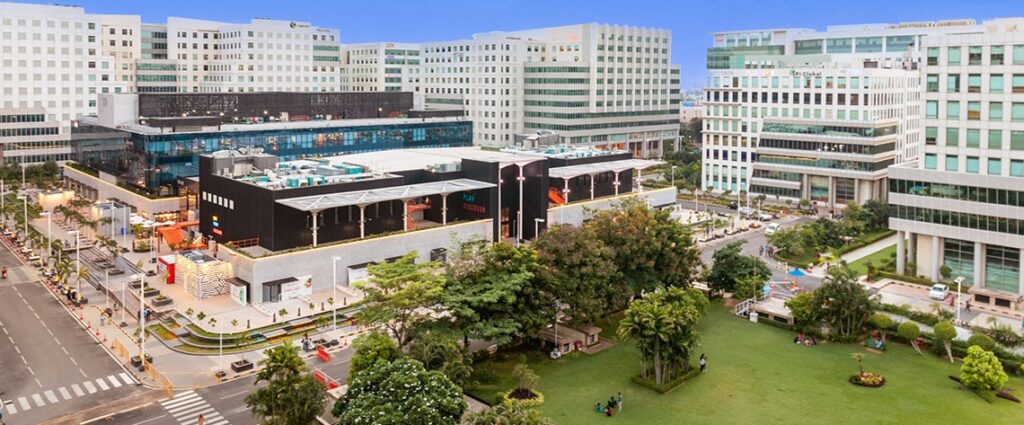
DLF Cybercity Chennai is a 46 acre integrated campus. The project has 12 operational office buildings approx 417900 sqft with a typical floor plate of 38000, along with a host of amenities including well connected internal roads, a dedicated fire station, a 2 acre sports zone, elegant landscaping and The Hub, which is a multifaceted leisure and entertainment centre that also includes leading retail stores, food zones with diverse cuisines, a fitness centre, and much more.

DLF Cybercity also has the advantage of being located close to the airport and with the new metro corridor being developed along that stretch; it now is the most accessible IT Park in Chennai.

RAHEJA COMMERZONE

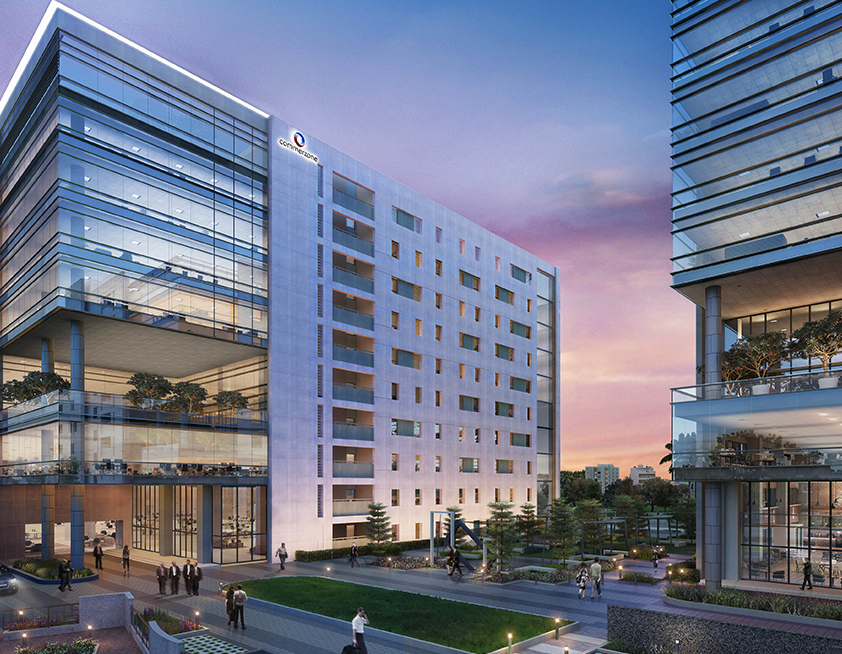
Commerzone is one of the top IT parks in developed by K Raheja. Recently completed in June 2020 spanning across 6 Acres of Land with a total built up area of 11, 05,000 sqft comprising 2 Towers A & B. It is the entity’s flagship commercial offering purposefully located in the South West Chennai micro-market. Advantages are that the project is easily accessible through public transport and is close to all the major celebrated markets and amenities and is  Approx 10km from Domestic and International Airport.

Its unique amenities and infrastructure see the incorporation of recreational, collaborative and wellness aspects that facilitate dynamic work-styles. It has received awards and recognitions including ‘Most Environment Friendly Commercial Space of the Year’ by Realty Plus Conclave and Excellence Award 2020 (South) and LEED Gold certification from USGBC for the entire asset.

RMZ ONE PARAMOUNT

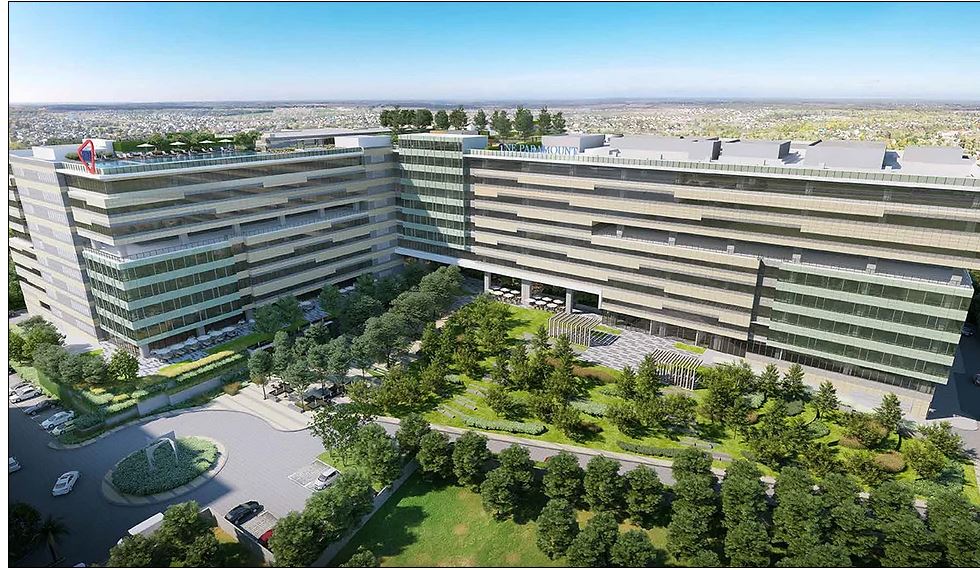
RMZ One Paramount is a striking skyscraper wrapped around views on all sides of the work environment It is constructed with 3 office towers with all modern amenities in 14 acres plotted area approx. 7.8 M sft. along with amenities that set the bench mark for integrated work-life environments. It’s resilient design features to alleviate catastrophes such as floods, cyclones, water shortages, etc. make the project unique.

It comprises 3 + 1 office towers and has a leasable space of 2.4 msft. Additionally features such as a social library, an art walk, intricately designed urban forest and an open air theatre make RMZ One Paramount unique to it’s competitors.  Located on the same Mount Poonamalle stretch, It is 11.5 KM away from the Chennai International Airport.

It also boasts a dedicated landscape area called “The Green Plaza” for more than half the buildings perimeter. It offers modern working spaces with  in-house speciality restaurants , café, executive health club and swimming pool.

Future development of Phase II 2.9 Msft and Phase III 2.5 M sft are what is planned with a final completion date ranging from 2023 – 2027.

 L&T INNOVATION CAMPUS

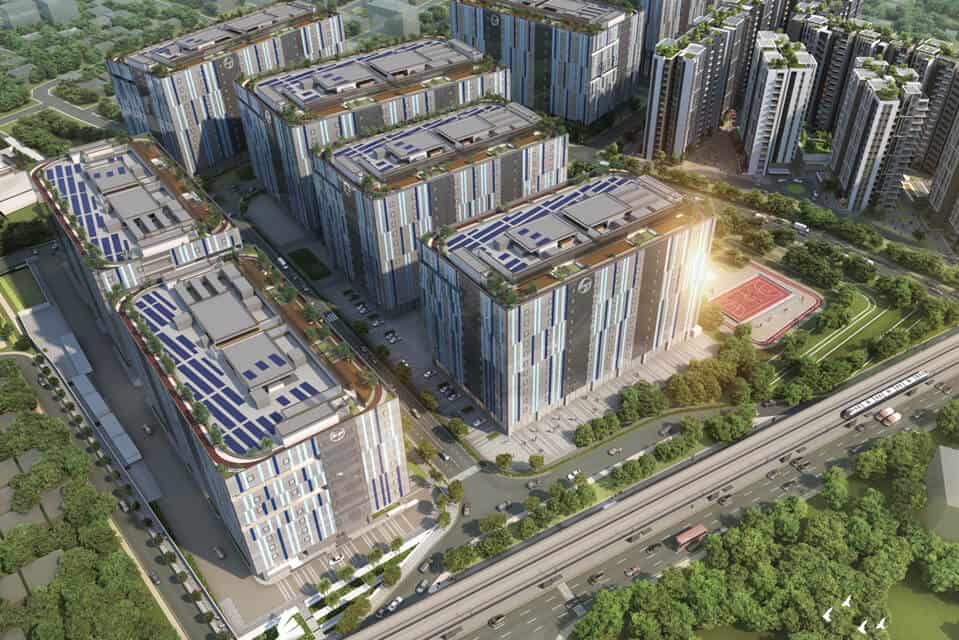
L&T Innovation Campus is a mixed use development spanning over 40 acres located on Mount Poonamalle. The project is under construction and expected to be delivered in 2023. Currently In Phase-I, the two towers can accommodate 1.05 Million sq. ft. of leasable space with the potential for a total of 6.5 million sq. ft. to be leased in the future. Designed to be futuristic, wellness centered and sustainable, with an abundance of green open spaces and a central parkland. The upcoming Metro Phase III corridor also makes this project easily accessible .

The Property is centrally located and is 11.5 KM from the Chennai Domestic & International airport, Its easy accessibility paired with the engineering and construction prowess of L&T make the campus a highly desirable space.

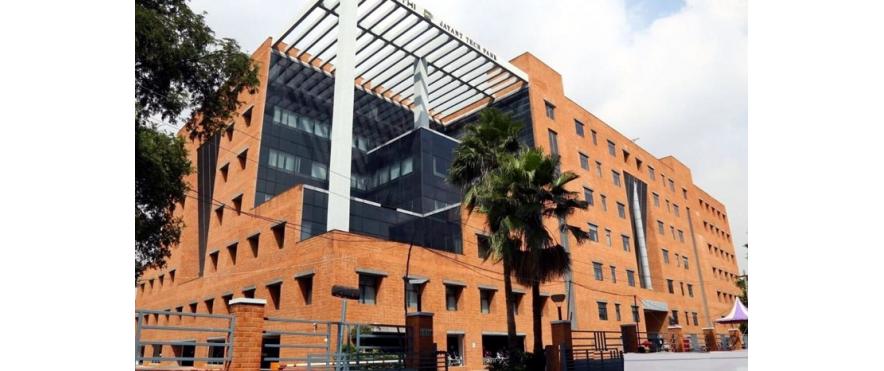
VISHRANTHI JAYANTH TECH PARK

It is a multi tenanted block with a total development size of 3,00,000 sq.ft. The A grade property offers spacious and skilfully designed commercial office space, with spectacular in-house parking backed by 24×7 security service. The project is well equipped with regard to the amenities offered and is  easily accessible by bus. Dining and hotel accommodation are in close proximity. With the location and eateries and transport this structure provides all the elements for comfortable and easy care working. The Project is approx. 7KM away from the Chennai Domestic & International Airport.

ASV HUSAINY TECH PARK

ASV HUSAINY TECH PARK is located in the main road of Manapakkam, with an initial development of 1 Million Sq.ft, Each floorplate is approx. 80,000 Sq.ft. The campus has an independent MLCP building with and a car parking facility that can hold more than 800 cars.

ASV HUSAINY TECH PARK is set to be the most iconic project in Manapakkam surrounding the high end residential projects, Convention centres and Hospitals.

ASV CRN BUSINESS PARK

ASV CRN BUSINESS PARK is located in the main road of Nandambakkam, opposite the Chennai Trade Centre with a total leasable development of 1,60,000 Sq.ft in Basement + Stilt + 9 floors. Each floorplate is approx..  17,700 sqft making it idle for any IT, MNCs, Corporate houses, financial institutions, CoWorking etc.
ASV CRN BUSINESS PARK will be the most iconic building in the Nandambakkam area with a joint experience of ASV and CRN the most renewed architect of INDIA.

For more Tech park and office space options kindly get it touch with us https://orelpc.com/contact-us/