WHAT IS JOINT VENTURE (JV) IN REAL ESTATE

A joint venture in real estate is two or more parties that combine resources for a specific development or investment. The parties in a joint venture maintain their own business identity while working together to complete a deal.

A joint venture in real estate investing is a way for Land Owners, Developers Investors, Construction Companies to put their property resources, capital , experience, and expertise together to accomplish more than they could on their own and to derive better values and profits.

Developers also undertake joint ventures between themselves jointly or participate with Investors.

A joint venture might be the solution to tackling larger real estate deals. Learn the ins and outs to see if it might be the solution for you.

Real estate investing involves a lot of individual goals, so teamwork is often overlooked when real estate investors want to scale their business.

WHY JOINT VENTURE

A Joint Venture with a reputed Builder gives the Landowners to derive maximum values and returns for their property. In addition they also have access to the expertise and experience that the Developer might have in construction, compliances, marketing, branding. In joint venture the Landowner or investor also have the flexibility to structure their deal to suit their capital and built area requirements. This has been the most successful model to develop large commercial, residential and office complexes.  

HOW ARE REAL ESTATE JOINT VENTURES STRUCTURED?

 A joint venture is similar to a partnership in many ways, but they’re not the same. Multiple people form one entity to conduct business together in a partnership. With a joint venture, each party continues to do business under their own entity. The joint venture partners are just working together on a specific deal or project.

The most common structure is a Joint Venture agreement between the Land Owner and Developer. Based on the agreement entered and the sharing of the profits and or the Developed Built space, a Power of Attorney or Resolutions are passed empowering the Developer to Obtain sanctions, represent before various authorities and the all acts needed for the development project to be made deliverable.. However the parties choose to structure it, there will be a joint venture agreement in place that specifies each party’s contributions and responsibilities as well as how profits will be distributed.

The joint venture partners might split any profits based on an agreed percentage, equity or in the most common structure of sharing of the Built Area or Units being developed. In addition for development of Large land parcels, SPV, LLC or partnerships are set up.

TYPES OF JOINT VENTURE

1.     LAND CONTRIBUTION

Land Owners with property parcels collaborate with Developers who have the expertise, knowledge, resources to develop the same. This entails that the Land owner does not part with the Property but develops in the entire Project by contributing the land to the deal to arrive at better realization and to tailor it to a need based right fit solution. In this case, the investor has the asset the developer needs and the developer has the ability to develop the land. Each party has something the other needs, so they form a joint venture.

2.     CONSTRUCTION MANAGEMENT

Investors choose this path of development wherein the opportunity and resources and with the Investor but takes in a Developer to use his expertise in Design, Liaison, and to manage the construction of the project. These models are largely used for commercial and retail development to harness the Return on Investment and offer solution to end users on Built to Suit projects.

3.     BRANDING AND MARKETABILITY OPTIONS

Developer enter into joint ventures, wherein a Developer may have the cash, credit, and expertise to get a project done, but challenges may arise with marketing and branding of the project, They may choose to put together a joint venture agreement with another reputable developer to leverage on their brand value.

ADVANTAGES OF JOINT VENTURE

Joint ventures allow multiple people, or businesses, to combine their resources to complete a deal. Each party involved may lack the experience, expertise, or capital that the other has. They’re able to get deals done by working together toward goals they wouldn’t be able to achieve otherwise. Joint ventures also have a benefit over partnerships because each party continues to operate under their own legal entity.

BENEFITS OF JOINT VENTURE

1.     Higher Value for your property

 The Developer is able to save interest cost on the Capital that is being locked up in purchasing the property on a outright basis. This value is transferred to the Landowner resulting in higher returns.

2.     Access to additional capital

 In addition to the share of the Built Area in the Development, the Land owner is provided with additional money. In most cases the decision to liquidate a property would be for a immediate capital  requirement , which can be done with returning the portion of the property.

3.     Settlement of property among heirs

On development of the property into multiple built nits the property can be shared or settled as per the requirement of the family or prospective hiers as built areas or through payment of money, to satisfy their respective need.

4.     Savings on Expenditure for Repurchase

When a property is sold and the money is to reinvested in another property there is a additional expenses relating to stamp duty, registration charges, brokerages, compliances etc

5.     Access to Professional Guidance

With the Developer having specialized teams for Liaison, Construction, Marketing, CRM etc., the Land Owner at every step receives support and guidance on the construction finishes, compliances, legal, accounting and tax issues. Brand Value also increases substantially.

6.     Tax Planning Benefits

In most cases when properties are partitioned and settled among family members , if carefully planned there is a huge scope for planning and tax saving  on Capital Gains Tax and reinvestment of gains.

HOW WE CAN HELP?

Orel Properties with a leadership team having a combined experience of 90+ years and having transacted 13 million sqft of property deals support Landowners from though to finish. With in-house expertise on legal, design, compliance and marketing we help to strategies an in-depth analysis on the Development potential and proposals

  • ANALYSING THE DEVELOPMENT POTENTIAL
  • VALUATION OF THE PROPERTY
  • DUE DILIGENCE ON DEVELOPER CAPABILITIES AND EXPERTISE
  • NEGOTIATION AND DEAL STRUCTURING
  • DESIGN ADVISORY
  • SCRUTINY OF JOINT VENTURE AGREEMENTS
  • REGISTRATION SUPPORT FOR POA AND JV AGREEMENTS
  • MONITORING OF CONSTRUCTION PROGRESS
  • COMPLIANCE AND HANDOVER CHECK LISTING

For more information and Enquires . Please get in touch with us @ 8939133344

Thiruvanmiyur is a largely residential neighbourhood in the south of Chennai and is Located at the starting point of East Coast Road (ECR) and along the Rajiv Gandhi IT Expressway. The subsequent rise of several information technology businesses, research centres and offices around Tidel Park, Ascendas, and Trill IT Park proved fortuitous for Thiruvanmiyur.

Thiruvanmiyur is a preferred choice among the IT professionals. It is also an attractive location for CEOs, high net-worth individuals (HNIs) and non-resident Indians (NRIs). Many Families and Youngsters have relocated from Tier 2 &3 cities.

Facilities & Connectivity:

The locality shares its neighbourhood with some of the premium localities of South Chennai such as Adyar& Besant Nagar. The area is well connected by Roads, Rail -accessible via the Thiruvanmiyur MRTS Station, which connects Velachery and Chennai Beach, 27mins away from the airport.

Besides closer to the IT Expressway, It is closer to ECR for weekend getaways, long drives etc…

In closest proximity be it:

  • College – National institute of Fashion Technology, Anna University, IIT.
  • Schools – Kalashetra, American International schools, Emerald kids Daycare & Preschool,
  • Hospitals – Apollo speciality, Fortis Malar Hospital,
  • Malls – Phoenix, Marina, Vivira.
  • Hotels – Holiday inn hotel, Tourist Taj Wellington Mews.
  • Theatres & Amusement Park – PVR Cinemas, Sathiyam Cinemas, VGP Golden Beach, MGM.
  • Place of worship: The Valmiki temple, Marundeeswarar Temple, Pamban Swamigal Temple Shirdi Sai Baba Temple, Besan nagar church etc…

Property Options:

The property types available in the locality are apartments, residential houses, villas, plots and commercial spaces. The most supplied inventories are 2BHK units & 3 BHK, which are offered within the budget range of Rs 1 Cr – 1.25 Cr and above.

Few premium Residential Property Options

  • Olympia Jayanthi residences
  • Amara Anaya
  • Vishranthi Ksheeya
  • Brigade WTC Residences


Well, if you are looking for more options in an affordable budget, other location etc.., Look for premium Villas in Chennai and here is the list of apartments which is in and around Chennai.

  • Apartments for sale in Chennai

Kindly get in touch with us for comparative analysis, budget planning, arranging site visits and Vasthu consultation on a no fee basis…

Real estate in India offers greater potential for growth and high ROI. The promising aspect is that both residential and commercial real estate are gaining equal importance. Home buying requires careful planning, proper budget allocation and scrutiny of properties. The cost of your flat is more often than not based on its saleable zone. But there are numerous ways to translate and calculate the saleable zone this may have an immense effect on the real range you get and your add up to buying cost.

Below terms will give you knowledge of what they mean and will help you in making better decisions:

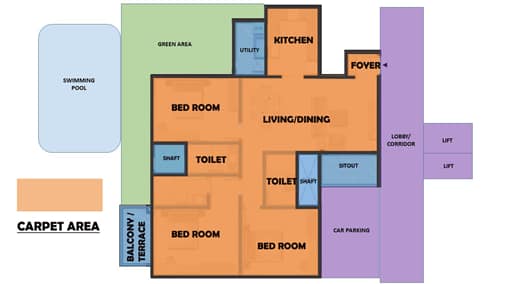
Carpet Area

According RERAcarpet area is defined as ‘the net usable floor area of an apartment, excluding the area covered by the external walls, areas under services shafts, exclusive balcony or verandah area and exclusive open terrace area, but includes the area covered by the internal partition walls of the apartment’

While the builders are now legally obliged to mention the carpet area to measure and price units, provisions have also been made for the increase and decrease in its measurement, while developing an under-construction project. If the carpet area is reduced through the course of the construction, the builder will have to refund the excess amount within 45 days, with annual interest, to the buyer. In case of an increase in the carpet area, the developer can also ask the buyer to pay the excess amount. However, the RERA caps the upper limit of the increase in carpet area at not be more than 3%.

RERA Carpet Area Includes             

  1. Rooms – Living room, Bedrooms, Study, Dining Room, Dressing Room & Other Rooms
  2. Kitchen & Bathrooms
  3. Stores
  4. Internal Walls
  5. Cupboard Spaces
  6. Staircases within the property unit

RERA Carpet Area Excludes

  1. External Walls
  2. Service Shafts
  3. Common Areas – Lift, Staircase, Clubhouse etc.
  4. Balconies, Terrace and Verandas

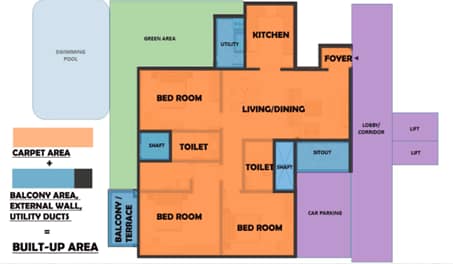
Built Up Area / Plinth Area

Built-up Area is total covered area of the apartment or commercial property unit. It can be calculated by adding areas of utility ducts within the property unit, external walls, Balconies / Terraces to the carpet area. 

Built up Area – Includes

  1. Balcony
  2. Service shafts
  3. Mezzanine floor
  4. Detached habitable areas such as servant’s room, etc.
  5. Columns and Walls

Built up Area – Excludes

  1. Lift and Lift lobby
  2. Staircases
  3. Clubhouse, swimming pool, etc.

Note:

Roughly built-up area is approximately 10% to 15% more than the carpet area 

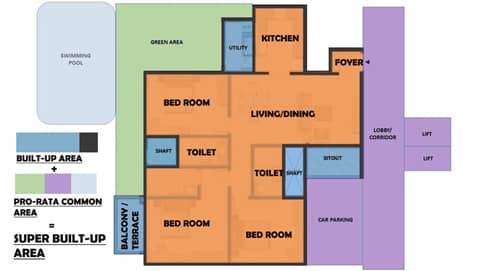
Super Built up Area / Saleable Area

Super Built up Area is the Built up Area plus proportionate area of common area such as lobby, lift shaft, stairs, etc. Sometime it may also include the common areas such as swimming pool, clubhouse etc.

Generally Carpet area is around 70-80% of super built up area. But this percentage varies from project to project and builder to builder.

Payment is made on Super Built up area or Saleable Area

Super Built up Area includes

  1. Entire Built up Area of the unit
  2. Built up common areas – Lobby, Lift Shaft, Staircase, Pipe ducts / shafts, Air ducts, Covered club house, other covered common facilities.

Super Built up Area Excludes

  1. Roof Terrace
  2. Open Areas – Parks, Gardens, Play Areas, Driveways etc.

Note:

Roughly Super built-up area is approximately 25% to 30% more than the carpet area 

At OREL, our teams have extensively helped clients estimate their office space needs, How much space they need to plan for their office now and for their future projected growth.

In this article we will explain:

How to calculate the :

  • Space Planning per Employee
  • Occupancy and Office Density needs
  • Plan for future growth

OREL Office Space Area calculator help you to calculate the area required for your office.                                              

Space Planning  per Employee

Different Companies have varying needs on deliverables, employee comfort, productivity and collaborative space.

To understand these, the basic questions, you would need to as ask yourself:

  • Maximize or minimize space allocated to each employee.
  • Cabin space or open office.
  • Individual desks or shared desks.
  • Ratios of Permanent Office employees to Part time, flex or remote working.
  • Space requirement of each department, if working styles and deliverables are different.
  • Collaborative space, innovation centers, open areas.
  • Operational Goals of the Company.

Density of Offices with Operational Examples

  • High Density (60 – 100 square feet per employee): Majority open seating with few cabins. Eg: IT Software, BPO, Sales, Co-working, Customer Support.
  • Average Density (100 – 200 square feet per employee): Mix of Cabins, Open seating.  Traditional office layout, catering to requirements of various departments.
  • Spacious (200 – 400 square feet per employee): Majority of the space consisting of large private offices. Corporate offices, Law firms, consulting firms.

To calculate the Space requirement for your next office, multiply your employee headcount by the number of square feet per employee that best fits your occupancy needs.

For example, a 50 person company with average space requirements would need an estimated _______ square feet (50 people x 150 sf/employee). Keep in mind this number does not account for future growth, but we go into more detail on that topic later in this article.

Space Allocation

When looking at Square feet per employee, this includes the common areas, For example, when we say 150 sft per person this includes the percentage of common areas allocated to that persons with regard to conference rooms, reception area, cafeteria, circulation spaces etc.,

Common and breakout areas are important, as it promotes team work, effective collaboration, innovation, socialization and also has an effect on productivity.

Accommodate space for Future Expansion

When determining how much office space you need, it is vital to plan for growth.

The expense of terminating a lease early combined with the costs of finding and moving offices is expensive. Because of this, it can be beneficial to add 10% to 20% to the total square footage you calculated to accommodate future growth.

Calculate your Office Area

Now that you actually have an Idea of the work stations, private cabins, reception, cafeteria etc., you now need to know the unit sizes, numbers and common areas to actually know the space required for your next office. You can do this using our free Office Space Calculator.

Our calculation is derived from a carefully-designed formula that weighs the number of employees, the amount of space desired for each employee and the use of common spaces.

This article is meant to give you an estimated range of how much space you will need. OREL, highly recommends working with a tenant representative and engaging an architect to determine exact requirements.

For further detailing of space planning for your office, kindly get in touch with us.