
When leasing commercial office space, businesses often focus on the monthly rent, location and office infrastructure. However, two clauses can have a significant impact on the total cost and flexibility of a commercial lease: the lock-in period and Rent Escalation in Office Leases in India.
The lock-in period and Rent Escalation in Office Leases in India in commercial lease agreements determine how long a tenant is financially committed to a property and how much the rent may increase during the lease term. These clauses influence business cash flow, expansion plans, relocation decisions and long-term occupancy costs.
For businesses looking for office space in Chennai, understanding these terms before signing a lease is particularly important. A property may appear affordable at the beginning, but a lengthy lock-in period or an unfavourable Rent Escalation in Office Leases in India clause can increase the financial commitment over time.
In this guide, OREL Properties & Consulting explains how commercial lease lock-in periods and Rent Escalation in Office Leases in India clauses work in India, the different structures available, how to calculate their financial impact and what tenants should negotiate before signing an office lease.
1. Why These Two Clauses Shape Your Total Lease Cost
A commercial lease involves more than paying a fixed monthly rental amount. The financial commitment changes depending on the lease duration, Rent Escalation in Office Leases in India schedule, lock-in period, security deposit and exit conditions.
The lock-in period determines how long the tenant must remain committed under the agreed exit restrictions. Rent Escalation in Office Leases in India determines how the rental amount increases over the lease term.
Together, these clauses influence:
- Total rental expenditure: How much the business pays throughout the lease.
- Financial flexibility: Whether the business can relocate without significant exit costs.
- Budget planning: How rental increases affect future operating expenses.
- Business expansion: Whether the office arrangement remains suitable as the company grows.
- Long-term occupancy decisions: Whether continuing the lease is financially beneficial.
For example, a business may agree to a five-year lease with a three-year lock-in and a 5% annual Rent Escalation in Office Leases in India. Even if the starting rent appears affordable, the tenant must consider the increasing rental commitment and the restrictions on early termination.
Therefore, tenants should evaluate both clauses together rather than negotiating them independently.
2. What Is a Lock-in Period in a Commercial Lease?
A lock-in period in commercial lease agreements refers to a specified minimum period during which one or both parties agree not to terminate the lease, except under the circumstances permitted by the agreement.
It creates a contractual commitment between the landlord and tenant for an agreed duration.
For example, if a commercial office lease has a 36-month lock-in period, the tenant may be restricted from exiting during those 36 months unless an agreed exception applies or the parties mutually agree to an early termination.
The purpose of a lock-in period is to provide greater certainty to both parties.
For tenants:
- Greater assurance of continued occupancy, subject to the agreement.
- Reduced risk of unexpected termination by the landlord where a mutual lock-in applies.
- More time to recover investment in office interiors and infrastructure.
For landlords:
- Greater certainty of rental income.
- Reduced risk of frequent tenant turnover.
- More time to recover leasing and property-related expenses.
A lock-in period is not necessarily the same as the total lease duration. A five-year lease, for instance, may have a three-year lock-in followed by an agreed exit option with notice.
The exact rights and obligations depend on the wording of the lease agreement and applicable law.
3. How Lock-in Periods Work: Who Is Bound and What Happens on Early Exit?
The lock-in clause should clearly explain which party is restricted from terminating the agreement and what happens if either party attempts to exit before the lock-in period ends.
Before signing, tenants should check the following:
Who is bound by the lock-in?
A lock-in period can apply to:
- The tenant only.
- The landlord only.
- Both the landlord and tenant.
This distinction is important because a tenant-only lock-in and a mutual lock-in provide different levels of contractual protection.
What happens if the tenant exits early?
If a tenant vacates the office before the lock-in period expires, the consequences depend on the agreed terms.
The agreement may provide for:
- Payment of rent for the remaining lock-in period.
- An agreed early termination charge.
- Compensation subject to specified contractual conditions.
- Adjustment of the security deposit against amounts lawfully payable.
- An agreed settlement between the landlord and tenant.
Tenants should not assume that simply vacating the property automatically ends their rental obligations.
Can a tenant exit if the landlord breaches the agreement?
A well-negotiated agreement should address situations where the landlord fails to meet essential contractual obligations.
Possible situations to address include:
- Failure to provide possession as agreed.
- Serious structural or safety-related issues.
- Prolonged interruption of essential services.
- Failure to provide agreed building facilities.
- Material breach of contractual obligations.
The agreement should specify notice requirements, opportunities to remedy a breach and any applicable termination rights.
Tenant tip: Negotiate clearly defined early-exit rights and exceptions before agreeing to a long lock-in period.
4. Typical Lock-in Structures: Tenant-Only vs Mutual Lock-in
Commercial office leases may use different lock-in structures depending on the landlord’s expectations, tenant requirements and commercial negotiations.
Tenant-only lock-in
Under a tenant-only lock-in, the tenant agrees not to terminate the lease during the specified period, except as permitted under the agreement.
The landlord may retain termination rights for specified circumstances, such as material breach or non-payment.
Example: A company signs a five-year office lease with a three-year tenant-only lock-in. The tenant is contractually restricted from exiting during the first three years, while the landlord’s rights are governed by the termination provisions.
Mutual lock-in
Under a mutual lock-in, both the landlord and tenant agree not to terminate the lease during the specified period, except under agreed exceptions.
This can offer greater occupancy certainty to the tenant.
Example: Both parties agree to a three-year mutual lock-in within a five-year lease. Neither party can terminate for convenience during the lock-in period, subject to the exceptions and remedies specified in the agreement.
Tenant-only vs mutual lock-in: Comparison
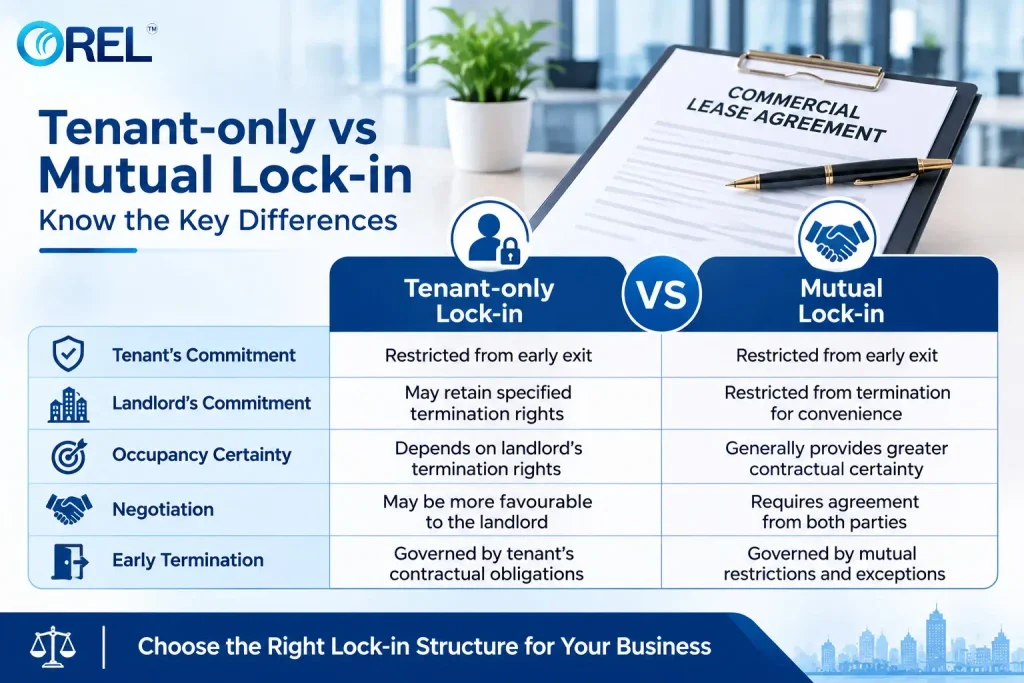
Which is better for tenants?
A mutual lock-in can offer stronger contractual certainty because both parties are committed to the agreed period. However, tenants should still ensure that the agreement contains reasonable exceptions for material breach, serious property issues and other agreed circumstances.
5. What Is a Rent Escalation Clause in a Commercial Lease?
A Rent Escalation in Office Leases in India clause in commercial lease agreements specifies how and when the monthly rental amount increases during the lease term.
Instead of keeping the rent unchanged throughout the agreement, the landlord and tenant agree on a rental increase schedule.
For example, a lease may provide for a 5% increase every year or a 15% increase every three years.
These percentages are illustrative examples. There is no single mandatory commercial Rent Escalation in Office Leases in India percentage applicable to every office lease in India.
A Rent Escalation in Office Leases in India clause should clearly mention:
- Initial monthly rental amount.
- Escalation percentage or calculation method.
- Frequency of rent increases.
- Date on which the increase becomes effective.
- Whether the increase is calculated on the original rent or revised rent.
- Whether escalation continues during the renewal period.
- Whether any additional conditions apply.
Why does rent escalation matter?
Rent Escalation in Office Leases in India directly affects the tenant’s future occupancy costs.
A business paying ₹1,00,000 per month at the beginning of a lease may pay significantly more in later years if the agreement provides for periodic increases.
For businesses operating with fixed budgets, this can affect profitability, operating expenditure and expansion plans.
Tenant tip: Always calculate the rental amount for every year of the lease before signing the agreement.
6. Types of Rent Escalation: Fixed Percentage, Stepped and Market-Linked
Commercial leases can include different Rent Escalation in Office Leases in India structures. Understanding these structures helps tenants negotiate a rental arrangement that suits their financial planning.
A. Fixed percentage escalation
Under this structure, rent increases by a predetermined percentage at agreed intervals.
Example:
- Starting monthly rent: ₹1,00,000
- Annual escalation: 5%
- First year: ₹1,00,000 per month
- Second year: ₹1,05,000 per month
- Third year: ₹1,10,250 per month
The revised rent is calculated based on the immediately preceding rental amount if the agreement uses a compounded escalation method.
Advantages:
- Predictable rental increases.
- Easier financial planning.
- Clear calculation method.
- Reduced uncertainty during the lease term.
B. Stepped Rent Escalation in Office Leases in India
Under a stepped escalation structure, rent increases by predetermined amounts or percentages at specified intervals.
For example:
| Year 1 | ₹1,00,000 |
| Year 2 | ₹1,00,000 |
| Year 3 | ₹1,10,000 |
| Year 4 | ₹1,10,000 |
| Year 5 | ₹1,20,000 |
This structure allows the tenant to maintain the same rental amount for an agreed period before the next increase.
Advantages:
- Predictable rental schedules.
- Potentially lower initial occupancy costs.
- Useful for businesses planning gradual growth.
C. Market-linked escalation
Under a market-linked structure, rent is revised based on agreed market conditions or a valuation mechanism.
The agreement should clearly explain:
- How market rent is determined.
- Who conducts the valuation.
- Which comparable properties are considered.
- When the revision takes place.
- Whether a minimum or maximum increase applies.
- What happens if the parties disagree on the revised rent.
Advantages:
- Can reflect changing market conditions.
- May provide flexibility during renewal.
- Can help align rental terms with property market movements.
Tenant caution: A market-linked clause without a clear valuation process or escalation cap can create uncertainty. Negotiate an objective method and a reasonable limit where possible.
Comparison of rent escalation structures
| Escalation type | How it works | Predictability |
| Fixed percentage | Rent increases by an agreed percentage | High |
| Stepped escalation | Rent increases at predetermined intervals or stages | High |
| Market-linked | Rent changes based on an agreed market valuation mechanism | Depends on the mechanism |
7. How Lock-in and Escalation Work Together Over the Lease Term
The lock-in period and Rent Escalation in Office Leases in India should be evaluated together because they affect both the tenant’s financial commitment and the flexibility to exit the property.
A longer lock-in period combined with frequent rent increases may create a substantial financial commitment.
To understand the impact, consider the following illustrative example.
Worked example: Five-year commercial office lease
Assumptions:
- Initial monthly rent: ₹1,00,000
- Total lease duration: 5 years
- Lock-in period: 3 years
- Annual rent escalation: 5%
- Escalation applies after every 12 months.
- Rent is calculated on a compounded basis.
- No taxes, maintenance charges, utilities or other expenses are included.
| Lease year | Monthly rent | Annual rent |
| Year 1 | ₹1,00,000 | ₹12,00,000 |
| Year 2 | ₹1,05,000 | ₹12,60,000 |
| Year 3 | ₹1,10,250 | ₹13,23,000 |
| Year 4 | ₹1,15,763 | ₹13,89,150 |
| Year 5 | ₹1,21,551 | ₹14,58,608 |
| Total | — | ₹66,30,758 approximately |
What does this example tell us?
- The monthly rent increases from ₹1,00,000 to approximately ₹1,21,551 by the fifth year.
- The tenant has a three-year lock-in commitment under the stated assumptions.
- Rent Escalation in Office Leases in India continues according to the agreed schedule, regardless of whether the lock-in has ended.
- The total base rent over five years is approximately ₹66.31 lakh.
The tenant should also account for maintenance charges, taxes, utilities, security deposit and fit-out expenses when calculating the actual cost of occupying the office.
What if the tenant wants to exit after two years?
In this example, the tenant would still be within the three-year lock-in period.
The financial consequences would depend on the agreement’s early termination provisions. The tenant may need to pay an agreed exit amount or meet other contractual obligations.
What if the tenant wants to exit after three years?
The lock-in period would have ended, but the tenant may still need to provide the agreed notice period and comply with the other exit conditions.
Important: The end of the lock-in period does not automatically mean that the lease itself has ended. The lease continues until its expiry or valid termination under the agreement.
8. Negotiation Tips for Tenants: How to Secure Better Lease Terms
Before signing a commercial office lease, tenants should negotiate both the lock-in and Rent Escalation in Office Leases in India clauses based on their business requirements.
Here are practical negotiation points to consider.
1. Negotiate a shorter lock-in period
Businesses that are uncertain about future space requirements should consider negotiating a shorter lock-in period.
This can be particularly useful for:
- Startups.
- Newly established businesses.
- Companies entering a new city.
- Businesses expecting rapid workforce changes.
- Organisations planning expansion or restructuring.
2. Request a mutual lock-in
A mutual lock-in can provide greater certainty by restricting both parties from terminating the agreement for convenience during the agreed period.
3. Negotiate capped rent escalation
If the landlord proposes market-linked Rent Escalation in Office Leases in India, request a maximum percentage or clearly defined calculation method.
This can help protect the tenant from unpredictable rental increases.
4. Request a longer escalation interval
Instead of annual escalation, tenants may negotiate increases every two or three years, depending on the commercial arrangement.
This can provide greater short-term budget stability.
5. Include reasonable early-exit rights
Negotiate early termination rights for specific situations, such as:
- Material contractual breach.
- Failure to provide agreed essential services.
- Serious safety or structural concerns.
- Other mutually agreed business circumstances.
The agreement should specify notice requirements and any applicable financial consequences.
6. Negotiate a rent-free fit-out period
Businesses often need time to complete interiors, install IT infrastructure and prepare the office for employees.
A rent-free period can reduce initial setup expenses.
However, clarify whether the lock-in period starts from:
- The date of signing.
- The date of possession.
- The rent commencement date.
- Another specifically agreed date.
Also clarify whether maintenance and utility charges remain payable during the rent-free period.
7. Calculate the total lease commitment
Do not negotiate only on the starting rental amount.
Prepare a five-year or three-year rental projection, depending on the lease duration, and include all recurring and one-time expenses.
8. Get every negotiated term in writing
Verbal assurances should not replace written contractual provisions.
Ensure that all agreed changes are included in the final executed lease agreement.
9. Landlord’s Perspective: Why Do These Clauses Exist?
Although tenants often view lock-in periods and Rent Escalation in Office Leases in India as restrictions, these clauses also serve important purposes for landlords.
Why do landlords include a lock-in period?
Commercial property owners invest in preparing and maintaining their properties for tenants.
A lock-in period can help landlords:
- Secure a more predictable rental income.
- Reduce frequent tenant turnover.
- Recover leasing and property preparation expenses.
- Plan maintenance and property operations.
- Reduce the risk of sudden vacancy.
Why do landlords include rent escalation?
Property owners may face increases in:
- Building maintenance costs.
- Property management expenses.
- Repair and maintenance costs.
- Operational expenses.
- General market rental values.
A Rent Escalation in Office Leases in India clause helps account for changes in the cost of owning and operating commercial property.
Why should both parties negotiate fairly?
A lease agreement should provide a commercially workable arrangement for both parties.
A tenant needs financial flexibility and predictable expenses, while a landlord needs reasonable income certainty and protection of the property.
Clear and balanced clauses can reduce misunderstandings and support a more stable landlord-tenant relationship.
10. Common Mistakes to Avoid When Negotiating Lock-in and Rent Escalation
Tenants should avoid these common mistakes before finalising a commercial lease.
1. Agreeing to a long lock-in without evaluating business needs
A business may outgrow its office or need to relocate before the lock-in ends. Consider future operational requirements before committing.
2. Accepting unclear early-exit conditions
The agreement should specify what happens if the tenant wants to leave during the lock-in period.
3. Ignoring compounded rent escalation
A 5% annual increase calculated on the revised rent produces a different result from a 5% increase calculated on the original rent. Confirm the calculation method.
4. Overlooking the rent commencement date
The commencement date should be clearly connected to possession, fit-out and rent-free arrangements.
5. Assuming escalation stops after the lock-in
Rent Escalation in Office Leases in India and lock-in are separate contractual provisions. Escalation may continue even after the lock-in period expires.
6. Not checking renewal terms
A tenant may face a substantial rent revision at renewal if the agreement does not clearly define the process.
7. Relying on verbal negotiations
All agreed commercial terms should be recorded in the final lease agreement.
8. Failing to calculate the total occupancy cost
Rent is only one part of the expense. Maintenance, utilities, taxes, parking and fit-out costs should also be considered.
11. How OREL Helps with Lease Negotiation and Management
Choosing the right commercial office space involves more than identifying a suitable building. Businesses must also evaluate the rental structure, property infrastructure, location, lease conditions and long-term occupancy requirements.
OREL Properties & Consulting assists businesses in exploring commercial office spaces in Chennai and understanding important aspects of the leasing process.
Our commercial property services include:
Commercial office space identification
We help businesses explore office properties based on:
- Preferred business location.
- Required office area.
- Employee strength.
- Budget and rental expectations.
- Building infrastructure.
- Parking and connectivity requirements.
Lease and transaction management
Lease and transaction management support can help businesses coordinate important aspects of the leasing process, including property evaluation, commercial discussions and transaction-related requirements.
Lease negotiation support
Businesses can evaluate important commercial terms such as:
- Monthly rent.
- Lock-in period.
- Rent escalation.
- Security deposit.
- Fit-out and rent-free period.
- Maintenance responsibilities.
- Renewal and exit conditions.
Office space solutions across Chennai
Businesses can explore commercial office opportunities in locations such as:
- Guindy.
- OMR.
- Thoraipakkam.
- Taramani.
- Anna Nagar.
- Ekkatuthangal.
Whether you are looking for a compact office for a growing team or a larger corporate workspace, OREL Properties & Consulting can help you identify suitable commercial property options.
Looking for office space for rent in Chennai?
Connect with OREL Properties & Consulting to explore commercial office spaces based on your business requirements.
12. Frequently Asked Questions About Lock-in Period and Rent Escalation in Commercial Lease
1. What is a lock-in period in a commercial lease?
A lock-in period is an agreed minimum period during which the landlord, tenant or both parties are restricted from terminating a commercial lease, except under specified contractual conditions. It provides greater certainty about the occupancy and rental arrangement.
2. What happens if I leave during the lock-in period?
If a tenant exits during the lock-in period, the financial consequences depend on the lease agreement. The tenant may be required to pay an agreed early termination amount, rent for a specified period or other contractual compensation. Review the exit clause before signing.
3. Is rent escalation fixed or negotiable?
Rent Escalation in Office Leases in India is negotiable between the landlord and tenant. The parties may agree on a fixed percentage, stepped increase or market-linked revision. The percentage, frequency and calculation method should be clearly mentioned in the agreement.
4. How often does rent increase in an office lease?
Rent may increase annually, every two or three years, or at another mutually agreed interval. There is no universal escalation frequency applicable to every commercial office lease in India. It depends on the negotiated terms.
5. Can the lock-in period be waived or reduced?
Yes, the parties can mutually negotiate a shorter lock-in period or agree to waive it through appropriate contractual documentation. Any change should be recorded in writing and properly executed.
6. Does the rent-free period count towards the lock-in?
It depends on the wording of the lease agreement. The parties may agree that the lock-in starts from the possession date, rent commencement date or another specified date. Tenants should clarify this before signing.
7. What is the difference between lock-in period and lease term?
The lease term is the total duration of the lease agreement. The lock-in period is the minimum agreed commitment during which termination for convenience may be restricted.
For example, a five-year lease with a three-year lock-in has a total lease duration of five years and a minimum lock-in commitment of three years.
8. Is rent escalation applicable during the lock-in period?
Yes, Rent Escalation in Office Leases in India can apply during the lock-in period if the lease agreement provides for it. The lock-in clause and escalation clause operate independently unless the agreement specifically connects them.
9. Can a landlord increase rent during the lock-in period?
A landlord generally must follow the rent terms agreed in the lease. If the agreement provides for scheduled escalation during the lock-in period, the rent may increase according to that provision. An increase outside the agreed terms should not be assumed to be automatically permitted.
10. What should tenants negotiate in a commercial lease agreement?
Tenants should negotiate the lock-in duration, early-exit rights, Rent Escalation in Office Leases in India percentage, escalation frequency, security deposit, rent-free period, maintenance charges, renewal terms and termination notice period.
11. Is a mutual lock-in better for tenants?
A mutual lock-in can offer greater contractual certainty because both the landlord and tenant agree not to terminate for convenience during the specified period. However, tenants should ensure that reasonable exceptions for breach and other agreed circumstances are included.
12. How can businesses find office space with flexible lease terms in Chennai?
Businesses can work with a commercial real estate consultant to identify suitable office properties and discuss lease terms with property owners. OREL Properties & Consulting helps businesses explore office space options in Chennai based on location, area, infrastructure and commercial requirements.
Conclusion: Negotiate Lock-in and Rent Escalation in Office Leases in India Before Signing Your Office Lease
The lock-in period and rent escalation in commercial lease agreements play a major role in determining a business’s long-term occupancy costs and flexibility.
A longer lock-in period can restrict relocation options, while frequent or high Rent Escalation in Office Leases in India can increase future rental expenditure. Understanding how these clauses work together helps businesses make informed leasing decisions.
Before signing a commercial office lease, tenants should carefully review the lock-in structure, early-exit conditions, escalation percentage, calculation method, rent commencement date and renewal terms.
For businesses planning to lease office space in Chennai, evaluating these clauses alongside the property’s location, infrastructure and total occupancy cost can help create a more practical and financially sustainable office arrangement.